




India’s Myanmar Calculus: A Strategy Guided by Security Imperatives
- In Foreign Policy
- 12:50 AM, Jun 05, 2026
- Ramaharitha Pusarla
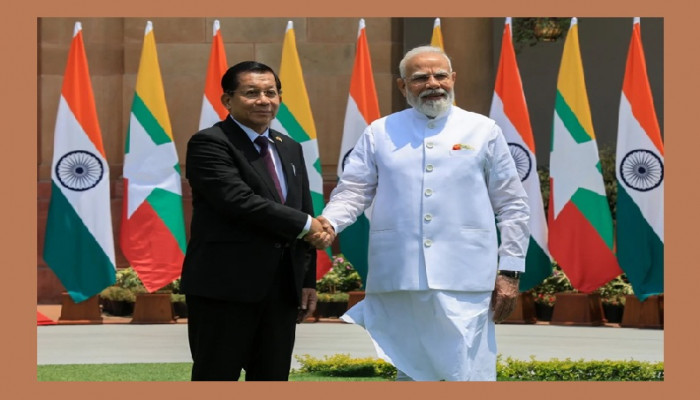
Myanmar President Min Aung Hlaing’s five-day visit to India comes at a time when India has determinedly prioritised border security. Last fortnight, Home Minister Amit Shah announced the ‘Smart Border Project’ to make frontiers impenetrable and ordered the demolition of illegal structures within 15 km of the international borders. The BJP Bengal government has put in place the “detect-deport-delete” initiative to curtail the entry of undocumented migrants. Besides security threats, borders have become floodgates for illegal infiltration.
Simmering tensions between the Buddhist and Rohingya Muslims since the 1970s have led to waves of Rohingya infiltration into India, which became more pronounced and severe after the Myanmar junta’s systematic persecution in 2016. The military coup that toppled the elected government in February 2021 displaced 3 million Myanmarese, triggering an endless wave of illegal migration of various ethnicities into India. The rapid crossover through the porous Indo-Myanmar border of 1,643km into adjoining Indian states -Arunachal Pradesh, Nagaland, Manipur and Mizoram has posed a pernicious security situation for India.
The conflagration of the Manipur Crisis in 2023 is a case in point. Recovery of a huge cache of arms and ammunition, drugs and the recent arrest of Ukrainian and American mercenaries in Mizoram along the Myanmar border have unravelled the impact of an unstable Myanmar on India.
In Myanmar, protesting the 2021 military takeover, opposition forces, pro-democracy groups and oppressed ethnic groups together formed the National Unity Government (NUG), the parallel civilian administration and its armed unit, People’s Defence Forces (PDF), carried out the resistance movement against the junta. Allying with the Ethnic Armed Organisations (EAOs), NUG and PDF are working towards establishing a federal government.
As per the latest reports, these resistance forces are exerting control over 42% of the Myanmar land holding, while the junta-backed government of Myanmar controls mere 21% of the territory, and the remaining land mass remains fiercely contested.
Post-military coup, Myanmar faced boycott, amid growing threats of international sanctions and regional pressure, the junta revoked the emergency order on July 31st 2025. Citing the 2008 Constitution, wherein elections must be held within six months of the suspension of the emergency, the junta scheduled elections for December 2025 and January 2026. The measure was rather cosmetic. It is an attempt to obtain international legitimacy with no serious intent to facilitate a democratic transition.
The Tatmadaw (Mynmar military) long used election as a tool to project a façade of normalcy while consolidating internal control. With bans on several political parties- including the National League for Democracy (NLD) and the Shan Nationalities League for Democracy (SNLD)- along with detention of political opponents and imposition of emergency across Kachin, Karenni, Karen, Rakhine, Shan, and Chin states, as well as the Sagaing, Mandalay, and Magwe regions, the electoral process amounted little more than a sham exercise. Predictably, the junta-aligned Union Development and Solidarity Party won the elections. The parliament elected General Min Aung Hlaing as the President in April.
The managed election was an attempt to gain international legitimacy. The US, the UK and ASEAN countries openly rejected the election outcome as the process lacked credibility. India reiterated the importance of free and fair elections and adopted a wait-and-watch policy. For a regime struggling to secure international legitimacy, President Hlaing’s first foreign visit to India marks a significant diplomatic gain.
While the pro-democracy camp in Myanmar expressed disappointment over hosting the junta leadership, India has been absolutely clear about its policy. Pushing back against the contrarian opinion, Foreign Minister Vikram Mistri stated, “We have always proceeded on the principle that sustained dialogue is what is important, and what is an imperative for India as a neighbour. And the answer is clearly not disengagement”. He countered, adding, “History has shown that disengagement doesn't give us any results that are better than engagement, and it certainly doesn't produce democratic change if that is what we are interested in. On the other hand, disengagement only produces a vacuum that others go on to fill, then to our detriment. And those others have no interest in democracy, I can assure you about that”.
Myanmar has descended into a fractured geographical and political entity and India’s stakes in its stability remain profound. For decades, secessionist groups from India’s Northeast have found safe sanctuaries across the border. Myanmar has been an indisputable epicentre of the (narcotic) Golden Triangle. The ongoing crisis has intensified this dynamic, with drug cartel operations spilling into India’s Northeast and transforming it into one of the most perilously sensitive frontiers—where insurgency and trafficking converge to threaten national security.
Beyond the security imperative for India, the marked influx of undocumented migrants is altering the demography of the North-Eastern border states. Now, a latest cross-border challenge has emerged- scam centres. Myanmar has become the hotspot of sophisticated e-scamming. Indians have been tricked, and in some cases, forcefully kidnapped to work in these scam centres. These scam centres are no longer isolated criminal enterprises, but advanced offshoots of a transnational global criminal network operating from Myanmar. These have targeted even Chinese and Thai citizens.
In the recent past, India has repatriated over 2200 Indians working under inhuman conditions in these scam centres. India is working with the junta to rescue trapped Indians. China extended tacit support to the Myanmar National Democratic Alliance Army (MNDAA), Brotherhood Alliance and Karen Border Guard Force to dismantle these scam centres to rescue its citizens. The collapse of the central governance has turned certain pockets of Myanmar into grey zone areas and safe havens for synthetic drug manufacturing and human trafficking. India closely aligns with the junta on the crackdown on these criminal networks to restore border stability.
Strategically, Myanmar lies at the intersection of India’s Neighbourhood policy, Act East Policy, Indo-Pacific Framework and Mutual and Holistic Advancement for Security and Growth Across Regions (MAHASAGAR), and holds immense significance. Bordering both India and China, Myanmar is an important theatre of regional competition. Political tremors in the country have implications for both countries.
Myanmar is India’s gateway to Southeast Asia. India’s two major connectivity projects- the Kaladan multi-modal Transit Transport Project and the India-Myanmar-Thailand Trilateral Highway, launched several years ago, are now stalled due to the precarious security situation in the country. India needs the junta’s help for their swift completion.
Rare earth minerals represent another area of strategic interest. Myanmar has huge reserves of rare earth elements, which are indispensable for electric vehicles, wind turbines, semiconductors, permanent magnets and defence systems. Although the recent joint statement has no mention of rare earths, India is eager to secure access. China engaged with both the military junta and the ethic armed groups to gain preferential access, with Myanmar supplying nearly half of China’s rare-earth exports.
Kachin region, bordering China, is a global hotspot for heavy rare earths like dysprosium and terbium. China has monopolised these minerals and imposed a ban on their exports. Seeking alternative sources, India reached out to the Kachin Independence Organisation (KIO) which controls the region. Beyond Kachin, areas like Shan State, Sagaing Region, Kayah State and the Mogok geological belt hold rich deposits of lithium and other critical minerals. India is exploring avenues of cooperation with the junta to tap into these reserves.
Myanmar President’s visit to India, his first official international trip, has garnered a lot of chatter among strategic circles. Originally scheduled to attend the International Big Cat Alliance (IBCA) summit, deferred now, Hlaing made his first touchdown at Bodhgaya, underscoring the strong cultural and religious connection between the countries. Referred to as Brahma Desha, India has deep civilisational ties with Myanmar. In New Delhi, leaders of both countries reviewed the bilateral ties and reaffirmed to strengthen cooperation in trade, defence and security, border management and cultural exchanges. Hlaing’s visit to the NTPC Energy Technology Research Alliance (NETRA) and Mumbai highlighted his focus on technology, energy and infrastructure cooperation.
China, India and ASEAN are the three major partners of Myanmar. India is Myanmar’s 11th largest investor. Bilateral trade stands at over $2 billion in favour of Myanmar. Accompanied by a huge business delegation, economic cooperation took front seat. Countries have agreed to enhance the Rupee-Kyat trade settlement mechanism, operationalised in 2024.
Addressing the core aspect of security and border stability, Hlaing assured that Myanmar’s territory will not be used for activities threatening India’s security. PM Modi extended India’s firm support for the sovereignty and territorial integrity of Myanmar and underscored the need for the restoration of the peace process through a dialogue with all the stakeholders for a united Myanmar.
Wedged between India and China, Myanmar is compelled to maintain cordial relations with both, driven by regional connectivity needs and economic dependence, respectively. China, eyeing access to the Indian Ocean through Myanmar, cultivated ties with the military junta and rebel groups, leveraging deep engagement for strategic advantage. In contrast, India’s inconsistent cycles of engagement and disengagement have failed to lend any strategic depth to this relationship, leaving New Delhi at a disadvantage in the regional power play.
In an era of turbulence and power contestation, the strategic calculus of engagement pivots on the imperatives of geopolitical security. Guided by both strategic and economic considerations, India has extended a red carpet to Myanmar President Min Aung Hlaing, seeking to mitigate the fallout of Myanmar’s political volatility and safeguard its regional interests.
Reference
Disclaimer: The opinions expressed within this article are the personal opinions of the author. MyIndMakers is not responsible for the accuracy, completeness, suitability, or validity of any information on this article. All information is provided on an as-is basis. The information, facts or opinions appearing in the article do not reflect the views of MyindMakers and it does not assume any responsibility or liability for the same.



 Loading...please wait
Comments