



India’s first ‘sovereign AI box’ promises secure, local AI for enterprises
- In Reports
- 08:24 PM, Feb 16, 2026
- Myind Staff
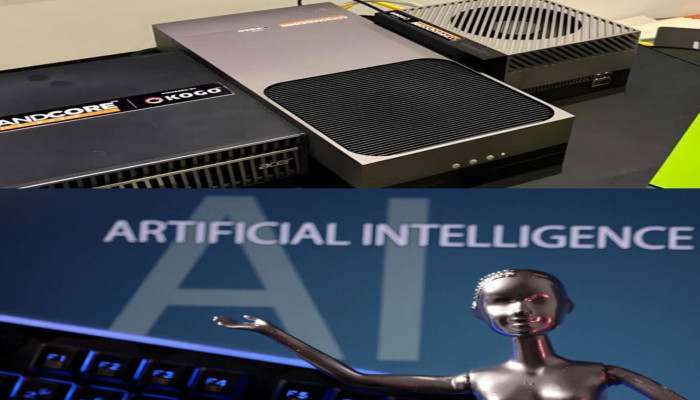
As artificial intelligence becomes more common in businesses, many companies are rushing to adopt AI agents and automation tools. However, along with this growth, serious concerns are also rising—especially around data privacy, security, and increasing cloud costs. Addressing these issues, Indian AI-native transformation foundry Arinox AI and agentic AI Company KOGO have launched what they call India’s first sovereign AI product, a system described as “AI in a box.”
The product, named CommandCORE, was introduced at the India AI Impact Summit 2026. The main goal of this system is to allow enterprises to use AI locally without depending heavily on internet-based cloud services. It is built to work on-premise, meaning the AI processing happens within the organisation’s own system rather than on external servers.
With CommandCORE, Arinox AI, and KOGO are promoting an AI future that is private, secure, and physically compact. The system is designed to compute locally and can function even without an internet connection. The companies have partnered with Nvidia and Qualcomm to build their agentic AI stack, and the latest version of CommandCORE runs on Nvidia hardware.
Raj K Gopalakrishnan, CEO and Co-Founder of KOGO AI, believes enterprises must keep their AI systems private if they want to truly grow their intelligence and efficiency. According to him, companies should not outsource their intelligence to public AI systems. He argues that for AI to truly help an organisation learn and improve, it must be owned and controlled internally.
He explains that many businesses using public foundational models are not just giving prompts but are also unintentionally exposing internal operational information. When sensitive sectors share data with cloud-based AI services, they may also be sharing valuable intelligence.
As agentic AI grows, concerns about security and privacy become more serious. Gopalakrishnan highlights that information is powerful, and when companies provide context to AI systems, they are also providing intelligence about how their organisation works.
A 2025 analysis by security platform HiddenLayer found that 88% of enterprises worry about vulnerabilities caused by third-party AI integrations. This includes popular tools like OpenAI’s ChatGPT, Microsoft Copilot, and Google Gemini.
In addition, an MIT report from August last year stated that 95% of generative AI pilots in companies failed to expand or become fully implemented. One of the key reasons was privacy-related concerns.
This is where CommandCORE is positioning itself as an alternative—offering AI capability without forcing companies to send their data outside.
The private “AI in a box” system has four main layers.
The first layer is custom hardware from Nvidia.
The second is KOGO’s agentic operating system, which runs on top of the hardware.
The third layer is an Enterprise Agent Suite, which includes more than 500 connectors that help integrate AI agents into enterprise workflows.
The fourth part is the use of open-source models to support sovereign AI use cases.
This setup aims to reduce the need for organisations to separately manage different hardware and software components. Instead of building everything from scratch, enterprises can deploy CommandCORE as a ready-made system.
Different versions of the product are being offered. These include Nvidia’s Jetson Orin-class edge systems, which can be used for field deployments, and DGX Spark, which supports compact on-premise AI development. Larger enterprise-level setups are also available, including data centre configurations using Nvidia RTX Pro 6000 Blackwell Server Edition graphics.
Angad Ahluwalia, chief spokesperson of Arinox AI, said the system is designed to reduce complexity for businesses. He explained that the box can handle repeatable tasks and focused workloads, and can also scale into larger clusters to support full workflows.
CommandCORE can scale by linking multiple units together. Currently, enterprises can choose between three main model configurations, and more versions are expected soon.
The pricing starts at ₹10 lakh, making it a high-end enterprise product but still potentially affordable compared to long-term cloud computing costs.
The smallest configuration can run AI models between 1 billion and 7 billion parameters. This option is meant for small enterprise needs such as batch processing, limited AI agent deployment, or even tasks like onboarding employees in human resource departments.
The medium configuration supports models between 20 billion and 30 billion parameters, which can handle more advanced agents and stronger inference needs.
Vishal Dhupar, Managing Director of Nvidia India, said that as AI expands in regulated industries, organisations require computing systems that can work completely on-premise under strict security rules.
The largest version of CommandCORE is designed for enterprise-wide transformation. Ahluwalia compared it to Nvidia DGX clusters based on the Grace Blackwell series, describing them as extremely powerful. NVIDIA documentation notes that two interconnected DGX units can support models up to 405 billion parameters.
Apart from the sovereignty and security argument, CommandCORE also makes a strong cost-related pitch. Gopalakrishnan explained that sending massive data to the cloud can become extremely expensive.
He gave an example of EV charging and battery swap stations, which can generate up to 30TB of data daily. If a company owns 1,000 such stations, transferring and processing all that data on the cloud would create huge bandwidth and compute costs.
Instead, edge processing offers a cheaper solution. A small device placed at each station can process data locally and only send essential data—around 200GB—to the cloud for further use. This reduces both internet usage and cloud processing charges.
Arinox AI and KOGO are hoping to attract industries where privacy is critical. These include finance and banking, government services, and defence, where organisations need strong control over their data and operations.
With growing AI adoption and increasing concerns about data leaks and third-party dependencies, CommandCORE is being positioned as a major step toward secure, local, and sovereign enterprise intelligence in India.



 Loading...please wait
Comments