



India's Defence Spending - The Current Challenges and the way forward
- In Military & Strategic Affairs
- 02:43 AM, Dec 13, 2019
- Mohal Joshi
The release of the Union budget in India triggers a new round of conversations around the same usual topics: How much did the Defence Budget go up by this year? Is there enough allocated for the upgradation of Defence equipment of the Armed Forces? And the age-old question of how much are we spending on the Defence as percentage of India’s GDP.
Let’s go back a few years to look at the budget allocations for defence in 2014-15 budget versus the current 2019-20 allocation for comparison. 2014-15 is an important year to compare against as it was the year when the OROP (One Rank, One Pension) was introduced. OROP helped secure similar pension for all the Indian Armed Forces veterans for same length of service irrespective of the date of retirement. 2014-15 Budget (i.e. the Full Budget presented by Arun Jaitely in July 2014) was also the first budget under the current NDA government which is in power today.
2014-15 vs 2019-20 Defence Budgets
For 2014-15 Budget the Capex Expenditures (used to purchase new weapons, platforms and military hardware) was Rs. 94,588 crore and the Revenue Expenditures (which includes expenses on payment of salaries and maintenance of establishments) was Rs. 134,412 crore.
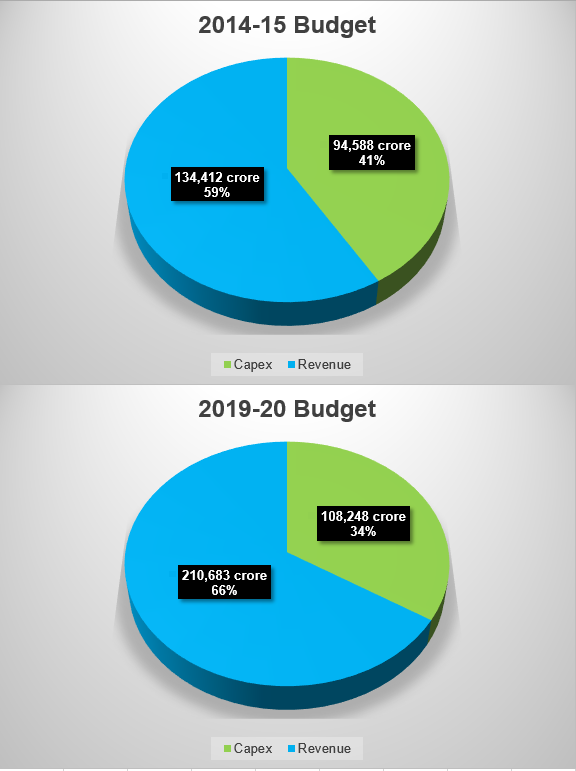
The % of money spent on Capex as % of Total Capex + Revenue Expenditures is 41% which was broadly in line with the previous few years prior to 2014 where ~40% of total expenditures was on Capex. Coming to the present budget of 2019-20, the expenditures on Capex is Rs.108,248 crore and on Revenue is Rs. 210,683 crore. The % of money spent on Capex which was 41% just 5 years ago has now shrunk to 34% while Revenue consume 2/3 (66%) of all Total Capex + Revenue Expenditures.
Now one set of expenses which account for Defence Budget but don’t actively contribute to the preparedness of the Armed Forces today are Defence Pensions.
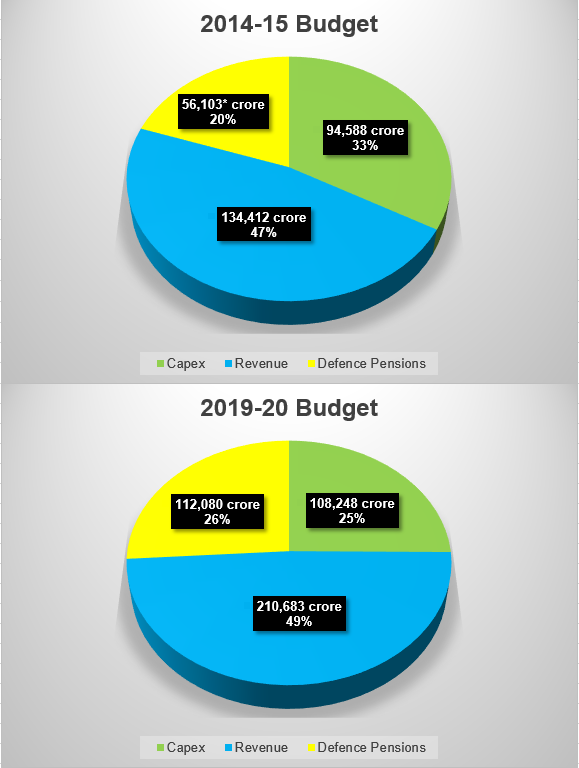
Note: *Defence Pensions for 2014-15 (56,103 crore) have been estimated to be Total Expenditure-Capex-Revenue
When one accounts for the Defence Pensions as part of the Total Defence Spending (i.e. Capex + Revenue + Pensions) it used to account for 20% of all spending back in 2014-15 which has risen to 26% today. Money spent on Revenue has also increased from 47% to 49% of all spending. As a result of increases in these 2 categories, Capex have been squeezed. I.e. reduced from 33% of all spending in 2014-15 to just 25% now. (~8% decline).
OROP (One Rank One Pension) has greatly helped the veterans get their dues in terms of fair pensions but it has also doubled the Pensions expenses in 5 years from Rs 56,103 crore to Rs. 112,080 crore.
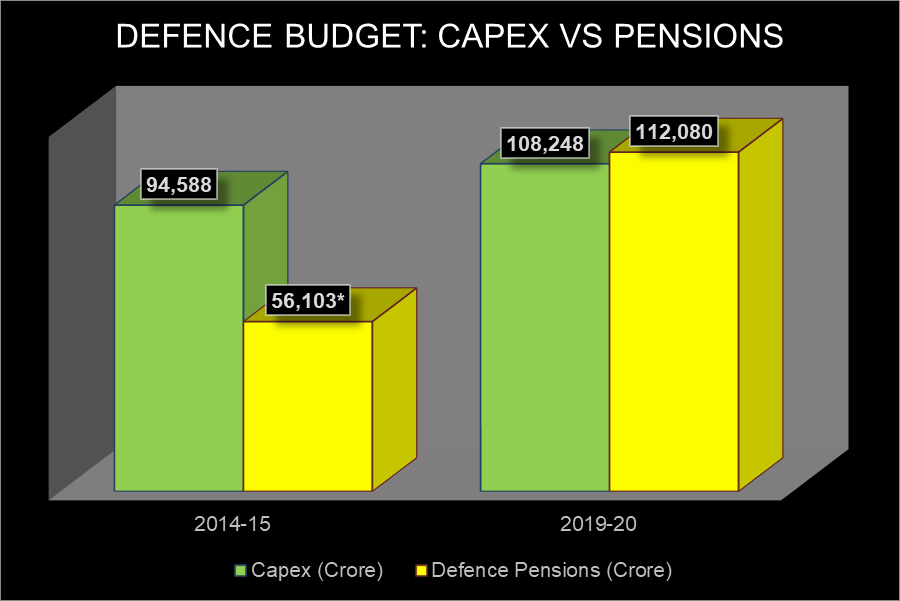
Half a decade ago Defence Pensions used to be around ~40% lower than Capex while now Pensions are ~3.5% higher than Capex.
If you add this to the Rs. 119,620 crore Salaries bill for the Armed Forces then a majority 54% (Rs 231,700 crore) of the Total 431,011 crore Defence Expenditures is used up just by Salaries and Pensions!

This has also led to a situation where today both the Salaries bill Rs 119,620 crore and the Defence Pensions Rs. 112,080 are individually greater than the Capex Expenditure of Rs 108,248 crore.
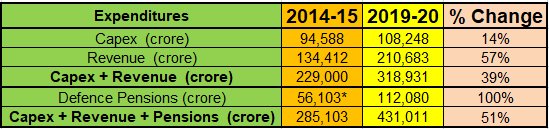
On a relative % terms, Defence Pensions have doubled (100% increase) & Revenue has grown by 57%. Since the Overall (Capex + Revenue + Pensions) have grown by just 51% over this period this has led to Capex being the odd man out where it increased by only 14%.
Defence Spending as fixed % of GDP?
One metric which quite a few people like to use to measure the amount of defence spending is spending as % of GDP. Total Defence spending including pensions which was 2.3% as a % of GDP five years ago is only 2% in 2019-20 budget year. If one excludes pensions (i.e. Capex + Revenue only) it declined from 1.8 % in 2014-15 to 1.5% today.
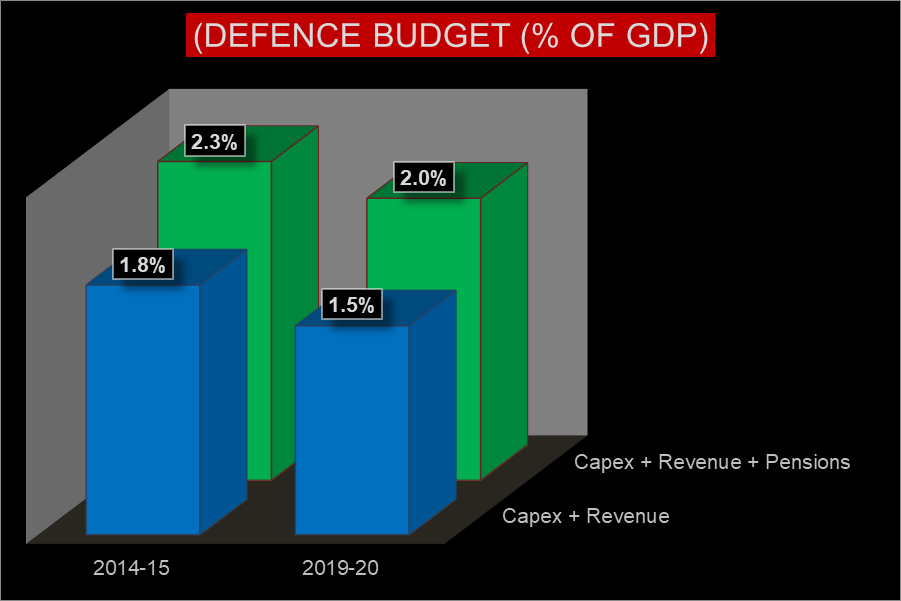
This 1.5% (as % of GDP) figure leads to lot of heartburn among some defence experts and veterans who claim that India is not spending enough. There are dire forecasts about Indian Armed Forces being not able to fight well in the next war as this spending is at a level last seen before the 1962 India-China war. Everyone then proceeds to tout their own magic figure (be it 2% or 3% or some other % of GDP) below which in their opinion India should not let their defence expenditures fall under any circumstances.
However this obsession of pegging Defence expenditures as a % of GDP overlooks a few variables in this case such as GDP growth of India and Central Government Budgets. India’s nominal GDP growth rate varies usually in the ~10-15% range (GDP growth is real growth plus inflation).
Now let’s say that India had to maintain its Defence spending as fixed % of GDP then the rise in Defence expenditures has to match the rise in GDP at same pace. The CGE (Central Government Expenditures) which funds Defence forces would also have to grow by an amount similar to the rise in GDP to fund the Defence Expenditures at the same rate as before.
From 2014-15 there have been few (3) years where the GDP has gone up by a faster rate than CGE. The significant increase in the CGE (vs GDP) for this year has brought the overall delta over the 5 year period to 3% (which earlier in the past few years was in the 4-5% range).

The past 5 years has seen that while India’s GDP has risen from Rs. 12,467,959 Crore to an estimated 21,184416 Crore (~70% growth), India’s CGE had risen only by 67% from Rs. 1,663,673 crore to Rs. 2,786,349 crore. (I.e. 3% delta in growth between both of them).
Now since Defence is one of several items that the Central Government spends on, even this small 3% difference in the rise of India’s GDP vs CGE means it is hard to maintain Defence Expenditures as a fixed % of GDP. If one excludes Pensions from the Core Defence Expenditures then a rising Pensions bill also adds more stress to this goal of some of maintaining a fixed % of GDP spending.
Defence Spending as fixed % of CGE
A better and more realistic metric (instead of % of GDP) to judge Defence spending would as a % of CGE (Central Government Expenditures).
Total Defence spending including pensions which was 17.1% as a % of GDP five years ago is now 15.5% in 2019-20 budget year. If one excludes pensions (i.e. Capex + Revenue only) it has declined from 13.8 % in 2014-15 to 11.4% today.
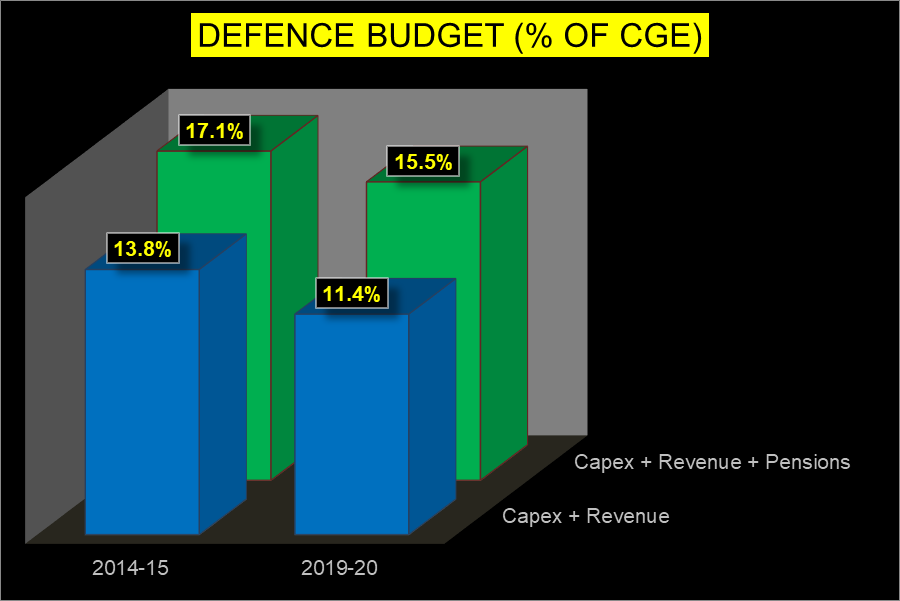
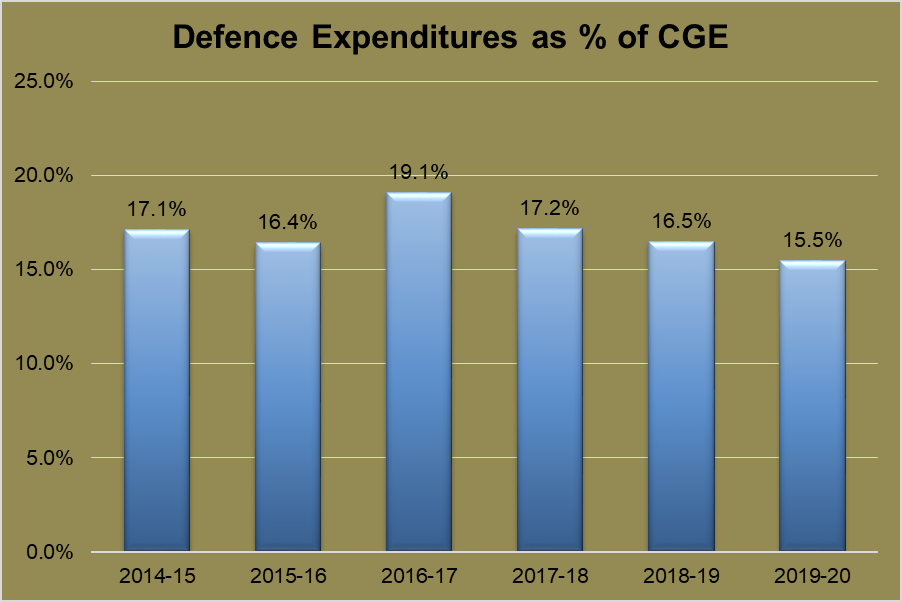
The past few years have seen the Defence Expenditures (including Pensions) as % of CGE varying between ~16 to 19%. However this year the Defence Expenditures have gone down to just 15.5% of CGE. The healthy 13.4% increase in CGE year over year shows that while the government was not afraid to spend more this year, it unfortunately didn’t fall into the lap of Defence expenditures.
Near-Term Defence Expenditure Trends
The Defence Expenditures for 2019-20 have seen two broad deviations from the near term trend which are worth highlighting
- Defence Expenditure which has hovered between ~16.5 to 19% of CGE (Central Government Expenditures) has now dropped to just 15.5%.
- The % of Capex as % of Total Capex + Revenue Expenditures was around 39 to 45% between 2008-09 to 2014-15 but after that it has declined to just 34% in 2019-20.
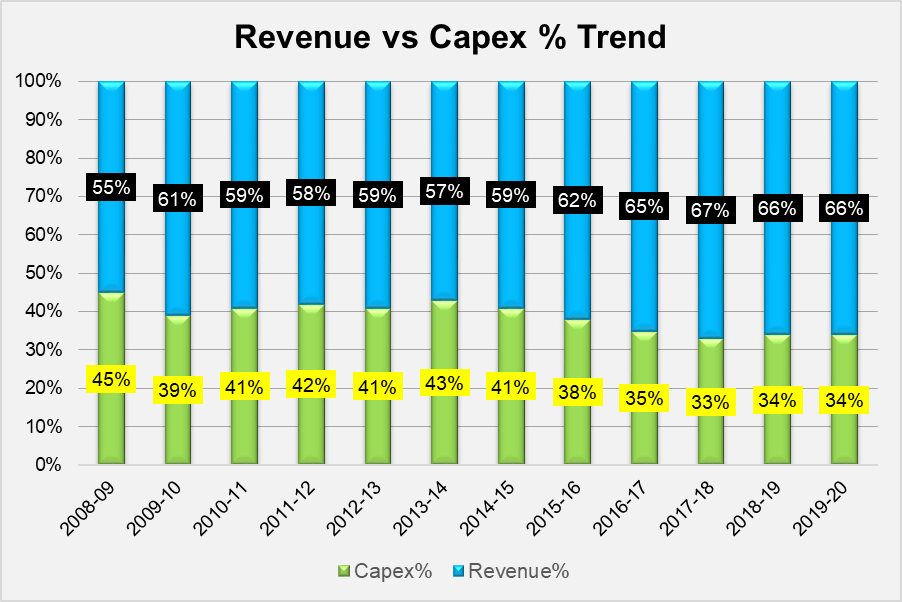
So the million dollar question is that how can one return to these earlier levels (Capex % >= 41% of Capex + Revenue Expenditures & ~17% of CGE (Central Government Spending) & importantly how much more capital would it require to do so.
Taking the overall CGE of 2019-20 at Rs. 2,786,349 Crore an increase of ~39,000 Crore towards Capex Expenditures would help achieve these levels (~41.1% Capex & ~16.9% of CGE). (I.e. an increase of 1.4% of CGE to go towards Capex)
Back in March 2018 then Vice Chief of Army Lt Gen Sarath Chand said 68 per cent of the army’s equipment is in the ‘vintage category’, adding fund crunch will also impact the serviceability of the existing equipment and may even affect payment of instalments for past purchases. So an increase in the Capex Expenditure by let’s say Rs. 39,000 crore would be highly welcomed by the Armed Forces.
This 39,000 crore increase in Capex budget would represent a 36% increase based on the current ~108,248 crore capex budget. This is similar to the proposal made by many defence experts who have argued for the capex budget to be increase by ~1/3 from current levels.
Central Government Budget Allocations
This does however create a new thorny question of where this additional money will come from. Today with the GDP growth down to just 4.5% in Q2 FY20, the revenues generated by the government are bound to be lower stretching the already precarious finances of the government. The Central Government in a bid to boost growth has to cut taxes which has now raised questions on how the government will look to recover lost revenue in the short term.
Any increase in Defence spending will mean that there will have to be cuts somewhere else in the central government spending. With no sign in any decreases in the welfare spending by this government it would seem hard to see how this extra money can be allocated to defence.
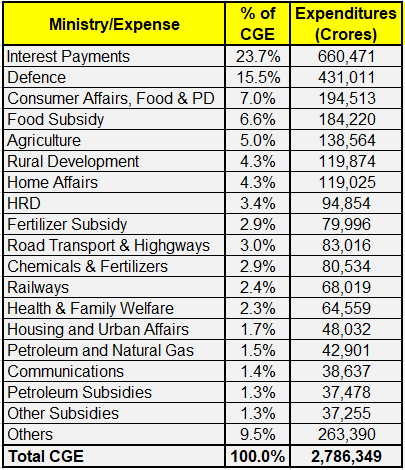
Today Defence already is the 2nd largest expenditure (15.5% of CGE) for the Central government only trailing Interest Payments which at 23.7%. Defence spending is not only greater than the 3rd & 4th largest expenditures combined (Consumer Affairs, Food & Public Distribution & Food Subsidy) but also bigger than all the various subsidies combined (~12.2%).
An increase of Rs. 39,000 crore in this case would be hard to come by since it would mean a cut in some other place. So how can we possibly go about solving this issue?
Ways to increase Capex spending
The Indian Army today has a strength of ~1.2M (12 lakh). This big manpower is now accounting for a large number of revenue expenditures. This is in turn leaves less room for money to be allocated to the capex budget. Indian Army has undertaken a review as part of proposed rationalization plan where up to 150,000 troops could be reduced over the next four to five years. One of the goals is to improve what is referred to as the Army’s teeth-to-tail ratio [i.e. the number of personnel (tail) required to support a soldier (teeth)] Reducing the size of the Army personnel on payroll will give some opportunity to increase allocations for Capex expenditures.
Starting Oct 1 Defence procurement and purchases will be not be assessed any customs duty and GST (goods and services tax). As per MoD (Ministry of Defence) estimates this should save Rs. 35,000 crore in GST taxes and 25,000 crore in customs duty over the next five years. This huge sum of Rs. 60,000 crore over a period of 5 years is estimated to produce yearly savings of ~Rs. 12,000 crore/year. This will go a long way towards getting the proposed Rs. 39,000 crore increase in the Capex budget.
India’s defence exports have grown significantly recently and last year it reached almost Rs. 11,000 crore. The target for current year is Rs. 15,000 crore with a target of Rs. 35,000 crore by 2024. Since a vast majority of them are from the public sector the profits realized from the increase in volume of sales could then be theoretically used by the government for helping to increase the defence budget.
With the constant commentary about Indian Armed Forces needing a larger budget one might think that all of the Defence Budget would be getting exhausted or close to it every year. But in reality the amount spent each year has been lower than the allocated Budget. In a report prepared by PRS Legislative research they have shown that the amounts utilized have been much less than the amounts projected. The unused money than is not spent by the Armed Forces lapses. If a “rollover” provision was added that will give more financial bandwidth for the Armed Forces in the following year. Many times deals are not closed in time due to protracted negotiations or geopolitical pressures or it getting simply bogged down in controversies. Many big ticket hardware purchases require a significant chunk of capital. Having the rollover provisions helps prevent purchases from being squeezed due to the large volume and/or high price concerns.
SOFT POWER vs HARD POWER
Talking of budgets while “hard” military power gets all the attention one must not forget “soft power”. Soft Power according to Joseph Nye, an American political scientist, is defined as the ability of an actor to change the behavior of another actor to achieve a favorable end through attraction rather than coercion. Chairman Mao Zedong once famously remarked that “Political power grows out of the barrel of a gun”. Chinese behavior especially in past few decades has been more of Mao’s intimidation and bullying. There is very little involvement of so called soft power in its dealing with other nations. India can’t be wholly dependent on hard power like China which is not desirable as it creates tension and stress in relationship with other nations. The best approach is a right mix of hard and soft power. India has to work on its soft power initiatives while continuing to improve its military firepower (i.e. hard power)
The (MEA) Ministry of External Affairs plays a huge role in statecraft and our dealings with the rest of the world. MEA’s budget also must not be ignored in the talk about allocating more money towards India’s strategic interest. MEA budget for 2019-20 was Rs. 17,800 crore (a healthy growth of 18.5+% from Rs 15,011 crore last year). The total aid to countries has increased by a whopping ~36% year over year from ~ Rs 5,545 crore in 2018-19 to Rs 7,582.79 crore in 2019-20 which will go a long way in burnishing our credentials with friendly nations.
A constant complaint has been the understaffing of the diplomatic corps of India vs other nations. Current estimates put it around ~1400 which still is way short of the desired number. Many of the big powers employ a large number of diplomats than India. To realize our aspirations of being a big power we can’t achieve all our goals without sufficient diplomatic corps staff. A few years ago, Shivshankar Menon (Former Indian Foreign Secretary & National Security Advisor) remarked that for every Indian there were 7 Chinese diplomats and even if we work as efficiently as them, we can never match their efforts. In their election manifesto BJP promised to “increase the strength of the diplomatic and allied cadres to keep pace with our increasing global engagement”. Now it is time for the BJP including PM Modi to put the money where their mouth is to significantly expand India’s diplomatic corps.
EPILOGUE
Many critics of India’s defence spending who want the spending to be pegged to a certain % of GDP don’t take into account India’s low Tax to GDP Ratio.
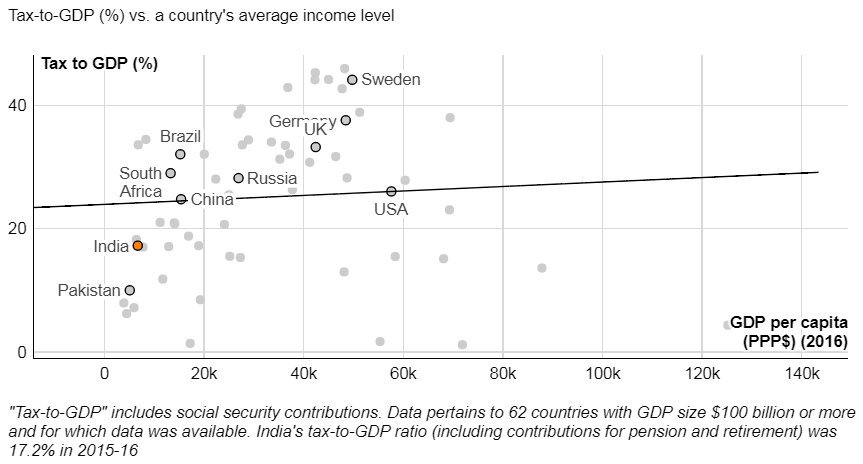
India’s defence expenditure is compared with other nations in terms of % of GDP which have a much higher tax to GDP Ratio. Defence Spending is a component of the government’s expenditure which is dictated by the revenues that it collects (and not by its GDP). With a lower Tax to GDP ratio it would be unrealistic to continuously peg the Defence spending to a certain % of GDP and maintain it.
As mentioned above there are creative ways to get back to ~40% Capex spending and ~17% of CGE. However, long term the only sure shot way of protecting India’s national interest is rapid economic growth over the next few years. As India’s GDP grows, the CGE and its Defence Budget will also grow automatically with it. A faster growth of the Indian economy should allow more room for the government of the day to give healthy increases for the Defence Budget. With a larger Defence Budget many of the needs of the Armed Forces would be met and the heartburn over Budget/GDP ratios will slowly die down.
India has a huge chunk of population of people who are not economically well off. This means that government has to devote a lot of the resources at its disposal for their upward mobility. A significant portion of resources in the Budget are geared towards social and economic welfare schemes. Political compulsions mean that pulling back on any of these welfare schemes can’t be done without suffering consequences in the next round of elections.
India’s rising power ambitions on the global political stage need to be matched with a competing fast economic growth. The primacy of economic growth having a bearing on the country’s strategic affairs was reiterated recently by current External Affairs Minister S Jaishankar at the 4th Ramnath Goenka Lecture where he said that “economy drives diplomacy and not the other way around”. Buying all the new hardware from around the world (even if you can increase the budget) won’t make India more secure if there is sluggish economic growth like the sub 5% growth that we had this past quarter. The 1980’s under PM Rajiv Gandhi saw a great modernization of India’s Armed Forces at the fastest rate ever with the Defence spending being reportedly pegged at ~4% of the GDP (much higher than today). But just then less a decade later in 1991 India faced a balance of payments crisis and was at the risk of defaulting on its financial obligations. (I.e. military might only by itself won’t secure your future). If the current slow growth in the economy persists over let’s say a few years the economic hardships will force government to make some hard choices. To reduce the misery of the economically weaker sections of the society government will have to offer more sops than what are currently given. This will then come at the cost of other expenditures like Defence. This will exacerbate the existing issue of low Capex allocations even further. In the short term we can use some methods to increase capex budget but in the long term there is no substitute for sustained level of high economic growth.
Buying 8 squadrons (~110 aircraft) of Rafale fighter under a possible MMRCA 2.0 deal jets while will help secure our interests but rather than purchase of 8 squadrons a sustained 8+% growth for India will be more helpful in securing our strategic interests.
References
https://www.tribuneindia.com/news/nation/wages-pensions-eat-into-defence-spending/797916.html
https://ajaishukla.blogspot.com/2019/07/defence-budget-inches-lower-towards-2.html
https://twitter.com/elmihiro/status/95914010645088665



 Loading...please wait
Comments