




India’s BRICS Diplomacy: Acumen, Foresight and Strategic Resilience
- In Foreign Policy
- 11:50 PM, Sep 16, 2026
- Ramaharitha Pusarla
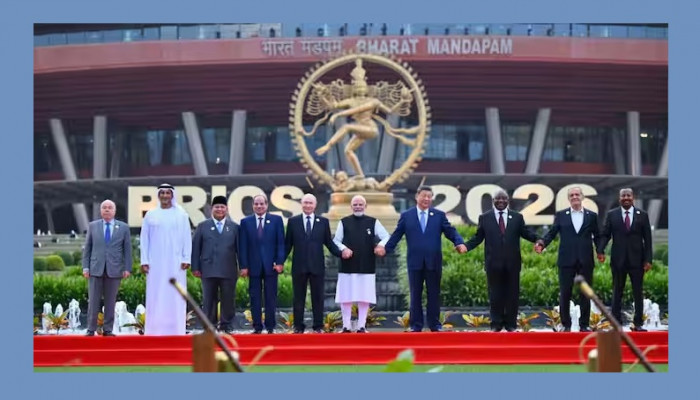
BRICS chairmanship returns to India after 2021, with New Delhi setting the stage for the 18th Edition of the BRICS+ Summit from September 12-13. Dismissed as a divergent group, analysts often downplayed BRICS. However, representing 49.5% of humanity, accounting for 26% of international trade and 40% of global GDP, the BRICS+ is now a counterweight to the G7, surpassing it in population and purchasing power output.
Statistical comparisons, made in the face, often come with an agenda. Commentariat, ahead of the New Delhi BRICS Summit, attempted to project it as an alternative to the US-led order or anti-West. Dismantling these narratives, India, the current chair of BRICS, in a strong demonstration of its multi-alignment policy, hosted the Quad sherpas meeting on September 3rd, ahead of the BRICS Summit. Even as India welcomed the BRICS delegation, Indian forces held bilateral exercises Veer Guardian 2026 and Yudh Abhyas with Japan and the United States, respectively.
India’s independent foreign policy has always stood for alliance with none and alignment with all. Reflecting it in true spirit, the New Delhi declaration resting on the four pillars of - Resilience, Innovation, Cooperation and Sustainability reinforced the need for an inclusive multilateralism anchored in 3Rs -Representative, Responsible and Rules-based multipolar world order with the United Nations at its centre. Unequivocally, positioning BRICS as a non-Western grouping, India has attempted to forge cooperation between countries to work for their common interests.
The thoughtfully conceived theme of the 18th BRICS Summit, “Building Resilience through Cooperation and Innovation for Sustainability”, is an acronym of BRICS.
The BRICS, which has now emerged as the representative of the Global South, is seeking a restructuring in tandem with the contemporary realities. Coming at a time when nations are fraught with conflicts, India’s chairship faced the indomitable challenge of bringing the diverse group of countries to a basic common denominator.
The BRICS foreign ministers’ meeting held in May at the height of the Middle East crisis failed to reach a consensus over the language. Member countries Iran and the UAE sharply differed over references to Palestine and the Red Sea. Though Indian diplomats tried to bridge the differences, the meeting failed to ensure a joint outcome. Hence, in the lead-up to the BRICS Summit, BRICS Sherpas burnt the midnight oil to overcome differences and bring out a balanced text. Through sustained consultations, India has built a consensus among the members. Pulling a major diplomatic feat, the eleven BRICS member countries unanimously approved the declaration on the first day of the summit.
In 2023, India pulled off a major diplomatic victory during its G20 presidency by forging an early consensus and adopting the declaration on the first day of the Summit. Replicating the same template, India has meticulously managed the contradictions on all major contentious issues. Back then, the previous 2022 Bali G20 edition failed to arrive at a joint declaration due to the hard positions of G7 members and the Russia-China duo over the Ukraine War. Successfully wielding the lever of global interests of the Global South and announcing African Union membership to G20, India has pulled off the impossible feat of avoiding condemning Russia, while stressing the inviolability of the “territorial integrity” of countries.
Evolving into a multi-continental grouping, BRICS is by far the most diverse group. A diverse group can either become a melting pot of integration or can crumble under the weight of disagreements. With BRICS member countries embroiled in ongoing conflicts, the current edition of the summit faced an additional challenge of coordination and cooperation. Turning this diversity into strength, India has managed to bring consensus in a highly polarised world order. The 45-page document with 140 paragraphs is a true testimony to India’s astute diplomatic skills.
Hosting the BRICS Summit for the fourth time, India has expanded the scale through wide-ranging sectoral engagements. Holding 400 meetings across 30 cities through ministerial tracks, business and joint working groups, India has made BRICS more development-oriented. BRICS, primarily a group evolved for coordinating economic policy of Emerging Markets and Developing Countries (EMDCs), has, through sustained dialogue and subsequent expansion, BRICS+ has become a channel for advancing the interests of the Global South. Positioning development as the cornerstone of BRICS during its chairship, India gave a productive direction to the grouping.
Even as Trump has been sharpening knives over dedollarisation, proposing 100% tariffs against BRICS countries, to the utter dismay of Breaking News frenzy media, the New Delhi declaration made no mention of a common currency. Acknowledging “no one size fits all approach”, the declaration, quietly advancing structural de-dollarisation, made a local currency pivot and encouraged the New Development Bank to expand financing in local currencies. Steering the course for an equitable and inclusive world where the interests of the Global South and EMDCs receive meaningful participation, BRICS called for representative participation for all stakeholders.
While the economic centre of gravity has drifted to the East, the power still rests with the West-controlled institutions and systems. Reiterating the need to reform the existing systems, the New Delhi BRICS declaration called for a review of quotas for the IMF and the World Bank and a two-tier dispute resolution system in the WTO.
The New Delhi Declaration, laid out under three sub-themes- Inclusive Global Governance and Strengthening Multilateralism, International and regional peace and security and Strengthening cultural and people-to-people cooperation have credibly underlined India’s motto for BRICS: “shared vision into win-win cooperation”.
Charting a development-oriented future course for BRICS, India has spearheaded the establishment of collaborative platforms such as the BRICS Vaccine R&D Centre, BRICS Food Grain Exchange, BRICS AGRIN (Agro-Inputs, Genetic Resources, and Information Network), BRICS CONNECT for Skilling, BRICS MSME Cooperation Portal, BRICS Incubator Network, BRICS Startup Innovation Fund, BRICS Science and Research Repository and adopted the BRICS Youth Cooperative Framework.
Ukraine War and the Iran War have exacerbated the energy security vulnerabilities of the Global South underscoring the need for greater and strategic preparedness. In response, India has initiated the BRICS Digital Centre of Excellence for Smart Grids and Energy Storage under the Smart Grids Workstream of the BRICS Energy Research Cooperation Platform (ERCP) for reliable, efficient, clean and accessible energy sources. Resilience, however, extends beyond energy security. It comes from identifying emerging challenges and preparing well for them in advance. In this spirit, BRICS countries supported India’s proposal for BRICS Integrated Early Warning System and the BRICS Logistics Supply Chain Cooperation Framework.
Pitching for inclusive global governance, the New Delhi Declaration called for a Woman UN Secretary-General, reiterated India and Brazil’s membership in the expanded UNSC, supported Iran and Ethiopia’s bid for WTO accession and strongly condemned the unilateral tariffs and coercive measures inconsistent with WTO rules.
On the security front, the strongest condemnation of the Pahalgam attacks in Jammu & Kashmir is a notable diplomatic win for India. The conflict in the Middle East, which has severely impacted the BRICS countries, received wide attention, with members expressing serious concerns over continued escalation and stressing the need to maintain smooth trade flow. Collectively, the group has reaffirmed support for Palestinian statehood, an unwavering commitment to a two-state solution with East Jerusalem and rejected unilateral measures to change the historical status of Jerusalem.
Prioritising consensus-building, while acknowledging different positions of countries on regional conflicts, India brought out a joint declaration which has put economic and development aspects at the forefront. Summit ideas can quickly fade away, and initial momentum might wane. To take these ideas forward, PM Modi proposed a BRICS Continuity and Implementation Mechanism, a Troika System, for a systematic follow-up of outcomes and implementation. Troika, comprising the preceding, current and future presidencies, has been the typical operating mechanism of G20.
Resisting domination by any power, India has offered countries a safe space to explore solutions for contemporary global challenges. Without pushing any agenda, India fostered “inclusive, mutually beneficial and development-oriented partnerships”. Respecting different perspectives, India built consensus among the BRICS’ conflicting members. Without donning the mediation mantle or making a brouhaha, India quietly facilitated meaningful consultations to resolve the Gulf crisis. The diplomatic engagement between Iran President Pezeshkian and Abu Dhabi's Crown Prince, Sheikh Khaled bin Mohamed bin Zayed Al Nahyan, on the sidelines of the BRICS Summit, resulted in both parties agreeing to “put the past behind” and mend ties.
Looking beyond differences, PM Modi and President Xi, who visited India after seven years, held bilateral talks, vowing to “be sensitive to each other’s core issues”. Turning BRICS into a platform of cooperation and collaboration, PM Modi held 15 bilateral talks with heads of state and government, world leaders and heads of international institutions. India and Russia set a $100 billion bilateral trade target, discussed alternative payments, mobility and critical minerals. Bilateral talks with the UAE yielded $11.5 billion investment in an integrated greenfield project in Odisha. PM Modi reviewed the strategic partnership with his South African counterpart.
India has always believed in diverse partnerships to pursue its core interests- but never allowed anyone to veto its growth and development. BRICS declaration had, in essence, reflected the same policy. The members resolutely rejected unilateralism of the West, condemned tariffs, sanctions and Europe’s discriminatory Carbon Border Adjustment Mechanism (CBAM).
India’s G20 Presidency has set a new benchmark with high standards, impactful outcomes and masterful execution. Acting as a moderate power, India steered BRICS towards resilience, cooperation and innovation rather than turning it into a geopolitical battle. Rejecting binding loyalties, India is using these multilateral groups to build partnerships and engage with different countries, widening its horizons and, in the process, accumulating significant diplomatic heft.
Disclaimer: The opinions expressed within this article are the personal opinions of the author. MyIndMakers is not responsible for the accuracy, completeness, suitability, or validity of any information on this article. All information is provided on an as-is basis. The information, facts or opinions appearing in the article do not reflect the views of MyindMakers and it does not assume any responsibility or liability for the same.



 Loading...please wait
Comments