




India’s artificial sun project inches closer to reality with commissioning of gyrotron
- In Reports
- 06:21 PM, Sep 15, 2026
- Myind Staff
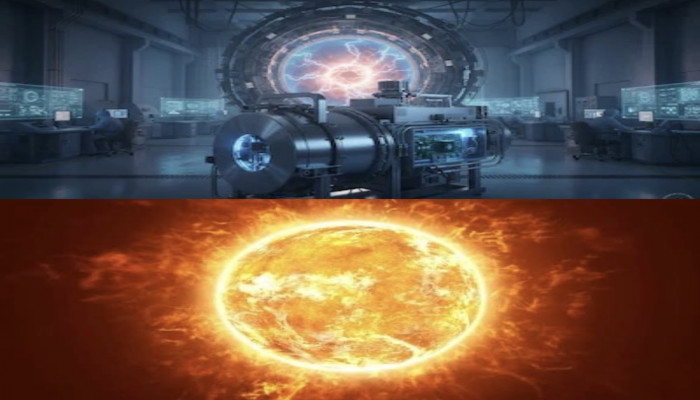
India’s fusion research programme has reached a key milestone with the installation and commissioning of a new 82.6 GHz, 400 kW gyrotron on the Steady State Superconducting Tokamak (SST-1). Scientists at the Institute for Plasma Research (IPR) in Gujarat are using the experimental device to study nuclear fusion, the process that powers the Sun.
Nuclear fusion is being explored as a potential source of low-carbon and safer energy. It aims to generate energy by combining light atomic nuclei under extremely high temperatures and pressure. The process occurs in plasma, a highly heated, electrically charged state of matter.
Inside a tokamak, scientists use powerful magnetic fields to confine the plasma within a doughnut-shaped chamber. This keeps the extremely hot plasma away from the reactor walls. The SST-1 is designed to recreate conditions similar to those needed for fusion inside stars.
Indian fusion experiments have already achieved plasma temperatures above 200 million degrees Celsius. This is around 20 times hotter than the temperature at the centre of the Sun. Reaching such temperatures, however, is only one part of the challenge. Scientists also need to keep the plasma stable and confined for long enough to study sustained fusion conditions.
The newly commissioned gyrotron is expected to strengthen this effort. A gyrotron generates high-frequency microwave energy that heats plasma. The new system operates at 82.6 GHz and provides 400 kW of power. It offers a major increase in heating capability over the earlier 42 GHz system used with SST-1.
The upgraded heating system will allow researchers to reach higher plasma temperatures and study plasma behaviour under more stable conditions. It will also support experiments aimed at improving plasma confinement and understanding the challenges involved in sustaining extremely hot plasma.
Controlling plasma remains one of the biggest hurdles in fusion research. The Sun can maintain its fusion reactions through its immense gravitational force, which keeps its hot plasma confined. Scientists on Earth cannot use gravity in the same way. They rely on powerful magnetic fields to control and contain the plasma.
Even small instabilities can disrupt the plasma and end the conditions needed for fusion. Researchers therefore need to maintain precise control over the plasma while keeping it at extreme temperatures.
Fusion is considered a promising low-carbon energy source. Its fuel sources are relatively abundant, and it produces far less long-lived radioactive waste than nuclear fission. Turning fusion into a reliable commercial source of electricity, however, remains a major scientific and engineering challenge.
The new gyrotron does not make SST-1 a fusion power plant, nor is the project currently producing electricity through fusion. Instead, it gives Indian scientists a more powerful tool to produce extreme temperatures and study plasma. The upgrade will help them investigate hotter plasma and its behaviour under more stable conditions.



 Loading...please wait
Comments