



Indian Students studying Abroad: Myopia of India’s Higher Education
- In Current Affairs
- 10:41 AM, Oct 02, 2017
- Dr. Gursharan Singh Kainth

UNIVERSITIES worldwide play a greater role in the Indian higher education scene. They attract many thousands of Indian students to their campuses every year. Graduates of accredited foreign institutions play important roles in the development of India upon their return home. The attraction of study abroad for Indian students, as a supplement to the Indian higher education available within India, is bound to continue for the foreseeable future. For most students, the motivation is to attain the best possible education. Competition for admission to India's best institutions is very intense - about two per cent of those taking admission tests for the prestigious Indian Institutes of Technology and Indian Institutes of Management gain admission and other high-quality education options are needed for the many talented students who are turned away from these and other premier institutions. Moreover, the Indian student population is growing at a fast pace, and Indian institutions strapped for funds will be hard-pressed to create seats to accommodate the demand. Beyond the issue of access to quality higher education, Indian educators recognize the need to supplement Indian content-rich curricula with activity-based learning and to bridge the gap between academia and industry. With a booming economy in the service sector industry, the time is right to prepare graduates for tomorrow's careers. Many educators acknowledge the need for change in Indian institutions to increase focus on life-long learning, which will result in even larger numbers of students beyond the usual 19-23year-old cohort seeking admission to higher education institutions, whether in India or abroad. Foreign Universities have seen a rise in the number of Indian students enrolling for admission, whether for a Bachelor’s Degree or even Master’s. And Indian job market does prefer students with a degree from an international university. Several universities abroad offer better infrastructure, better quality education and focus a lot more on research based education. The number of Indian students migrating abroad to study is growing at a faster pace than ever before. No precise figures are available for the number of student leaving India for higher education. Even the Reserve Bank of India (RBI) hasn’t come up with these numbers. This is despite the fact that the RBI insists on the reason for any remittance of foreign exchange overseas. Education is one category that it looks at. But in a little-reviewed document placed before the government in 2005 (WENR: World Education News and Reviews: IDP, Australia and IIE Ministry of Commerce, Government of India), the magnitude of this problem begins to come into focus. According to this document, almost 120,000 students from India made their way to some of the leading centers of education in the world for higher education during 2004-05. The number has significantly larger today and reached the mark of four and a half lakhs.
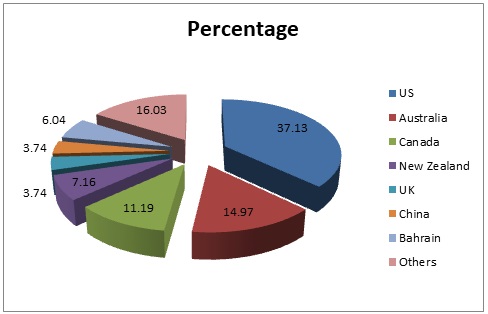

Fig: Indian Students Abroad in Top 7 countries during 2015-16
With the exception of the United Kingdom, student numbers from India to the United States, Australia, Canada and New Zealand grew faster than overall overseas student numbers to these destinations, according to the latest report by MM Advisory Services in New Delhi. Despite a focus on a record number of students from China, particularly to US and Canadian universities, the growth of Indian students heading abroad has been faster than China’s, according to the report entitled Indian Students Mobility Report 2016. For years, India’s numbers have been a bit of a see-saw, but 12 per cent growth in 2014, and now clocking an even higher rate of 17.8 per cent – this is the second year in a row that India’s growth rate has been higher than China. However, in terms of absolute numbers China is still well ahead with almost 700,000 internationally mobile students, close to one and half times India’s students at key destinations. There was unlikely to be a significant easing of academic pressure for the best institutions in the coming years. Students leaving India are some of the best brains. This push factor is coupled with rising purchasing power among India’s growing middle class that has increased the affordability of overseas study
Emerging Destinations:
In a new trend, Germany is emerging strongly as a favored destination and could soon overtake the UK as the most popular study destination in Europe for international students. In 2015 it attracted some 340,000 international students, compared to almost 450,000 in the UK. Given the lower cost of higher education in Germany, the trend from India is also going to get stronger. Nearly 85 per cent of internationally mobile Indian students head for five countries: the US, UK, Australia, Canada and New Zealand, but China and Germany are both emerging destinations for Indian students heading abroad, though the numbers heading for Germany are still very small. US numbers from India jumped by almost 30 per cent, accounting for a major share of large proportion of the overall increase of foreign student numbers. In US alone, almost half the market of international students is either Chinese or Indians. Canada seems to be headed that way too. Australia is back as the second favourite choice for Indian students after a downturn for several years after 2009 when a number of racial attacks led to a drop. In 2015 Australia crossed its previous peak for international students in 2009.
Canada:
According to statistics, around 14 per cent of all international students studying in Canada, are Indians. Furthermore, the Canadian government has introduced immigration policies that are beneficial for Indian students like offering permanent residency to highly skilled students passing out of a Canadian university. Being an English speaking country, Canada is one of the most preferred countries to study at, for Indian students. During 2015-16, 11.19 per cent of Indian students were enrolled in Canada. The country offers a cosmopolitan environment and a high quality of life. York University, University of Toronto and University of Winnipeg are some of the best ranking universities in Canada.
Germany:
International students enjoy free tuition in German public universities for various English taught courses. Moreover, a program in particular called DAAD is especially dedicated to Indian students. There is lot of scholarship programs as well, offered to students. Universities in Germany also have a wide network of partnerships with local and international research institutes and thus there is more focus on research and innovative options. Justus Liebig University Giessen, Karlsruhe Institute of Technology and University of Bonn are some of the top ranking German universities.
Based on the smart initiatives being rolled out to attract students, Germany is likely to become the international education leader in Europe in the years to come. After five years of virtually no growth in international students to Germany, the country attracted a lot of attention globally when it announced an initiative to waive tuition fees for international students. That’s made many students, especially in high-cost countries including the US, start evaluating Germany as a serious option for international education. The package that Germany offers now is perceived to be so attractive that the language hurdle is something that students feel they can manage. Germany is a leader in Europe and a strong technological country. It is seen as a place where cutting edge high-tech happens, although the number of Indian student is still relatively small.
Australia:
The visa process for many Asian students has become more relaxed over the past few years, which is why Indian students form a huge part of the total population of international students. During 2015-16, 14.97 per cent of Indian students are enrolled in Australia which offers a multicultural and a friendly environment. Moreover, the country also has great opportunities for work during studies and after graduation. University of Tasmania, Charles Darwin University and University of Adelaide are some examples of Australian universities that have found a position for themselves in world university rankings.
United States of America:
One of the most sought out study-abroad destinations for Indian students is USA. Little more than one-third of the (37.13 per cent) Indian students have got enrolled in US during 2015-16. American universities provide top education and scholarships are numerous. Studying in the United States leads to a worldwide acknowledgement of one’s qualification or so is the mindset of many. Also higher education in the US does prepare a student in the long run. Harvard University, Princeton University and Stanford University are some of the top ranking universities in the country.
United Kingdom:
According to statistics, the number of Indian students enrolling in UK universities has been increasing. A rise of 10 per cent has been witnessed in the last year itself. Though the cost of living is definitely higher in the UK, it offers some of the best educational programs and Indian students benefit a lot more from the kind of exposure and expertise offered to the students. University of Oxford, London Schools of Economics and Political Science and University of Cambridge are some of the top ranking universities in the world.
The number of Indian students studying in the UK has been flat lining after major drops – of around 23 per cent between 2012 and 2014. During 2015-16 3.74 per cent of the students have got enrolled in UK. It is the only key destination that has seen a major downturn. Immigration policies have made it more difficult for overseas students to secure visas, with Indian students the most affected.
China:
Indian students to China jumped by almost 23 per cent to 16,694 – approaching the number going to the UK, 16715. Though China was a surprise, but Indian student flows to China are almost all for medical studies, given a severe shortage of medical school places in India. Unlike Indian students to other destinations, the vast majority Indian students who study in China return home to practice medicine .
Why Departure:
No doubt, there are, inter alia, paraphernalia of reasons why Indians are choosing to study abroad. But two most important factors are troubling for India’s universities and for prospects for the high-tech economy. When bright students look around India for a place to study for an advanced degree, they find few top-quality programmes. In the social sciences and humanities, there are a small number of respectable departments, but absolutely none that are considered by international experts in the top class of academic programmes. In the hard sciences, biotechnology, and related fields, the situation is somewhat favourable with a few institutions such as the Indian Institutes of Technology, the All-India Institute of Medical Sciences, the Tata Institute of Fundamental Research and some others, despite limited acknowledgement from abroad, being internationally competitive by most measures. But the numbers of students who can be served by these institutes is very limited.
Thus, if a bright Indian wants to study for a doctorate or even a master’s degree at a top department or university in most fields, s/he is forced to study overseas. Further, a degree from a top foreign university tends to be valued more in the Indian job market than a local degree — a perception based not only on snobbery but also on facts. While master’s degrees can be quite costly in U.S., U.K., Australia, and elsewhere, doctorates are in fact quite inexpensive because of the likelihood of securing a research or teaching fellowship or assistantship that pays for most or all of the costs.
Not only are overseas programmes and departments more prestigious, they also have far better facilities, laboratories and a more favourable culture of research. Top faculty members are often more accessible and it is easier to become affiliated with a laboratory or institute. Academic politics exists everywhere, and Indians may suffer from occasional discrimination abroad, but overall academic conditions are likely to be better than at home.
A Step toward Emigration
Additionally, studying abroad is often seen as the first step toward emigration. Of course, few students will admit this, but statistics show that a very large proportion of students from India — and also from China, South Korea and other Asian countries — choose to stay in the US following the completion of doctoral degrees. Data from the US National Science Foundation’s Survey of Earned Doctorates show that 80 per cent or more of students who complete their PhDs in the US from India and some other Asian countries remain in the US Since everyone who completes a doctorate is required to fill the survey, the data is quite accurate. Further, the US and other host nations are making it easier for foreign doctoral holders to remain — boosting their “stay rates”— and in this way contribute to the brain drain.
The reasons for deciding not to return to India are varied and not hard to discern. Better salaries and facilities abroad, easier access to research funds, working on cutting-edge topics and many others are part of the mix. While some are lured back to India later in their careers, but their numbers are small. Once established overseas, either in a university or in the research or corporate sectors, it is difficult to return.
It may be relevant to note that the rate of Chinese post-graduate students going abroad is flat after a number of years of steady increases. A likely explanation, with relevance for India, is that China has invested heavily in its top-tier universities and now has significant quality and capacity in most academic fields for post-graduate study. Chinese students are no longer obliged to go abroad for high-quality programmes, with an apparent trend toward choosing to remain at home.
Good or Bad?
Is studying overseas good or bad? All depends on the perspective. As a student, desirous of getting good education and which one cannot get in India because there are very few seats (or the rates extortionately high), it would be a good move. The universities overseas would, obviously, consider this a good move, as it would encourage a “freedom of choice” for aspiring students.
But from an economic perspective, every student who goes overseas, India is financing the payment of their teachers and of infrastructure. That money could have created more jobs and more facilities in India. India, has thus encouraged the formation of jobs overseas, and has failed to do that in India. And yet Indian government claims that it wants to increase employment opportunities. This is done in two ways. Firstly, by not opening greater number of Centers of Excellence. The usual excuse is that the funds for doing this aren’t adequate. The second, insidious, method is to encourage the closure of key departments, so that private universities can then rake in the money. This has happened with post graduate studies in medicine in Maharashtra, and there is no reason to believe that this is not happening elsewhere as well. The result is that a good student, desirous of having good education, prefers to go overseas. Ukraine charges fees of around Rs 15 lakh a year for a medical course. China charges even less – Rs 12.5 lakh for the entire five-year course. Both countries teach in English, and invite the best teachers in the world. Compare this with the Rs 50 lakh to Rs 1 crore donations that people must pay to get a single child admitted to a private medical college. Apparently, students would prefer going overseas, because of the government’s own inability to allow high quality higher education to flourish within India.
If this is not bad enough, there are many who want the Indian government to let foreign universities set up bases in India as well. That would, obviously, lead to a calamity. You cannot allow a domestic university – with limits on fees, on payment to teachers, and curbs on capital spending – to compete with foreign universities who have a free hand on all the three accounting heads. If a foreign university is allowed into India and is permitted to pay more to a teacher than what the government permits aided institutes to pay, the best teachers quickly taking up jobs with foreign universities within India. That will spell the downfall of all aided institutions.
THE SOLUTION:
There is no short-term solution to this problem for India. The only remedy is to build up high-quality capacity in key disciplines at national institutions so that a greater number of Indian students can obtain excellent training at home. This means significant investment over time, and careful choices about where to invest since all universities cannot be top research universities. It also means significant changes in India’s academic culture to ensure that meritocracy operates at all levels. China’s top universities are beginning to show up in the mid-levels of the global rankings, an indication that they are having some success. India, so far, is nowhere to be seen.
Overall, Indian student growth overseas is still powered by a lack of places in good Indian institutions, even for the best students. Even those with 90 per cent marks cannot assume they will get into the Indian institution of their choice. There was unlikely to be a significant easing of academic pressure for the best institutions in the coming years. Students leaving India are some of the best brains. This push factor is coupled with rising purchasing power among India’s growing middle class that has increased the affordability of overseas study. What would a sensible government do? Banning foreign education is no answer. It would worsen the problem.
- Allow students to go overseas. But at the same time work towards weaning them away towards Indian institutes. This can be done by providing them better facilities, and better teachers within India itself. Start cleansing the rot of extortion and sleaze in private medical and engineering colleges.
- Build capacity for excellent higher education in India. Allow them to charge higher fees, but only if they can ensure that the students perform well at each qualifying examination. The penalty for not achieving academic excellence should not be derecognition. Such a move hurts students more than it does unscrupulous managements. The penalty should be that the institute itself is taken away from the errant management and given to another management which has excellent in imparting education and maintaining good standards.
- Put into place a uniform filter which ensures that the meritorious students get admission first at the prescribed fee levels. This will prevent managements from charging capitation fees – though they should be allowed to charge higher tuition fees. Majority of private managements don’t like doing this. Private medical colleges have resisted this for over about two decades. In the recent past, the Supreme Court ordered that the common entrance test would be applicable to private medical colleges as well. Unfortunately, many medical colleges are owned by politicians. Several sting operations have shown how they collect ‘donations’ in exchange for admission. What is worse is that many such institutions do not have good teachers or even equipment. Yet, few educational institutions have been taken over and transferred to better managements.
- Do not allow foreign universities into India, till you first allow for liberalized domestic educational institutions. Liberalize their ability to charge higher fees and pay higher salaries to competent teachers. Allowing foreign universities -- without first liberalizing domestic institutions -- would be suicidal for Indian education.
- Stop diluting the IIT brand by opening more IIT campuses under the same brand. An educational institution is not just many more classrooms. If that were the case, Harvard would have opened 10,000 Harvard clones across the world. Education is a matter of culture and organic growth; of chemistry between students, teachers and the university administration. If you want more good engineering colleges, grade them as was being done earlier, into NITs (National Institutes of Technologies), RECs (Regional Engineering Colleges) and the like. Calling all of them IITs will damage the reputation of IITs and hurt India’s academic excellence.
- Allow premier educational institutions the autonomy they deserve. Do not fall prey to the temptation of having directors or teachers who follow a certain ideology. And remember, if you want teachers to be respected, do not allow hooligans to get violent with teachers or principals of colleges.
Disclaimer: The opinions expressed within this article are the personal opinions of the author. MyIndMakers is not responsible for the accuracy, completeness, suitability, or validity of any information on this article. All information is provided on an as-is basis. The information, facts or opinions appearing in the article do not reflect the views of MyindMakers and it does not assume any responsibility or liability for the same.



 Loading...please wait
Comments