




Indian Navy welcomes new anti-submarine warship INS Anjadip to strengthen coastal defence
- In Reports
- 07:14 PM, Feb 27, 2026
- Myind Staff
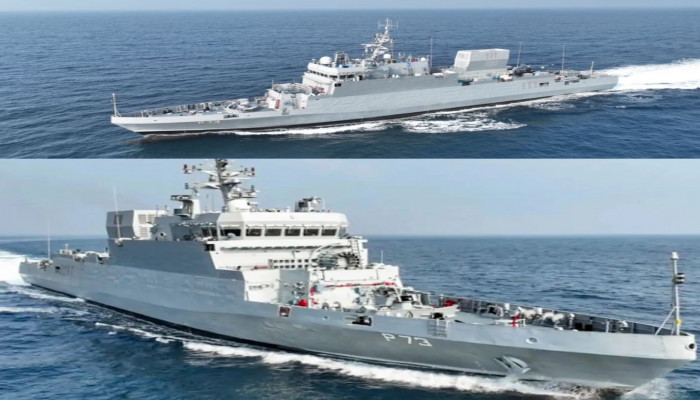
The Indian Navy has officially inducted INS Anjadip into its fleet, marking a significant step in enhancing the country’s capability to counter underwater threats and conduct surveillance close to its shores. The vessel, often referred to as a “Dolphin Hunter,” was formally commissioned at a ceremony held at Chennai Port on February 27, 2026, in the presence of senior naval officers, government officials, and other dignitaries.
INS Anjadip is the third warship in a series of eight being constructed under the Anti-Submarine Warfare Shallow Water Craft (ASW-SWC) project, which aims to enhance India’s ability to detect, track, and neutralise hostile submarines operating in shallow and littoral waters. Designed and built by Garden Reach Shipbuilders & Engineers (GRSE) in Kolkata, the 77-metre-long ship represents the Indian Navy’s focus on strengthening its coastal defence and maritime security through more specialised indigenous platforms.
The ship’s primary purpose is anti-submarine warfare (ASW), and it has been engineered to perform this mission efficiently in coastal regions where submarines might attempt to operate undetected. For this role, INS Anjadip is equipped with a modern and largely indigenous suite of ASW weapons and sensors. These include the hull-mounted sonar system called ‘Abhay’, which helps detect underwater activity, lightweight torpedoes capable of striking hostile submarines, and ASW rockets designed to expand its reach in underwater engagements. This advanced sensor and weapon package enhances the ship’s ability to sense and respond to threats beneath the surface, especially in shallow waters that are traditionally more challenging for larger warships to operate in.
Beyond its core anti-submarine role, Anjadip is also capable of supporting a wider range of naval tasks. The ship is built to conduct coastal surveillance, assist in low-intensity maritime operations, and participate in search-and-rescue missions when needed, making it a versatile asset for the Indian Navy. Its design reflects the Navy’s intent to address multiple operational requirements along India’s long and strategically important coastline.
One of the notable features of Anjadip is its high-speed water-jet propulsion system, which allows the vessel to reach maximum speeds of up to 25 knots. This propulsion setup gives the ship quick response capabilities and enhanced manoeuvrability in shallow coastal waters, which is vital during operations that require rapid positioning or pursuit. The water-jet mechanism also reduces the likelihood of damage from debris or shallow sea hazards, making it well-suited for littoral environments.
The naming of the ship carries historical and geographical significance. Anjadip is named after an island located off the coast of Karwar in North Karnataka, in the Arabian Sea. This naming continues a tradition of linking Indian naval vessels to important maritime landmarks and regions. The induction of this vessel is not just symbolic but also reflects the Navy’s ongoing shift toward building and integrating more indigenously designed and manufactured warships, which supports India’s broader goals of defence self-reliance, or Atma Nirbhar Bharat.
INS Anjadip forms part of the Indian Navy’s larger plan to modernise and expand its undersea and coastal defence capabilities. Analysts have noted that with growing regional maritime tensions and the strategic importance of the Indian Ocean Region, the need for specialised vessels like shallow-water ASW craft is increasing. Such ships enable the Navy to maintain a vigilant watch over submarine activity close to Indian shores and to act swiftly in the face of emerging threats.
At the commissioning event, the Navy emphasised that Anjadip will work alongside other ASW ships and naval assets to create an effective layered defence system along India’s vast coastline, including areas such as the Tamil Nadu and Puducherry coasts. This layered approach is designed to enhance surveillance, deterrence, and rapid response across India’s coastal waters.
In addition to bolstering anti-submarine capabilities, the addition of Anjadip underscores the Indian Navy’s commitment to expanding its indigenous shipbuilding base. With more vessels planned under the ASW-SWC project and other naval programmes, the Navy is expected to continue strengthening its maritime posture in the years ahead.



 Loading...please wait
Comments