




Indian Army's Sarvada Agrani Brigade demonstrates rapid engineer support in high-intensity combat drill
- In Reports
- 01:13 PM, Dec 20, 2025
- Myind Staff
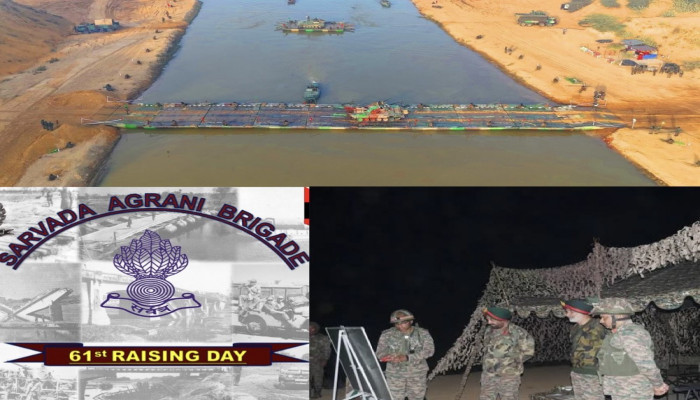
The Indian Army’s Sarvada Agrani Brigade recently conducted a major operational preparedness and combat engineering validation drill in a realistic battlefield environment. The exercise tested the brigade’s ability to provide quick and effective engineering support to combat forces, ensuring smooth coordination during high-tempo operations.
The drill was carried out under simulated high-threat conditions, replicating the challenges of modern warfare. These included difficult terrains and adversary disruptions. Engineer units showed strong agility by building essential infrastructure, such as assault bridges and mine-clearing lanes, within strict timelines that matched real combat situations.
A significant part of the exercise focused on innovation and the use of advanced technology. Unmanned ground vehicles (UGVs) with explosive ordnance disposal capabilities were deployed to safely neutralise improvised explosive devices (IEDs). This reduced risks to soldiers and allowed the forces to advance more quickly.
The brigade also highlighted new mobility solutions through next-generation modular bridging systems. These bridges, developed indigenously under the Atmanirbhar Bharat initiative, used lightweight composite materials and were deployed 40% faster than older systems. They could support heavy armoured vehicles while crossing water obstacles, even under enemy fire.
Survivability was another key focus during the drill. Engineering teams used active protection systems and rapid fortification methods to stay safe in combat. Deployable barrier systems with integrated sensors allowed engineers to detect threats in real time and take countermeasures against anti-tank missiles and drone attacks.
The exercise also demonstrated enhanced operational reach. Autonomous logistics platforms were used to deliver construction materials and fuel to forward positions, even in contested areas. This ensured that combat forces maintained momentum without waiting for resupply.
Multi-domain operations were a major part of the validation. The brigade combined cyber-electronic warfare with physical engineering tasks. Communication relays resistant to jamming were set up, allowing engineers to coordinate effectively even in simulated electronic warfare scenarios. This helped maintain command and control throughout the exercise.
Indigenous technologies played a central role in the drill. Engineer vehicles were equipped with DRDO-developed explosive reactive armour to improve protection against blasts. AI-driven route optimisation tools helped engineers find safe paths through minefields efficiently.
Teams carried out rapid obstacle breaching using precision-guided munitions and robotic sappers. They created passageways wide enough for mechanised infantry in under 15 minutes. This showed that the brigade is ready for high-intensity conflicts along India’s northern and western borders. Units participating in the exercise highlighted how it helped improve tactics. Combat forces praised the engineers’ ability to adapt and provide support in sync with fast-changing operations. This strengthened trust between engineers and manoeuvre forces in joint missions.
Environmental realism was also part of the drill. Operations were carried out in varied terrains, including high-altitude and semi-arid areas. This ensured that the brigade’s skills were tested across different seasonal and geographical conditions, relevant to India’s diverse operational environments.
Technology has extended to augmented reality (AR) tools for engineers. AR interfaces offered holographic overlays of hidden threats and optimal points for placing equipment. These tools reduced human error and sped up decision-making, even in low-visibility situations.
Sustainability was integrated into the exercise as well. Engineers used low-signature equipment that avoided thermal detection, while solar-powered auxiliary systems provided energy to remote sensors, reducing the need for resupply. After the exercise, debriefs showed measurable improvements. Engineer response times improved by 25%, and survivability performance exceeded targets by 30%. These results indicate that the Sarvada Agrani Brigade has evolved into a highly capable, future-ready force. The brigade’s performance reflects the Indian Army’s ongoing transformation towards technology-driven warfare. By focusing on innovation, the exercise validated the brigade’s key capabilities and set a standard for other units in delivering decisive engineering support on the battlefield.



 Loading...please wait
Comments