




Indian Army rolls out Bharat Rice, signs five-year FCI pact to boost military logistics
- In Reports
- 07:10 PM, Oct 12, 2026
- Myind Staff
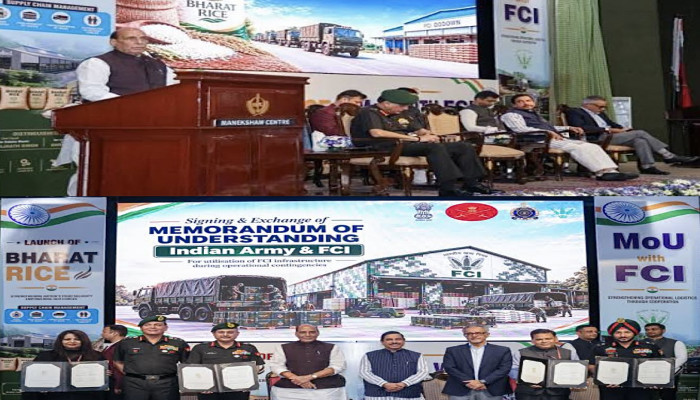
The Indian Army on Monday launched ‘Bharat Rice’ for troops and signed a five-year agreement with the Food Corporation of India (FCI) to strengthen operational logistics during emergencies.
Defence Minister Rajnath Singh and Union Minister for Consumer Affairs, Food and Public Distribution Pralhad Joshi attended the event in New Delhi.
Under the initiative, rice will be delivered directly to Army Supply Depots, including remote locations in Ladakh and the Northeast. This will replace the existing system of collecting supplies from local FCI facilities.
Led by the Directorate General of Supplies and Transport, the initiative follows feedback from troops and nearly 18 months of coordination among the Army, FCI, the National Agricultural Cooperative Marketing Federation of India Limited (NAFED) and the Department of Food and Public Distribution.
NAFED will supply rice meeting prescribed defence specifications during FY 2026–27. The rice will undergo quality checks to ensure it is free from foreign matter and admixtures, with minimal broken, damaged and discoloured grains. Procurement in 10-kg and 30-kg bags will simplify handling and transportation, particularly at forward posts.
Singh called the initiative a bond of trust between farmers and soldiers, reflecting “Jai Jawan, Jai Kisan”.
“This superior-quality rice will be provided in accordance with standard specifications. Furthermore, we are ensuring ergonomic packaging,” he said, adding that the initiative would ease the burden on personnel transporting rations through difficult terrain.
He stressed that operational readiness depends on soldiers’ physical health, mental balance, morale and stamina, alongside weapons and equipment. He added that soldiers’ welfare was integral to national security.
The five-year MoU with FCI, extendable by mutual consent, will allow the Army to use designated warehouses, labour and material-handling equipment during operational contingencies. It will support additional storage, rapid mobilisation and forward positioning of rations, stores and equipment closer to operational areas.
The Army’s Supply and Transport units will coordinate with FCI’s regional and divisional offices. The arrangements will also be incorporated into operational logistics plans.
Referring to Operation Sindoor, Singh said, “The strategic analysis of Operation Sindoor indicated that warning times could be extremely short in future conflicts,” warning that zero-warning situations and technology-driven warfare could challenge preparedness and logistics networks.
He described logistics as combat power, highlighting the importance of storage, transportation, warehousing and timely replenishment. FCI’s nationwide warehouses, modern silos, equipment and trained workforce could support military requirements while serving civilian needs.
“This MoU is far more than a mere administrative arrangement. It acts as a force multiplier for operational preparedness and reflects our ‘Whole-of-Government’ and ‘Whole-of-Nation’ approach,” he said.
Singh also highlighted self-reliance and modernisation in weapons, technology, clothing, equipment and training. Joshi described providing quality food to those protecting the nation as a duty and a matter of pride.
The Army has introduced additional rations for Agniveer recruits and greater uniformity in ration scales across the three Services. Organic rations are also proposed. These measures align with the PM Gati Shakti initiative.
Chief of the Army Staff General Dhiraj Seth, Food and Public Distribution Secretary Sanjeev Chopra and senior officials from the ministries, FCI, NAFED and the cooperative sector attended the event.



 Loading...please wait
Comments