




India warns Pakistan at UN against nuclear blackmail, vows firm response to terror attacks
- In Reports
- 05:41 PM, Oct 10, 2026
- Myind Staff
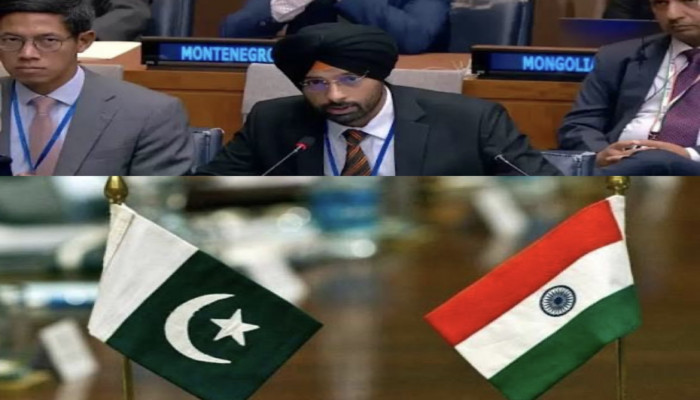
India has warned Pakistan against treating nuclear weapons as routine instruments of statecraft, asserting that New Delhi will not bow to nuclear blackmail. The statement came during India’s Right of Reply at Friday’s plenary meeting of the UN General Assembly’s First Committee, which deals with disarmament and international security, after Pakistan raised the issue of Jammu and Kashmir.
Anmol Sher Singh Bedi, Senior Adviser (Disarmament) at India’s Permanent Mission to the Conference on Disarmament in Geneva, reiterated that Jammu and Kashmir is an integral and inalienable part of India. “We call for India's illegally occupied territories to be vacated and returned,” he said, adding that India does not seek conflict.
"India has always stood for peace and continues to seek peace with one and with all. However, if there is no accountability for reckless actions, then peace rarely becomes a pause between crises,” he said.
Bedi said India’s capabilities are defensive and shaped by its security environment, not directed against any state. “Nuclear weapons must not be treated as routine instruments of statecraft,” he said, calling concerns over escalation legitimate.
"A posture that relies on nuclear overhang to limit the consequences of sub-conventional activity raises the risk of escalation and not the prospect of restraint,” Bedi said.
He described a recurring pattern in regional crises involving provocation, denial of responsibility and appeals for restraint after a response. He added that leaders who are neither elected by the people nor accountable to them face no personal costs for their decisions, allowing instability to become a tool of power.
“The use of force by states under the garb of non-state actors does not erase the state's responsibility. India's right of self-defence remains intact,” he said.
Bedi outlined India’s three positions: “First, any terrorist attack against India will receive a fitting response. Second, India will not bow to nuclear blackmail. Third, India will make no distinction between those who sponsor terrorism and those who mastermind it,” he said.
He said India’s actions in May last year followed a “grave provocation” and were taken in self-defence after the April 22 Pahalgam terror attack killed 26 civilians. “These actions were measured, targeted, and designed to be non-escalatory,” Bedi said.
India launched Operation Sindoor in May last year, targeting terror infrastructure in Pakistan and Pakistan-occupied Kashmir. The operation followed the Pahalgam attack, carried out by The Resistance Front, a proxy of Pakistan-based Lashkar-e-Taiba.
On the Indus Waters Treaty, Bedi said its foundations rested on good faith and goodwill. "A state cannot undermine those foundations of trust and cooperation and at the same time insist that the privileges flowing from the relationship remain untouched,” he said. India has held the treaty in abeyance until Pakistan credibly and irrevocably ends its support for cross-border and other forms of terrorism.
Bedi also cited the AQ Khan network’s role in nuclear proliferation, which contributed to the adoption of UN Security Council Resolution 1540 nearly two decades ago. Khan’s network supplied nuclear equipment and expertise internationally. “We urge all states and all responsible suppliers to exercise the highest degree of vigilance, not because of India, but for their own security,” Bedi said.



 Loading...please wait
Comments