



India vs UK: The Story of an Unprecedented Diplomatic Win
- In Book Reviews
- 12:26 PM, Oct 11, 2021
- Venkataraman Ganesan
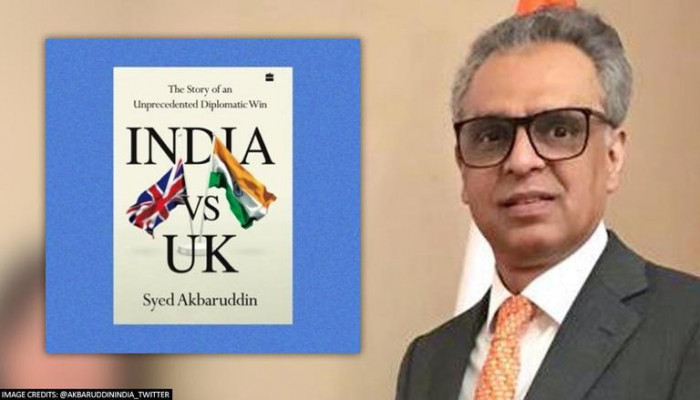
The wily veteran of diplomacy, Henry Kissinger once remarked, “Intellectuals analyze the operations of international systems; statesmen build them.” What for the rustic - possessing an incomplete “outside-in” perspective - represents a Byzantine system of rustling papers, ruffling feathers and running protracted deliberations, is for a seasoned diplomat the very difference between national pride and global humiliation. Syed Akbaruddin, former Permanent Representative of India at the United Nations (UN) from January 2016 to April 2020, in his riveting book, ‘India vs UK” writes about one such diplomatic humdinger in the UN, which pitted India and the United Kingdom against one another in the year 2017. In fact, this battle of wits assumed gravitas of such proportions, that Ambassador Inga Rhonda King, then Permanent Representative of Saint Vincent and the Grenadines, accorded a unique perspective to the whole episode, viewing it as ‘a revolt of the former colonies against their former colonial master’.
At its quintessential level the book holds forth on the 2017 elections held by the UN for determining independent judges of the International Court of Justice (ICJ). India’s nomination of a candidate for this post was an ‘after-thought’ almost, and was triggered by urgent developments in the Kulbushan Jadhav case. Kulbushan Jadhav, accused of spying, was arrested by the Pakistani law agencies in 2016 and subsequently sentenced to death in 2017. India, in a remarkable departure from the prism of bilateral negotiations, approached the ICJ, arguing that Pakistan had blatantly violated the standard norms of the Vienna Convention of Diplomatic Relations by failing to provide consular access to the accused. The ICJ in its verdict rendered in July 2019 stayed the order of execution and demanded Pakistan to accord Consular Access to Jadhav.
In 2017 the arrest of Jadhav and the subsequent appeal to the ICJ drove home the point that it would be absolutely imperative for India to have a seat for its own representative in the ICJ. However, there was a hitch. India had expended all its energies and diplomatic currency in canvassing and securing support for candidates contesting the International Law Commission (ILC) and the International Tribunal for the Law of the Seas (ITLOS) elections at the UN. Dr. Aniruddha Rajput and Dr. Neeru Chadha both emerged victorious in their contests and secured their positions on the ILC and ITLOS bodies respectively. If India decided to throw its hat into the ICJ elections as well, it would be the only country to contest all three elections in the space of a year.
India incidentally happened to have a judge serving out a term in the ICJ. Judge Dalveer Bhandari had won a seat when an incumbent Judge Awn Shawkat Al Khasawneh of Jordan resigned before the expiry of his term. Bhandari thus was to serve for the reminder of Khasawneh ‘s term. “Never before has an Indian judge who had contested a bye election then contested for a full term upon completion of the initial limited term.” So, when former Foreign Secretary S. Jaishankar after frenetic discussions with the late Sushma Swaraj, who was the Minister of External Affairs at that time, instructed Akbaruddin to fly to Delhi with an airtight plan to announce the candidacy of Judge Bhandari to the ICJ, the Permanent Representative of India at the UN knew that the die was cast. “Come as a plan and not as a plaintiff” was the simple but strong missive provided by Jaishankar to Syed Akbaruddin.
With the announcement of the delayed candidature, Akbaruddin and his team had more than just a handful on their plate. This is where the narrative in the book assumes momentum and discloses remarkable revelations. The tenacity of the diplomats acting as point personnel in various capacities at the UN in New York, the sagacity and astuteness of their staff, the co-operation rendered from within the corridors of power in New Delhi and the resilience of the Prime Minister himself in convincing many global leaders to support India and Judge Bhandari’s bid birthed an international convergence and consensus the likes of which was never seen before and has never been witnessed since.
The elections also unearthed in an incandescent fashion the cordial rapport and indelible amicability cultivated by India across geographies. While there were the usual handful of resolute foes, friends abounded to provide support and lend succour. India’s carefully nurtured relationships that embellished various economic and social developments in smaller developing nations bore fascinating fruition, as in a show of extraordinary reciprocity, nations bested an arcane system of voting by unhesitatingly trusting their ally. An abstruse and imperceptive method of voting which negates the “first past the post” rule and requires an absolute majority of 2/3rds at both the General Assembly and Security Council posed some formidable niggles for India.
With just one seat left among the five on the ICJ, the two candidates remaining in the fray were Justice Bhandari of India and Judge Christopher Greenwood of the United Kingdom. A curious and unwritten arrangement amongst the permanent members of the Security Council, which mandated the principle of ‘Unus pro omnibus, omnes pro uno’ or in its French version, ‘Un pour tous, tous pour un’, that means ‘One for all, all for one’, (as made famous by Alexandre Dumas in his 1844 novel Les Trois Mousquetaires—The Three Musketeers) ensured that Judge Greenwood would always stay in the clear when it came to the number of votes in the Security Council.
But India’s phenomenal diplomacy led by Syed Akbaruddin and his indomitable team consisting of Deputy Permanent Representative to the UN Ambassador Tanmaya Lal, the Election Officer, Counselor Anjani Kumar, Lakshmi Swaminathan, the Second Secretary at the Peace Building Commission, Enam Gambhir, Counsellor in the Permanent Mission of India to the United Nations in New York, and Paulomi Tripathi, the First Secretary at the Permanent Mission of India to the UN, swayed the General Assembly to vote for Judge Bhandari. After multiple rounds of voting, Judge Bhandari maintained a comfortable lead over his compatriot at the General Assembly even though he fell short of the required majority (nine votes) in the Security Council by a meagre two votes.
Greasing the wheels of fortune and lubricating the engine of optimism was India’s brilliant outreach. India has been engaging with the world on a continuous basis not just on matters of politics but also on an entire gamut of socio-cultural aspects. Paraphrasing Akbaruddin himself, “The International Day of Yoga has become a fixture in the UN calendar, and the activities associated with the celebrations attract a large number of UN diplomats and staff. The lighting up of lamps on the UN premises to mark the first observance of Diwali as a ‘floating’ holiday garnered huge interest…. More substantively, the India–UN Development Partnership for sustainable development, initiated in June 2017, generated enormous interest amongst several small island states and the least developed countries inside the UN bubble. We have ventured on this solo ‘start-up’ effort, drawing upon the success of the established India– Brazil–South Africa (IBSA) Fund. To use the proper nomenclature, the IBSA Facility for Poverty and Hunger Alleviation was established in 2004 and operationalized through the Office of South–South Cooperation at the UN since 2006. It was a pioneering tripartite effort at South–South cooperation. Each of the three countries contributed $1 million annually and agreed to implement development projects primarily through UN agencies. The template was simple and was used over a decade to fund several small development projects in developing countries. Buoyed by this success, over a decade later, we established in 2017 the India–UN Development Partnership Fund focused on the implementation of SDGs by leveraging the presence of the UN system in various small islands and developing countries.”
Just when it looked as though the UK and Judge Greenwood had no choice but to fold over and concede defeat, they engaged in one last and devious throw of the dice. The UK claimed refuge under an ante diluvian and draconic piece of legal chicanery, which hitherto had never been employed in the history of elections at the UN. Going by the unflattering and unimaginative phrase of “Joint Conference”, this method involved breaking an impasse by deviating from the support of majority in both the General Assembly and the Security Council. Instead, the deadlock would be broken by the Security Council which would decide amongst the warring contenders. It was as clear as daylight to the Indian contingent at the UN that this was resorting to pure anachronism in so far as a fair fight was concerned. Since India was not a Permanent Member of the Security Council, while the UK was, India would remain an impassive and inevitable by stander, a mute spectator in fact, as the permanent members would invariably favour a candidate fielded by one of their own.
This unexpected and unwarranted flimflam ensured that India had a two-pronged fight on their hands. Not only would it be required to argue against the unfair provisions of the law, but the country also had to mount a diplomatic offensive by appealing to the members within the Security Council requesting them to not side with the methodology proposed by the United Kingdom. Frantic messaging to the Republican Niki Haley, the former Governor of South Carolina ensured that the United States, which all along was unfortunately egging many members of the UN to vote for Britain, would remain unbiased, non-interfering and would also insist on the fight between Judge Bhandari and Justice Greenwood to be resolved by the ballot rather than by a unanimous decision, courtesy a handful of countries.
This is where the incomparable optimism and verve of Sushma Swaraj came to India’s aid. As Akbaruddin informs his readers in a heartwarming manner, the Minister agreed to bear the full responsibility of the outcome of India’s determined push. “‘However, all of the senior officials of the Ministry of External Affairs are in unison supporting the recommendation to proceed. ‘Don’t worry, I will be Don Quixote and lead the charge. You can be Sancho Panza.’
There is a hilarious passage in the book where Akbaruddin pleads with both Jaishankar and Sushma Swaraj, not to attend to any calls made by the then Foreign Secretary, Boris Johnson. Afraid that Johnson may exploit his splendid relationship with India in general and Swaraj in particular by making overt and covert entreaties to them requesting India to withdraw the candidacy of Judge Bhandari, Akbaruddin, tells both of them, “please don’t pick up the phone”.
Finally resigned to both logic as well as an unrelenting India backed by an unflinching support of a global community, UK informs India of its decision to withdraw Justice Greenwood’s candidature. The news was made doubly sweet for India, when it was revealed that Justice Greenwood was actively moonlighting by providing legal advice to Pakistan on various matters in the capacity of an arbitrator/legal advisor.
Syed Akbaruddin has always held himself in absolute dignity and has been emblematic of etiquette. Whether in his interactions with the media or in diplomatic briefings he has been an epitome of composure, class and calmness. His suave bearing and impeccable academic and professional credentials have served the cause of India well on more occasions than one. In his superb book, he brings to bear those same qualities. Always sharing the credit for every accomplishment whether simple or significant with his team, he is quick to recognise talent and hard work. In the true vein of an immortal Dr. A.P.J. Abdul Kalam or the unforgettable Dr. Satish Dhawan, Akbaruddin never shies away from assuming responsibilities for obstacles and stumbling blocks.
No wonder then that under the astute guidance of such a man, India pulled off what has arguably been, the greatest and incomparable ‘heist’ ever, in the annals of any elections at the United Nations. “India vs UK” needs to be read by policy wonks, students of politics and all those who have an interest in India’s political relations and maneuvers with the world in general.
Image source: Republic World
Disclaimer: The opinions expressed within this article are the personal opinions of the author. MyIndMakers is not responsible for the accuracy, completeness, suitability, or validity of any information on this article. All information is provided on an as-is basis. The information, facts or opinions appearing in the article do not reflect the views of MyindMakers and it does not assume any responsibility or liability for the same.



 Loading...please wait
Comments