




India, Uzbekistan target $3 billion trade, explore FTA and expand investment partnership
- In Reports
- 04:42 PM, Aug 03, 2026
- Myind Staff
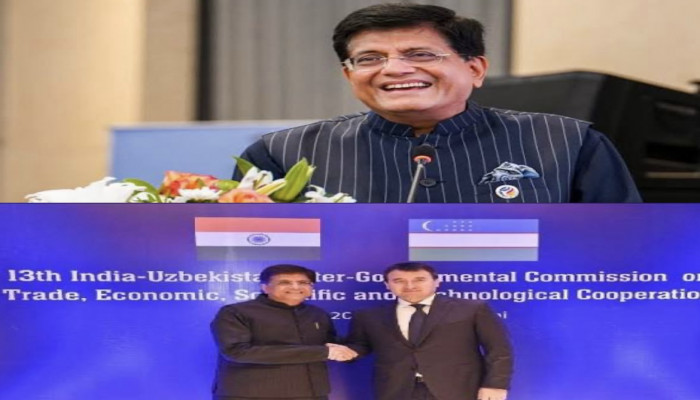
On Monday, Union Commerce and Industry Minister Piyush Goyal announced that India and Uzbekistan are looking to strengthen their economic partnership by setting an ambitious target of doubling bilateral trade to around $3 billion over the next three years at the India-Uzbekistan Business Forum. He also said the two countries could explore the possibility of signing a free trade agreement (FTA) to deepen commercial ties. Along with trade, both sides discussed increasing investments across several strategic sectors, including mining, rare earth minerals, renewable energy and pharmaceuticals.
During his address, Goyal stressed that trade should play the leading role in expanding economic relations between India and Uzbekistan. Bilateral trade between the two countries currently stands at around $1.5 billion. Merchandise trade during FY26 was about $672.5 million. Highlighting the need for faster growth, he said, "Trade will have to lead from the front" to strengthen economic relations, adding, "Let's look to double trade in the next three years."
His remarks came only weeks after India and Uzbekistan held the 14th Session of the India-Uzbekistan Intergovernmental Commission. During the meeting, both countries agreed to work towards doubling bilateral trade within the next three years. They decided to achieve this by reducing non-tariff barriers and expanding cooperation across sectors such as pharmaceuticals, medical devices, automobiles and machinery.
Goyal also called for greater investment from both countries. He said India has strong capabilities in information technology, a skilled workforce and well-developed digital public infrastructure. At the same time, Uzbekistan offers significant opportunities in sectors such as mining and cotton production. He said these complementary strengths can help both countries build a stronger economic partnership.
Speaking about the possibility of signing a trade agreement, Goyal welcomed the idea and said, "That is a promising idea. We can look at that." His statement indicates that both countries may begin discussions on an FTA in the future to further improve market access and investment opportunities.
Uzbekistan also invited Indian companies to increase investments in its mining and metallurgy sector. Addressing the business forum, Uzbekistan's Minister of Investment, Industry and Trade, Laziz Kudratov, highlighted the country's rich reserves of minerals and critical resources. He said Uzbekistan ranks among the top ten countries globally in terms of gold, copper and uranium deposits. He added that the country also has a wide range of critical minerals and rare earth elements that offer strong investment opportunities.
Inviting Indian businesses to participate in these projects, Kudratov said, "We are top 10 globally in terms of gold, copper, uranium deposits. We have almost all types of critical minerals and rare earth elements. We would be happy to discuss and to bring Indian technologies, know-how, and capital to develop steel production, deep processing of copper, and rare earth metals."
Kudratov also highlighted the steady growth in trade between the two countries. He said bilateral trade increased by 30% last year and crossed $1.3 billion for the first time. He expressed confidence that trade would continue to grow rapidly over the coming years.
Speaking about future targets, he said, "We expect this next year we will be reaching USD 2 billion and then we should join efforts to increase our trade to USD 3-5 billion in coming years."
The Uzbek minister said nearly 400 Indian companies are already operating in Uzbekistan. He added that the joint project pipeline between the two countries has crossed $5 billion. Apart from mining, he identified chemicals, renewable energy, pharmaceuticals and automobiles as major sectors where both countries can strengthen cooperation.
Kudratov also encouraged Indian companies to expand fertiliser manufacturing in Uzbekistan. He invited Indian firms to establish pharmaceutical and vaccine production facilities in the country. He also sought greater Indian participation in renewable energy projects as Uzbekistan plans to increase the share of renewable energy in its overall energy mix to 54% by 2030. In the automobile sector, he urged Indian manufacturers to localise the production of components and industrial equipment to support industrial growth.
Building on earlier efforts by both governments, the business forum agreed to deepen economic cooperation. Earlier this year, India and Uzbekistan identified several sectors with high growth potential for future collaboration. These include pharmaceuticals, agriculture, engineering goods, electronics, healthcare services, information and communication technology (ICT), and critical minerals.
The renewed focus on trade, investment and sector-specific partnerships reflects the growing importance of India-Uzbekistan relations. Both countries are now working towards expanding business opportunities, attracting fresh investments and creating stronger industrial partnerships. The proposed trade target of $3 billion, along with the possibility of an FTA and increased cooperation in sectors, signals a broader effort to strengthen long-term economic ties between the two nations.



 Loading...please wait
Comments