




India urges countries to end double standards in global fight against terrorism at UNGA
- In Reports
- 12:46 PM, Jul 02, 2026
- Myind Staff
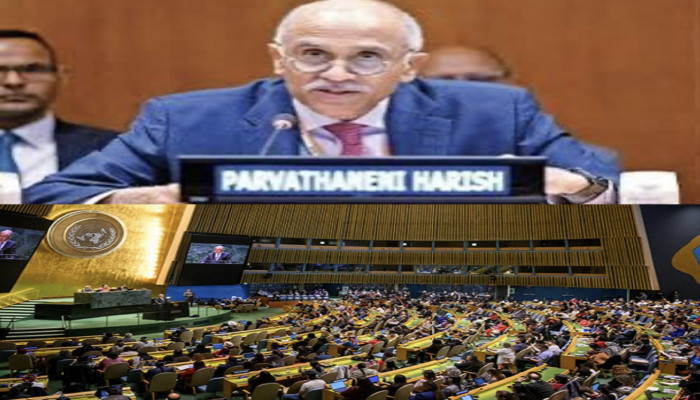
India has strongly called on the international community to take a united stand against terrorism without making any exceptions or offering any justification for such acts. Speaking at the United Nations General Assembly during the adoption of the Ninth Review of the United Nations Global Counter-Terrorism Strategy (GCTS), India's Permanent Representative to the UN, Ambassador Harish Parvathaneni, stressed that every country must reject double standards while dealing with terrorism.
Parvathaneni said India has suffered from cross-border terrorism for several decades. He highlighted the high human cost the country has faced over the years. He said, "India has been a victim of cross-border terrorism for decades. Our people have paid the price of terrorism in lives lost, families scarred, and societies shattered. This experience has shaped India's approach: there can be no justification for terrorism."
He made it clear that terrorism cannot be defended under any circumstances. He said, "Irrespective of any grievance, political cause or strategic calculation, terrorism in all its forms and manifestations must be condemned unequivocally." He urged all countries to work together against terrorism instead of allowing political interests to influence counter-terrorism efforts.
The Indian envoy said every nation has a responsibility to hold terrorists, organisers, financiers and sponsors of terrorism accountable. He asked member states to cooperate fully in identifying them and bringing them to justice. Stressing India's position, he said, "A terrorist is a terrorist!! We must work hand in hand to root out the murderous ideology without finding any grievance to justify terrorism."
India also stated that global efforts against terrorism should not lose their purpose due to false comparisons or politically motivated narratives. Parvathaneni said countries must address the conditions that help terrorism spread. At the same time, they should never use those conditions to justify terrorist acts. He said, "We must address the conditions conducive to the spread of terrorism, but we must never confuse context with justification. We must uphold human rights and the rule of law, but we must also recognise that the first human right is the right to life, and terrorism is the most direct assault on this human right."
India stressed that stopping terror financing must remain a key priority for the international community. It called for stronger financial intelligence sharing among countries and better implementation of the standards set by the Financial Action Task Force (FATF). India also urged all nations to ensure that no jurisdiction becomes a safe route for funding terrorist activities.
The country also raised concerns about the growing misuse of new and emerging technologies by terrorist groups. India said these technologies have become powerful tools for terrorists and require urgent global attention and expressed disappointment that negotiations during the latest review of the Global Counter-Terrorism Strategy failed to reach an acceptable agreement on preventing terrorists from gaining access to such technologies. According to India, this remains a major gap in international counter-terrorism efforts.
Parvathaneni noted that the latest review of the strategy comes at an important time. It marks 20 years since UN member states first adopted the Global Counter-Terrorism Strategy in 2006. He said the international community had then recognised terrorism as a serious threat to humanity and had agreed that only global cooperation could defeat it.
India also reminded the Assembly that it had proposed the Comprehensive Convention on International Terrorism (CCIT) almost a decade before the Global Counter-Terrorism Strategy came into existence. Parvathaneni said the continued absence of a universally accepted legal framework has weakened global efforts against terrorism. He explained that such a convention would help close legal gaps, strengthen prosecution and extradition, and deny terrorists and their supporters access to safe havens, financial resources and weapons.
He said, "Nearly three decades of delay have hindered our collective efforts to combat terrorism. The time has come to demonstrate political will to conclude the CCIT." India urged member states to show the necessary political commitment to finalise the long-pending convention.
The Indian envoy also highlighted India's continued contribution to global counter-terrorism initiatives. He referred to international discussions hosted by India, including the Delhi Declaration on countering the use of new and emerging technologies for terrorist purposes and the No Money for Terror Conferences. India expressed disappointment that the landmark Delhi Declaration did not find a place in the Global Counter-Terrorism Strategy in 2023. It said this omission reflected unnecessary political differences within the UN system. India added that it was unfortunate that the international community continued to tolerate such behaviour.
India also reaffirmed its stand against hatred directed at any religion or community. Parvathaneni said the country condemns all acts motivated by prejudice against any faith, ethnicity, nationality, geography or race. He said, "As this is the United Nations, a multilateral forum of universal membership, our lens too should be universal. While we condemn all acts motivated by Islamophobia, Christianophobia and antisemitism, this august body must acknowledge that such phobias extend to other faiths as well."
In his concluding remarks, Parvathaneni warned that the world would face serious consequences if countries failed to cooperate against terrorism. He stressed that success would depend on equal treatment of all terrorist groups and complete transparency in global counter-terrorism efforts. He said, "Only if we have the political will to counter it in all its manifestations; Only if there are no double standards; Only if there is no distinction between good or bad terrorists."
He further added, "Only if there is transparency and objectivity in the way sanctions regimes function to secure listings of genuine and evidence-based objective listing proposals; Only if exclusivist frameworks, new terminologies and false priorities are thwarted, could the menace of terrorism be successfully combatted by us together."



 Loading...please wait
Comments