




India-UK deepen launches new initiatives for maritime security, critical minerals cooperation
- In Reports
- 02:41 PM, Jun 05, 2026
- Myind Staff
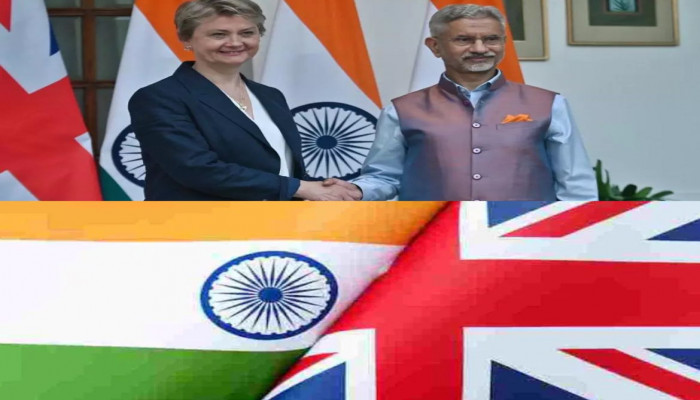
India and the United Kingdom on Thursday launched two major initiatives aimed at strengthening cooperation in maritime security and critical minerals. The announcements came as External Affairs Minister S Jaishankar and UK Home Secretary Yvette Cooper reviewed bilateral security and economic cooperation and discussed the impact of the ongoing conflict in West Asia.
The two countries signed a Memorandum of Understanding (MoU) to establish the Regional Maritime Security Centre of Excellence (RMSCE). The centre will help countries in the Indian Ocean region strengthen their ability to tackle non-traditional maritime security challenges. India and the UK also launched the India-UK Critical Minerals Global Supply Chain Observatory (GSCO), which is expected to enhance collaboration in the critical minerals sector and support the development of secure and resilient global supply chains.
Cooper arrived in India on Wednesday for her first official visit to the country. The visit followed her recent trip to China. During her stay, she held discussions with Jaishankar on the implementation of the India-UK Vision 2035 roadmap. She also met Union Coal and Mines Minister G Kishan Reddy to formally launch the GSCO.
Prime Minister Narendra Modi also met Cooper during her visit. Following the meeting, Modi said on social media that the India-UK partnership has grown significantly in recent years and created new opportunities for growth in both countries. He said, “India-UK Vision 2035 will continue to guide our partnership and strengthen our joint efforts for global good.”
Speaking at the beginning of his meeting with Cooper, Jaishankar highlighted the transformation of bilateral ties. He said the relationship had evolved beyond its historical foundations and had become a partnership focused on future opportunities. He stated that the India-UK relationship has moved from its historical roots to become a “forward-looking highway of shared economic ambitions and high technology”.
Jaishankar noted that the Comprehensive Economic and Trade Agreement (CETA) and the Defence Industrial Roadmap, both concluded last year, have created a strong foundation for a future-oriented and mutually beneficial partnership. He added that the CETA addresses important concerns related to resilient supply chains, trade, energy security and economic security.
Cooper said the bilateral relationship has “gone from strength to strength” due to the signing of CETA and continued cooperation under the five pillars of Vision 2035. These pillars focus on economic growth, technology including artificial intelligence, defence and security, climate and clean energy, and education.
She said that the partnership is advancing at a time of significant global uncertainty. According to Cooper, the two countries are working together because of their shared commitment to trade and economic security. She said this shared approach is reflected in the launch of the new maritime security and critical minerals initiatives.
The idea of creating the Regional Maritime Security Centre of Excellence was first announced in July 2025 when India and the UK adopted Vision 2035. The centre forms part of the defence and security pillar of the roadmap. It will be established through collaboration between King’s College London and the National Maritime Foundation. The initiative is also expected to strengthen cooperation under the Indo-Pacific Oceans’ Initiative.
The newly launched Critical Minerals Global Supply Chain Observatory will be supported by funding worth £1.2 million. A satellite observatory will be established at the Mining Innovation Hub of IIT-Dhanbad. According to an Indian government statement, the launch of the GSCO marks an important step in India-UK cooperation on critical minerals and supply chain resilience. It also strengthens efforts to secure essential resources required for clean energy transitions, advanced manufacturing and electric mobility.
Coal and Mines Minister G Kishan Reddy said the observatory would improve India’s ability to monitor and understand global critical mineral supply chains. He said it would support the goals of the National Critical Mineral Mission and strengthen cooperation with trusted international partners.
Cooper said greater information-sharing on critical minerals would benefit both countries and contribute to stronger supply chain security.
The GSCO is being developed as a joint initiative involving India’s Technology Innovation in Exploration and Mining Foundation (TEXMiN), IIT-Dhanbad and the University of Cambridge. The observatory will help track global critical mineral supply chains, identify risks and disruptions, and generate market intelligence for policymakers and industry stakeholders.
As part of the visit, Jaishankar and Cooper also joined Education Minister Dharmendra Pradhan at an event where the University of Liverpool received a letter of approval to establish a campus in Bengaluru. The development marks another step in expanding educational cooperation between India and the UK.
The latest initiatives underline the growing strategic partnership between the two countries. With cooperation expanding across trade, technology, defence, education and supply chain security, both sides are seeking to build a stronger and more future-focused relationship under the Vision 2035 framework.



 Loading...please wait
Comments