




India to stop excess Ravi water flow to Pakistan as Shahpur Kandi Dam nears Completion: J&K Minister
- In Reports
- 08:58 PM, Feb 16, 2026
- Myind Staff
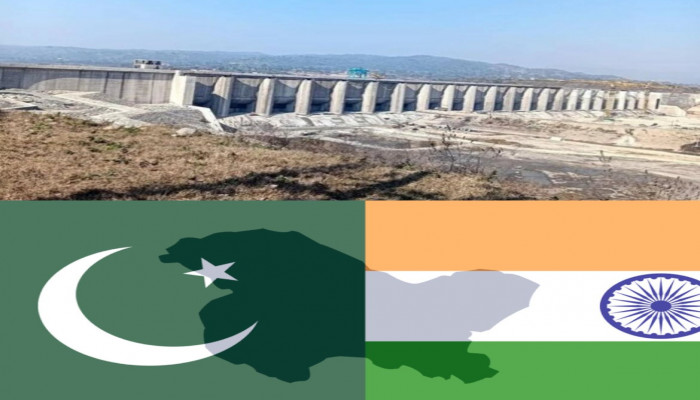
As the Indus Waters Treaty (IWT) remains suspended after the Pahalgam terror attack of April 22 last year, India is preparing to stop excess water from the Ravi River from flowing into Pakistan. This will be possible due to the Shahpur Kandi dam project, which is now close to completion.
Jammu and Kashmir Water Resources Minister Javed Ahmed Rana said the Shahpur Kandi dam, located near the Union Territory’s border with Punjab, is expected to be completed by March 31. Once the project is completed, the excess Ravi water that was earlier flowing towards Pakistan will be controlled and diverted for use within India.
Answering a question from a television channel, Rana clearly stated that the extra water going to Pakistan will be stopped. “Yes, excess water (from the Ravi River) to Pakistan will be stopped. It has to be stopped,” he said. He added that the Kathua and Samba districts in Jammu and Kashmir are drought-hit and the project is a major priority for the region. According to him, the dam is being constructed mainly to support the Kandi belt, which faces water shortages.
This development comes after India took several strong steps against Pakistan following the terror attack in Baisaran valley, Pahalgam, where 25 tourists and a local guide were killed. After the incident, Prime Minister Narendra Modi announced several punitive measures against Pakistan, including the suspension of the Indus Waters Treaty of 1960.
Following the suspension, the government also increased its focus on hydroelectric and water-related projects in the Jammu region to make better use of river waters. The Shahpur Kandi barrage, which is a national project, was revived after decades. The project was revised after nearly four decades due to the Prime Minister’s intervention.
Reports also suggest that since the Pahalgam attack, India has made steady progress on four hydroelectric power projects on the Chenab River in Jammu and Kashmir. These projects are expected to be completed and commissioned by 2027-28.
The Indus Waters Treaty, brokered by the World Bank, divided six rivers between India and Pakistan. Under the agreement, India was given control over the eastern rivers—Ravi, Beas, and Sutlej. Pakistan was given control over the western rivers—Indus, Jhelum, and Chenab. India was allowed only limited and non-consumptive use of the western rivers. The treaty has often been criticised by Indian leaders and experts as unfair and imbalanced.
The Shahpur Kandi dam project has a long history and has faced several delays. On December 6, 2018, the Union Cabinet, chaired by Prime Minister Modi approved the implementation of the Shahpur Kandi project. The Centre also provided financial support of ₹485.38 crore for the irrigation component.
Once completed, the project will create irrigation potential for around 5,000 hectares of land in Punjab and 32,173 hectares in Jammu and Kashmir, mainly in Kathua and Samba districts. This is expected to bring major relief to farmers in these areas and improve agricultural output.
The project will also help in reducing the waste of Ravi water that currently flows through the Madhopur Headworks downstream into Pakistan. Officials said the dam will allow India to store and use this water more effectively instead of letting it go unused.
In addition, the project will help in managing and regulating the water that is released for irrigation purposes in Punjab. At present, water is being released to irrigate around 1.18 lakh hectares in Punjab. After the Shahpur Kandi project is completed, this water flow can be regulated in a more efficient way.
Another major benefit of the project is hydropower generation. After completion, Punjab will be able to generate around 206 MW of electricity through this dam. This will support the state’s energy needs and reduce dependence on other power sources.
The origins of the project go back several decades. In 1979, Punjab and Jammu and Kashmir signed a bilateral agreement. Under this agreement, Punjab was responsible for constructing both the Ranjit Sagar Dam (Thein Dam) and the Shahpur Kandi Dam. The project was later approved by the Planning Commission in 2001. A revised cost was approved by the central government in 2009.
However, the project did not progress smoothly. Work was delayed due to a lack of funds from Punjab for the power component. Later, disputes between Punjab and Jammu and Kashmir also slowed down the project. Several meetings were held between both states and the Centre to resolve the issues.
Finally, in 2018, a fresh agreement was reached between Punjab and Jammu and Kashmir in Delhi. The foundation stone for the project was laid in 1995 by then Prime Minister P.V. Narasimha Rao. Later, in February 2008, the Union Ministry of Water Resources declared it a national project, showing its importance for the country.
Despite the project’s long delay, some infrastructure had already built earlier. Around 80 km of the Ravi canal and nearly 492.5 km of the distribution network in Jammu and Kashmir were constructed years ago. However, they remained unused because the barrage was not completed on time.
With the Shahpur Kandi dam now nearing completion, officials believe the project will finally start delivering benefits. It will help provide irrigation, improve water supply in drought-hit regions, regulate water use in Punjab, and also strengthen India’s ability to control its share of Ravi water.



 Loading...please wait
Comments