




India That is Bharat: Coloniality, Civilization, Constitution
- In Book Reviews
- 08:06 PM, Sep 16, 2021
- Venkataraman Ganesan
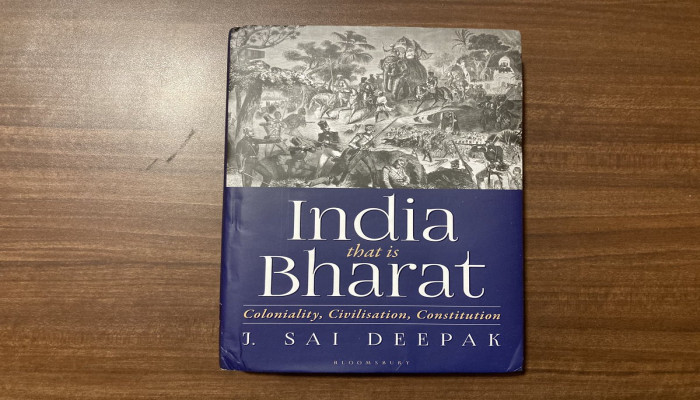
While Independence for India transcended a tangible and symbolic disentanglement from the tyrannical yoke of Colonisation, a free India found herself (and even after seven decades of freedom continues to find herself) inextricably, interminably and innately wedded to constructs having at their kernel the quintessence of colonialism. Hence an urgent and indispensable need for India as a nation represented, and continues to represent, an inculcation of a decolonial conscience rather than remaining smug in an illusory and metaphorical comfort offered by post-colonial philosophies.
We are, putting it mildly, inhabiting interesting times. A mere acknowledgment (leave alone appreciation or assertion) of our indigenous Indic roots seems to trigger a fusillade of vitriol. Commencing with labeling and stereotyping, the allegations skirt the contours of illiberalism, gird the borders of intolerance before finally concluding with perorations of conflated acculturations and imagined affiliations. Thus we have conferences and symposiums proclaiming to engage in acts of “dismantling” notions. Pseudo-scholars with shallow credentials and suspect motives ascend the Bully Pulpit from where they issue thunderous proclamations which are unfortunately laughable euphemisms for garbage.
Hence Supreme Court Advocate and practicing lawyer, J. Sai Deepak’s “India That is Bharat” comes as a timely and refreshing antidote to antiquated notions of thinking. While it would be an exaggeration to declare this book a pioneering effort at revivalism in the métier of decolonization, it is surely a surreal exercise in reclaiming lost roots. Rarely has a book appeared in contemporaneous memory, bearing within its confines import of such magnanimity and boasting as its ternary, kernels of epistemic introspection.
The book itself is compartmentalized into three sections and forms the first installment in a trilogy. The first section, titled, “Coloniality”, dwells on the rapacious nature of settler colonialism and the deliberate and calculated evisceration of the indigenous Onto-Epistemology and Theology (OET).
A carefully orchestrated substitution of the coloniser’s own values and belief system ensures more or less a total obliteration of the identity of the colonized. The pernicious impact of such a switch being the establishment of an unfortunate precedent. This precedence ensures that even after getting itself unshackled from the vice like grip of colonialism, a colonized nation charts its future economic, social and cultural trajectory based on the very same values and beliefs which it has spent an agonizingly long time in getting rid of. The colonial mindset unconsciously remains etched in the consciousness of the colonized. This is where the key tenet of “decolonization” comes into play. The author in alluding to decolonization relies on a plethora of works produce by a phalanx of decolonization scholars. Mostly hailing from the Latin and North Americas, the storied names include Anibal Quijano, Walter D. Mignolo, Sylvia Wynter, Ramon Grosfoguel, Catherine E. Walsh and Nelson Maldonado-Torres[1]. Sai Deepak distinguishes the terms Colonisation (the process), colonialism (the policy) and coloniality (a mindset that underpins colonialism) before proceeding to unravel decolonialism.
The colonizer by labeling the colonized as heathen, soul-less and of a deprecating stock, completely fails to comprehend the faith system and culture permeating the territory ripe for a ‘conquest.’ A key failing of the colonizer is to totally disregard the land-ontology or the pristine and almost sacred relationship that exists between the native and her land. A relationship based on a symbiotic reciprocity. The native exists for the land and the land in turn is benevolence personified towards the native.
The normative Western mindset, incapable of both acknowledging and respecting such relationship proceeds to mercilessly pillage the land and enslave the native. As Sai Deepak paraphrasing the book, “The Spiritual Legacy of the American Indian” by Joseph Epes Brown, writes, “their relationship with the earth was one of ‘reciprocal appropriation’, that is to give and receive, ‘in which humans participated in the landscape while at the same time they incorporated the landscape and its inhabitants into the most fundamental human experience and understanding’. The invaders, nursing a Westphalian nation state mentality and a Judeo Christian OET that places man at the pinnacle of animate and inanimate existence, not just dehumanized humanity but also objectified nature. This blatant and brazen rejection of all onto-epistemological systems that worships nature as opposed to ‘harnessing’ it led to not just a forced displacement of the indigenous education systems but also a top down imposition of Christianity and in some cases a subtle and covert ‘Christianising’ of the native faith.
The process of substituting Western OET for indigenous OET was rendered convenient due to a paucity of written records maintained by the native. Sai Deepak elucidates this arresting fact that all the tales that remained to be told once the spiritual, cultural and educational structures/architecture were razed to the ground, represented those which the colonizer deemed fit to both write and narrate. A phenomenal opportunity for the colonizer to mock the OET of the colonized as abstruse and apocryphal flights of fancy. This complete obfuscation of indigenous thought and deed completes the loop of Colonisation.
When it came to “Bharat” such attempts at obfuscation assumed menacing tones. Drawing on the theology birthed by the Protestant Reformist Movement pioneered by Martin Luther, the British placed all the civic and societal problems plaguing Bharat firmly at the doorstep of “Brahminism.” Brahminism thus became a convenient and unwitting scapegoat against which many irrelevant axes could be ground and to which, inchoate acts, attributed. This tendency, unfortunately prevails even to this day as one of most cliched phrases in social media reads, “smash Brahminical patriarchy.” Neither the individual employing this pejorative nor the one against whom this is supposedly directed has any clue as to the import of and purport behind such a scorn.
With a view to ameliorating the malevolent designs of colonialism from constantly festering in the psyche of policy making mavens and the common man alike, in any post-colonial era, decolonization attempts to “release production of knowledge from the stranglehold of the West, which could lead to greater diversity of thought and subjectivity, in particular, resurgence and re-existence of indigenous perspective.” The primary goals of decolonization as articulated by Sai Deepak include an untethering from the moorings of identity politics and a conclusive escape from the entrenched dogmas of exclusionary ethnocentrism (race) which otherwise constituted the bulwark of colonialism.
Section 2 of the book bearing the heading “Civilisation” strives to demonstrate how Bharat’s consciousness was impacted during the nation’s prolonged tryst with colonialism, coloniality and Colonisation. In arriving at informed conclusions and educated opinions, Sai Deepak draws liberally from the works of Dr. Balagangadhara, Professor emeritus of the Ghent University in Belgium, and former Director of the India Platform and the Research Centre Vergelijkende Cutuurwetenschap (Comparative Science of Cultures), and Dr. Jakob De Roover, a member of the international research group Comparative Science of Cultures and an Assistant Professor at Ghent University, Belgium.
Sai Deepak while calling bunkum the Marxian notion of colonialism aiding and abetting development within the country by way of establishing rail links etc, does not devote much space for rebutting this reformist nature of arguments. The intrepid and the intrigued may refer to the brilliant book “Inglorious Empire” by Shashi Tharoor[2], for an illuminating discussion and dissection of the subject. Instead, Sai Deepak concentrates on the tools of “subalternalism” employed by the British to create divisions and fissures within the indigenous subconsciousness.
Sai Deepak also vociferously strives to nullify the proposition that India did not possess an identity as a nation state prior to the Sepoy Mutiny of 1857. This antiquarian fallacy has received amplification from many Western scholars such as the likes of John Strachey who averred that ‘there is not and never was an India, or even any country of India, possessing, according to European ideas, any sort of unity, physical or political’. The polarization or schisms associated with such a controversial postulation may be gauged by contrasting opinions espoused by other Western authorities and Indologists. For example, Vincent Arthur Smith and George Chisholm boldly claim “India, encircled as she is by seas and mountains, is indisputably a geographical unit, and as such is rightly designated by one name...”
The British, Sai Deepak argues, proceeded to systematically promulgate a series of statutes and legislations, which while outwardly giving the veneer of liberalism, were in fact devious mechanisms to strip the last vestiges of indigeneity characterizing the fabric of pre-Independence India. The colonizers seem to have succeeded beyond their own imagination even. The colonial mind set had taken such a deep rooted seating in the minds of a predominant segment of the colonized that even after Independence, the burnished language of colonialism remained intact, alive and well. Justifying the encroachment into Indian land and usurpation of sacred Indian territory by the adventurous Chinese, the first Prime Minister of India, Jawaharlal Nehru, incredulously said that the land occupied by the Chinese was where not a single blade of grass grew thereby rendering the geography useless and uninhabitable. There cannot be a more searing example of the sacred land ontology being elided out of the human consciousness.
Clergymen and zealots in the garb of missionaries also played their bit exemplarily well in endeavouring to eviscerate the Indic OET from the colonized land. Claudius Buchanan a Scottish clergyman credited with corruption of the word “Jagannath” to “juggernaut”, portrayed Hinduism as a ‘bloody, violent, superstitious and backward religious system’, which required an immediate ‘social reform’. Brahmins again were the favourite whipping boys against whom cudgels could be wielded with gay abandon and elan. Conflating the Devadasi tradition with prostitution, the Britishers equated temples with parlaying prostitution and hence vociferously advocated a state takeover of the management and affairs of the temples. This debauched caricature of Brahminism and Brahmins was even categorised under a convenient and esoteric term ‘priestcraft’.
The sad and unfortunate precedent of unwarranted, unnecessary and unacceptable interference with the religious practices representing an Indic EOT continues to this day with many Governments in states such as Tamil Nadu, Karnataka and Andhra Pradesh going to illogical lengths by enacting the Hindu Religious and Charitable Endowments Regulations. These statutes provide unfettered powers to the State Government to assume the control, management, affairs and assets of only Hindu temples. Interestingly Sai Deepak himself is at the forefront of a litigation against these draconian and anti-diluvian measures and the matter currently is pending adjudication by the Apex Court.
The dangerous lengths to which even the colonized embraced the EOT representing a normative Western framework is highlighted in chilling fashion by Sai Deepak by reproducing a letter issued by the founder of the Brahmo Samaj, Raja Ram Mohun Roy, to the then Governor-General in Council, bemoaning the British intent to establish a Sanskrit educational institution. While the abuse of a venerable language such as Sanskrit by ignorant, perverted elitists such as Thomas Babington Macaulay should come as no surprise to anyone possessing even a shard of literacy, it is downright lamentable, that a person of the stature of Mohun Roy protesting and railing against the language. The reasons proffered are also ludicrous shameful. “The Sangscrit language, so difficult that almost a lifetime is necessary for its perfect acquisition, is well known to have been for ages, a lamentable check for the diffusion of knowledge; and the learning concealed under this almost impervious veil is far from sufficient to reward the labour for acquiring it…Again, no essential benefit can be derived by the student of Meemangsa from knowledge what it is that makes the killer of a goat sinless on pronouncing certain passages of the Veds, and what is the real nature and operative influence of passages of the Ved, etc.”
It is a totally different matter altogether that there were more insidious motives for establishing an institution engaged in imparting the secrets of a vernacular language, such as obscuring and veil the more urgent need for proselytization and conversion by appealing to not just the allure of a native language but also to the innocence of an unsuspecting populace.
The final part of the book traces the events leading to the establishment of the Government of India Act, 1919, the first concrete legislation that mulled the drafting of a Constitution for India with the objective of paving the way for self-governance. Even this exertion had at its underpinning a universalized, harmonised and customized Western standard of civilization that deemed Indic EOT as mainly rooted in bias, prejudices and superstitions. The Montagu-Chelmsford Reforms in fact had the temerity and gall to propose that unless and until India confirmed to such universalized tenets, deemed to be a vital pre-requisite for a ‘civilised’ nation it would be deemed ‘unready’ for governance. This absurd notion received a stinging rebuke from the lambent Lala Lajpat Rai.
This section is particularly relevant in the context of recently enacted legislations such as the abrogation of Article 370 of the Indian Constitution, enactment of the CAA/NRC legislation etc. The reactions to the passing of these Bills have ranged from the sublime to the silly and asinine to the alarming. But they have all signified one unmistakable truth – that the attribute of colonialism is not just a detritus or a residue influencing the thought process of our nation. It is a powerful, pulsating and possessing force exercising and exerting its influence in a myriad of ways, overt and covert.
The research undergirding the book is exhausting and humongous. The sources mined are diverse and it comes as no surprise that the notes to the book are capable of constituting a stand-alone block of precocious resources for further embellishing and distilling one’s knowledge in the domains of decolonization and Indic OET. The fact that Sai Deepak is an autodidact in so far as this sphere of knowledge goes, makes it all the more fascinating. Sai Deepak also brings to bear his enviable experience in the field of Constitutional Law and his involvement with some of the most controversial and path breaking cases that have warranted the attention of the Apex Court in recent times, such as the Sabarimala Case and the HRCE Rulings.
“India That is Bharat” - Rapturous in sweep; reverberating in wake!
- An illustrative listing of the works of these scholars as appearing in the book itself is as set out herein below: 1. Designs for the Pluriverse: Radical Interdependence, Autonomy, and the Making of Worlds (New Ecologies for the Twenty-First Century) - Arturo Escobar; 2. Encountering Development: The Making and Unmaking of the Third World (Princeton Studies in Culture/Power/History, 1) - Arturo Escobar; 3. On Decoloniality: Concepts, Analytics, Praxis - Walter Mignolo & Catherine E. Walsh; 4. The Darker Side of Western Modernity: Global Futures, Decolonial Options (Latin America Otherwise) - Walter Mignolo.
- https://www.amazon.com/Inglorious-Empire-what-British-India-ebook/dp/B073VWW2DV/ref=sr_1_1?crid=3N41SKOSP5ALT&dchild=1&keywords=inglorious+empire+by+shashi+tharoor&qid=1631798353&sprefix=Inglorious+empire+%2Caps%2C388&sr=8-1
Image source: Trendsmap



 Loading...please wait
Comments