




India successfully tests indigenous TARA glide weapon to boost precision strike capability
- In Reports
- 05:09 PM, May 08, 2026
- Myind Staff
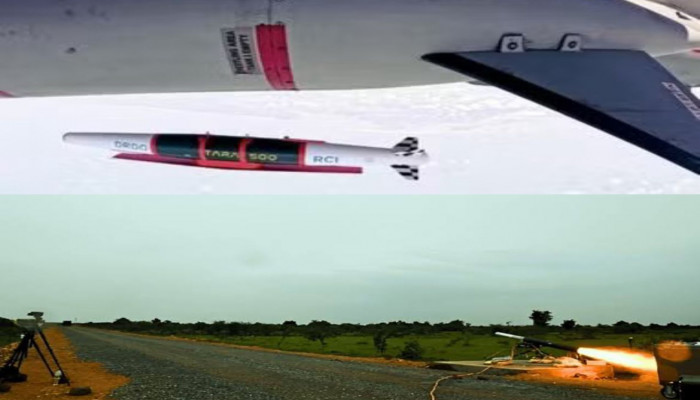
India has successfully carried out the maiden flight-trial of the indigenous Tactical Advanced Range Augmentation (TARA) weapon system off the coast of the Bay of Bengal in Odisha. The successful test marks a major step in strengthening the country’s indigenous defence capabilities and improving the Indian Air Force’s stand-off precision strike power with a low-cost smart weapon system.
The trial took place exactly one year after Operation Sindoor, which had signalled a major shift in India’s military doctrine towards stand-off precision warfare. Defence officials said the latest test demonstrates another important advancement in India’s growing strike capability developed within the country.
The flight trial was conducted in coordination with the Indian Air Force using an airborne platform. According to a defence official, “this first test validated not only the aerodynamic performance of the winged glide configuration but also the navigation, guidance and control architecture of the weapon,” a defence official told Business Standard.
TARA has been developed as a modular range extension kit equipped with fibre-optic gyro-based inertial navigation, multi-GNSS guidance and an electro-optical or imaging infrared terminal seeker. The system allows combat aircraft to hit high-value enemy ground targets from safer stand-off distances with high accuracy.
The Ministry of Defence stated that TARA was designed and developed by Hyderabad-based Research Centre Imarat along with other laboratories of the Defence Research and Development Organisation. It is India’s first indigenous modular glide weapon capable of converting conventional unguided warheads into long-range precision-guided weapons.
Officials described the successful trial as a significant milestone in India’s effort to build affordable and highly effective precision-strike systems domestically. The weapon is expected to improve the operational reach, accuracy and lethality of existing aerial munitions used by the Indian Air Force.
A defence scientist said, “TARA is the first glide weapon to utilise state-of-the-art low-cost systems. It will provide the IAF with the ability to engage strategic and tactical targets with significantly higher precision while reducing exposure of pilots and aircraft to enemy radar-guided missile systems.”
Scientists also highlighted the importance of the electro-optical and imaging-infrared terminal guidance systems. According to him, these systems can help identify targets even in difficult electronic warfare situations where satellite navigation systems may be jammed or disrupted.
Defence experts believe the successful test reflects India’s attempt to absorb lessons from recent high-intensity conflicts across the world, where precision-guided glide munitions have become critical force multipliers on the battlefield.
Former Indian Air Force officer, N K Samal said, “Modern battlefields demand the ability to strike hardened infrastructure, logistics nodes, radar stations, command centres and different formations from outside adversarial engagement envelopes. TARA addresses these requirements by giving the IAF an indigenous low-cost stand-off strike option that can be produced at scale.”
The weapon system has already entered the manufacturing stage, which could help speed up its operational induction into the armed forces. Production work is currently underway with development-cum-production partners and other Indian industries.
Samir V Kamat, Secretary of the Department of Defence R&D and Chairman of DRDO, congratulated the scientists, engineers, Indian Air Force personnel and industry partners involved in the successful trial. Defence Minister Rajnath Singh described the maiden flight trial as an important advancement in India’s indigenous defence capabilities.
TARA has been designed as an air-launched, long-range stand-off air-to-ground precision weapon. Its main role is to convert conventional unguided bombs into smart glide munitions. The system can travel towards targets at speeds exceeding 650 kilometres per hour. It also uses rear-actuated fins that allow the weapon to perform complex manoeuvres during the terminal phase before impact.
Sources said the weapon will come in multiple variants. The TARA-250 version weighs around 308 kilograms, while the TARA-450 and TARA-500 variants weigh nearly 546 kilograms. The glide and guidance kit itself weighs around 98 kilograms. This allows the system to be integrated with existing bomb inventories without requiring major structural changes.
The weapon has been developed for deployment from combat aircraft operating at altitudes ranging from 10,000 feet to 45,000 feet. This enables strike missions from medium and high-altitude profiles. TARA can also be integrated with advanced combat aircraft such as the Sukhoi Su-30MKI and HAL Tejas.
The stand-off range of the smart bomb is more than 80 kilometres. This allows fighter aircraft to engage enemy ground targets while remaining outside frontline air-defence zones.
In terms of accuracy, the uncooled imaging infrared seeker-based variant reportedly delivers a circular error probability of less than three metres. This provides near-pinpoint strike capability against fixed and high-value targets.
The system also includes advanced electronic protection features such as anti-jamming, anti-spoofing and “drop-and-forget” capability. These features allow the weapon to independently navigate towards its target even in contested electronic warfare environments.
Officials said the weapon currently has two separate guidance configurations — INGPS-based and electro-optical seeker-based. Production of the system is already underway. Defence sources added, “It can be comparable to globally proven stand-off precision weapons such as SPICE-1000 of Israel and Hammer of France.”



 Loading...please wait
Comments