



India strongly rebuts Pakistan’s Remarks on Kashmir & Ladakh at UNSC debate
- In Reports
- 12:00 PM, Dec 16, 2025
- Myind Staff
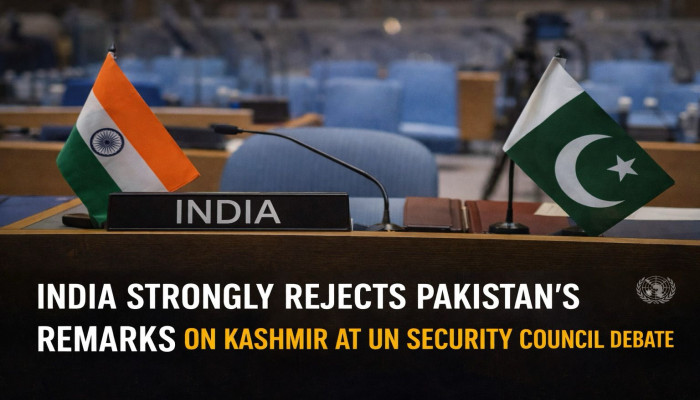
In a firm response on Monday, India strongly rejected Pakistan’s reference to the issue of Jammu & Kashmir and Ladakh during an open debate at the United Nations Security Council (UNSC), saying the two Union Territories are an integral and permanent part of the country and will always remain so.
India’s response came during an open discussion in the UNSC session on “Leadership for Peace,” a platform where countries speak about global peace and security. Pakistan’s remarks earlier in the debate had brought up the long-standing dispute over Jammu & Kashmir, prompting New Delhi to issue a detailed rebuttal.
India’s Permanent Representative to the United Nations, Ambassador Harish Parvathaneni, took the floor to respond to Pakistan’s comments. He described Pakistan’s repeated focus on the Kashmir issue as “obsessive” and harmful, and made India’s position very clear.
Ambassador Parvathaneni said, “I refer to the statement made by the representative of Pakistan today. India would like to reiterate that the Union Territories of Jammu & Kashmir and Ladakh are an integral and inalienable part of India. They were, are, and will always remain so.”
He emphasised that what Pakistan chose to raise in the debate was not only unwarranted but also reflected a constant attempt to harm India’s interests, rather than a genuine concern for global peace.
Parvathaneni also criticised Pakistan’s behaviour in global forums, saying that continuing to promote a divisive agenda was not the role expected of a nation serving on the Security Council.
Apart from countering Pakistan’s reference to the Kashmir issue, India also took the opportunity to highlight what it called Pakistan’s failure to address terrorism and its internal political issues. The Indian envoy pointed out that Pakistan had repeatedly condoned or supported terror activities that affected India. He referred to the deadly Pahalgam terror attack of April 2025, in which 26 innocent civilians were killed, saying that the attack involved religion-based targeted killings carried out by terrorists supported from across the border.
Parvathaneni said that India had endured tens of thousands of deaths over the past four decades due to what it believes is Pakistan-sponsored terrorism. This was part of India’s broader criticism of Islamabad’s approach to cross-border militancy.
India also referred to the Indus Waters Treaty, a water-sharing agreement between India and Pakistan that has existed for decades. The ambassador noted that India had signed the treaty in good faith and friendship, but said Pakistan had violated the spirit of the agreement over time, largely because of repeated wars and support for terrorism. In this context, India explained that it had decided to hold the treaty in abeyance, meaning temporarily suspended until Pakistan made credible and irreversible commitments to stop supporting terrorism.
India did not limit itself to only the Kashmir dispute and terrorism. It also brought up Pakistan’s domestic political situation, which it said was marked by instability and a lack of democratic norms.
Ambassador Parvathaneni mentioned that Pakistan’s government had jailed former Prime Minister Imran Khan and introduced constitutional changes that gave lifetime immunity to General Asim Munir, the chief of Pakistan’s armed forces. According to India’s statement, these actions showed a lack of respect for governance and judicial independence.
The Indian representative said: “Pakistan, of course, has a unique way of respecting the will of its people by jailing a Prime Minister, by banning the ruling political party and by letting its armed forces engineer a constitutional coup through the 27th amendment and giving lifetime immunity to its Chief of Defence Forces.”
This criticism highlighted India’s broader concerns about the rule of law and democratic processes in Pakistan, contrasting them with its own political framework.
India made it clear that it would continue to counter Pakistan-sponsored terrorism in all its forms and manifestations. The statement reaffirmed New Delhi’s commitment to fight terrorism and protect its citizens, emphasising that terrorism remains a serious threat and must be addressed firmly.
India also reiterated that disputes between the two countries should be resolved through direct dialogue within agreed frameworks, without internationalising bilateral issues or using global platforms for political leverage.



 Loading...please wait
Comments