




India, South Korea expand cooperation in defence, cybersecurity, military training
- In Reports
- 01:09 PM, May 21, 2026
- Myind Staff
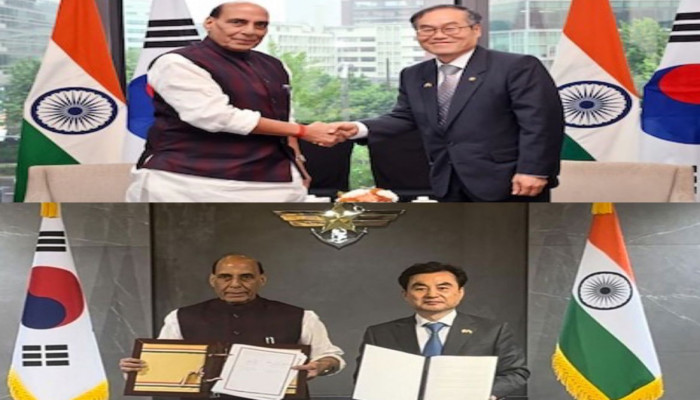
India and South Korea on Wednesday expanded their defence partnership by signing a series of agreements aimed at increasing cooperation in defence, cybersecurity, military training and United Nations peacekeeping operations during talks between Defence Minister Rajnath Singh and his South Korean counterpart Ahn Gyu-back in Seoul.
The discussions focused on strengthening ties in defence production, maritime security, military exchanges, logistics, emerging technologies and regional security. According to the Indian defence ministry, both countries recognised the growing alignment between India’s Act East Policy and South Korea’s regional strategic vision. They also reaffirmed their commitment to building stronger defence ties while supporting a “free, open, inclusive and rules-based Indo-Pacific”.
The Indo-Pacific region continues to face strategic challenges, especially due to China’s growing attempts to expand its influence. India has repeatedly stressed the importance of resolving disputes peacefully through dialogue and in accordance with international laws.
The agreements signed during the meeting reflected the widening scope of cooperation between the two countries. One of the important agreements focused on training cooperation between India’s National Defence College and the Korea National Defence University.
Rajnath Singh, who arrived in Seoul on Tuesday for a two-day visit, also met Lee Yong-cheol, the Korean Minister of Defence Acquisition Programme Administration (DAPA). During the meeting, both sides discussed increasing cooperation in defence manufacturing and military technology.
The defence ministry said, “Both leaders agreed to harness their symbiotic efforts to create avenues for joint development, production, and export (of military hardware). A roadmap to unlock the potential of the India-Korea Defence Innovation Accelerator Ecosystem to synergise the innovation ecosystems of the two countries was discussed.”
Later in the day, Singh chaired the India-South Korea defence industry business roundtable in Seoul. The meeting brought together senior government officials and representatives from leading defence companies of both countries. The interaction focused on new opportunities in defence manufacturing, co-development and co-production of military equipment, along with supply chain partnerships.
During the roundtable, Singh invited South Korean defence companies to increase collaboration with Indian firms and build long-term partnerships. He highlighted the success of industrial cooperation between India and South Korea in the commercial sector and said the same model can now be expanded into defence manufacturing.
He said, “The time has now come to extend this successful model into the defence sector, where technology, innovation, manufacturing capability, and strategic trust are becoming increasingly interconnected. Korea’s technological excellence, combined with India’s scale, talent, manufacturing ecosystem, and innovation capabilities, creates a powerful foundation for cooperation. Together, our two countries can jointly develop and produce advanced technologies and defence systems for the future. Trusted partnerships between technologically capable nations acquire immense strategic importance. India and South Korea are uniquely positioned to work together in this changing global landscape.”
Singh also underlined how defence manufacturing is rapidly changing beyond traditional weapons and military platforms. He said modern defence systems are now driven by advanced technologies such as artificial intelligence, autonomous systems, cyber technologies, sensors, semiconductors, quantum technologies, advanced materials and space-based capabilities.
According to Singh, the future of defence preparedness will depend heavily on the ability to innovate quickly and integrate technologies across different sectors. His remarks reflected India’s increasing push towards modernisation and technology-driven defence capabilities.
The defence minister also referred to Operation Sindoor and described it as a sign of India’s transformation into a “strong, confident and capable nation”. He said the operation demonstrated India’s firm position against terrorism and made it clear that the country would not tolerate terrorism in any form.
Speaking on India’s nuclear policy, Singh said, “The operation was proof that India will not tolerate terrorism in any form. As a responsible nuclear power, we firmly adhere to a ‘No First Use’ policy. However, there are times when people mistake our restraint and commitment to peace for weakness. While India remains committed to its ‘No First Use’ policy, it will not tolerate any form of nuclear blackmail. This is New India.”
The visit and the agreements signed in Seoul are being seen as another important step in strengthening strategic ties between India and South Korea. Both countries are now looking to deepen cooperation not only in defence and security, but also in technology, innovation and military manufacturing as the Indo-Pacific region continues to gain strategic importance.



 Loading...please wait
Comments