



India slashes solar imports from China as domestic manufacturing thrives
- In Reports
- 12:44 PM, Sep 14, 2023
- Myind Staff
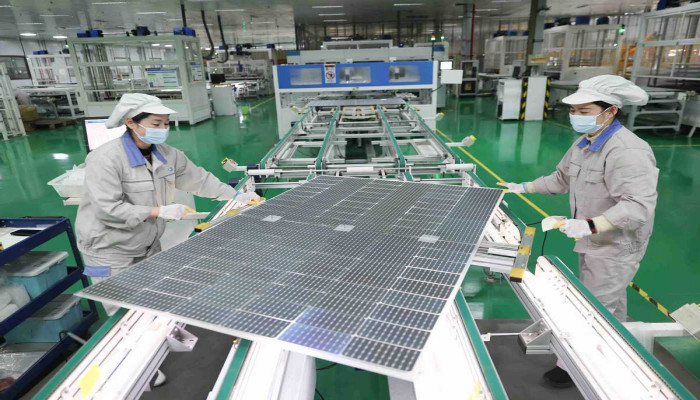
Diverging from prevailing global patterns, India has witnessed a significant 76 percent decline in its imports of solar modules from China during the first half of 2023, underscoring New Delhi's unwavering commitment to achieving self-sufficiency in solar manufacturing. This pivotal shift in strategy is detailed in a recent report by the global energy think tank Ember.
Comparing year-on-year data, India's solar module imports from China have nosedived from 9.8 GW in the initial half of 2022 to a mere 2.3 GW during the corresponding period in 2023, as revealed by the Ember report.
This strategic transformation, coupled with the imposition of tariffs, exemplifies India's resolute determination to reduce its reliance on imports while giving paramount importance to fostering the growth of its domestic manufacturing capabilities.
An India Electricity Policy Analyst at Ember, Neshwin Rodrigues, said, "India's dependence on China for solar module imports is well and truly reducing post-2022. Domestic manufacturing is gaining momentum, thanks to recent policy interventions."
"As India edges closer to self-sufficiency in solar manufacturing, reliance on Chinese modules and cells is no longer a constraint. What's crucial now is creating an enabling policy environment to ensure that solar installations keep pace with the National Electricity Plan," he said.
Commencing in April 2022, India initiated the imposition of a 40 percent customs duty on solar modules and a 25 percent duty on solar cells. This strategic move aimed to curtail imports and invigorate domestic manufacturing.
India's dedication to diminishing import reliance while fostering a resilient domestic solar manufacturing sector is in harmony with the nation's overarching objectives of sustainability and achieving energy self-sufficiency.
According to its recently updated nationally determined contributions (NDCs), outlining national strategies to curb global warming to 1.5 degrees Celsius, India has pledged to achieve a remarkable 500 GW of installed power capacity sourced from non-fossil fuel-based resources by 2030, with a particular emphasis on solar energy.
Furthermore, a report reveals that China's solar panel exports surged by an impressive 3 percent during the initial half of 2023, culminating in a total of 114 GW shipped worldwide. This substantial increase is noteworthy when compared to the 85 GW exported during the same period in the preceding year.
Sam Hawkins, the data lead at Ember, remarked, "Solar growth is experiencing exponential expansion." China's dominant presence in the solar panel manufacturing sector, encompassing approximately 80 percent of the global market share, carries significant global implications.
During the first half of 2023, more than half of China's solar module exports, totaling 52.5 percent were directed toward Europe. Europe registered the most significant absolute growth globally, with Chinese exports surging by 47 percent year-on-year (21 GW), reaching a total of 65 GW compared to 44 GW in the same period the previous year.
However, the most rapid expansion occurred in Africa and the Middle East, notably with South Africa witnessing a remarkable 438 percent increase (2.7 GW) in solar panel imports from China during the first half of 2023 compared to the same period last year.
Africa's solar panel imports from China, bolstered by a 187 percent surge (3.7 GW), propelled the continent to become the fastest-growing region. Subsequently, the Middle East witnessed a substantial 64 percent growth (2.4 GW) in solar panel imports from China during the first half of 2023, compared to the previous year.
Despite the surge in solar panel exports, a global gap between exports and installed PV capacity is widening, primarily due to module stockpiling and challenges in installation and grid integration.
Sam Hawkins, Ember's data lead, emphasized the urgency of accelerating installation and grid integration to align with the growing module supply, stating, "We have sufficient solar panels; now, we must expedite their installation." He called for policies prioritizing rapid scaling in these areas to match the expanding module supply.
Image source: AP



 Loading...please wait
Comments