




India slams Pakistan at UNSC, cites 1971 genocide and Kabul airstrike during Ramadan
- In Reports
- 01:08 PM, May 21, 2026
- Myind Staff
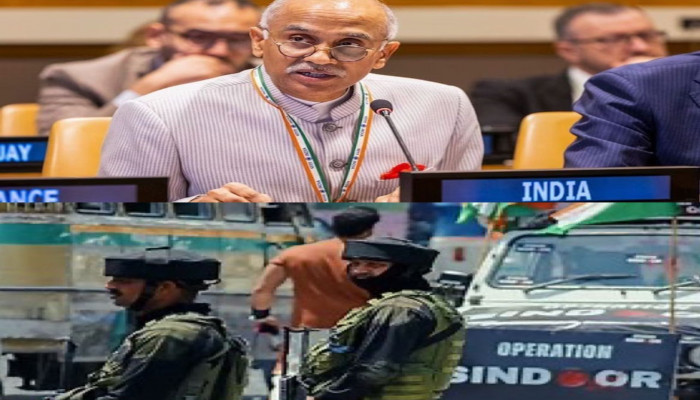
India strongly criticised Pakistan at the United Nations Security Council on Wednesday after Islamabad raised the issue of Jammu and Kashmir during an open debate on the protection of civilians in armed conflict. India said it was “ironic” that Pakistan was trying to lecture others on human rights and civilian protection despite what New Delhi described as its own history of violence, military aggression and genocidal acts.
India’s Permanent Representative to the UN, Harish Parvathaneni, delivered a sharp response during the annual UNSC debate. His remarks came after Pakistan’s representative referred to Jammu and Kashmir in the discussion.
Parvathaneni rejected Pakistan’s comments and said, “It is ironic that Pakistan, with its long-tainted record of genocidal acts, has chosen to refer to issues that are strictly internal to India.” India maintained that Jammu and Kashmir remains an internal matter and accused Pakistan of repeatedly trying to internationalise the issue at global forums.
The Indian envoy said Pakistan had a long history of using violence to divert attention from its own domestic failures. He stated that Pakistan’s actions over the years reflected a pattern of aggression both within its own borders and beyond them. According to India, such behaviour weakened Pakistan’s attempts to speak about international law or civilian safety.
Parvathaneni also referred to Pakistan’s reported airstrikes in Afghanistan earlier this year. He said the attacks showed Pakistan’s disregard for civilian lives. Referring to the incident in Kabul, he said, “The world has not forgotten that it was during the holy month of Ramadan in March this year, at a time of peace, reflection, and mercy, that Pakistan conducted a barbaric airstrike on the Omid Addiction Treatment Hospital in Kabul.”
He further said the attack targeted a civilian facility that could not be considered a military site under any circumstances. Citing findings from the United Nations Assistance Mission in Afghanistan (UNAMA), Parvathaneni said, “This cowardly and unconscionable act of violence claimed the lives of 269 civilians and injured a further 122 in a facility which can by no means be justified as a military target.”
According to UNAMA, the strikes took place shortly after tarawih evening prayers during Ramadan. Many patients were reportedly leaving the masjid at the time of the attack. India used the UN findings to argue that the incident reflected Pakistan’s continued disregard for civilian safety during military operations.
The Indian envoy also said the violence had caused large-scale displacement in Afghanistan. Referring again to UNAMA’s assessment, he stated that more than 94,000 people were displaced due to cross-border armed violence carried out against Afghan civilians. India argued that such actions were proof of Pakistan’s repeated involvement in activities that harmed innocent people.
Parvathaneni accused Pakistan of hypocrisy for speaking about international law while allegedly targeting civilians. He said it was “hypocritical” for Pakistan to talk about humanitarian values after carrying out attacks “targeting innocent civilians in the dark.” India said Pakistan’s statements at the UNSC lacked credibility because of its own record.
The Indian representative also referred to the events of 1971 during Operation Searchlight, when the Pakistani military carried out a crackdown in East Pakistan, now Bangladesh. He alleged that Pakistan’s army had sanctioned mass atrocities during the operation. Parvathaneni said Pakistan had carried out “a systematic campaign of genocidal mass rape of 400,000 women by its own army during Operation Searchlight in 1971.”
India said these historical events showed why Pakistan’s criticism of other countries on civilian protection and human rights could not be taken seriously. The intervention at the UNSC largely focused on countering Pakistan’s references to Jammu and Kashmir and highlighting what India described as Pakistan’s own record of violence and aggression.
The exchange once again reflected the continuing tensions between India and Pakistan at international forums. Both countries have frequently clashed at the United Nations over Kashmir and regional security issues. India has consistently maintained that Jammu and Kashmir is an internal matter and has opposed any attempts by Pakistan to raise the issue globally.



 Loading...please wait
Comments