




India signs Pax Silica declaration, joins US-led alliance on AI, critical minerals
- In Reports
- 07:09 PM, Feb 20, 2026
- Myind Staff
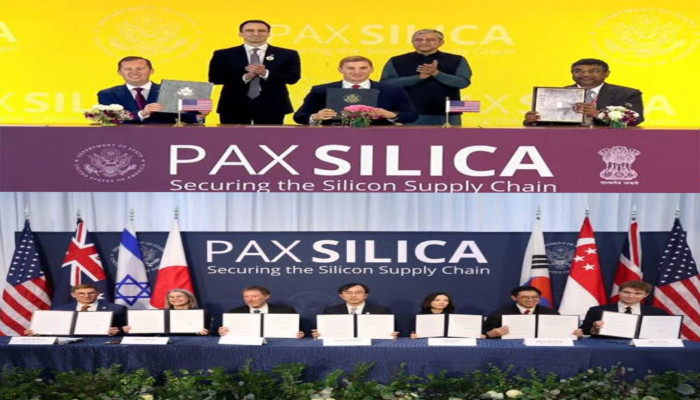
India on Friday signed a declaration to formally join the US-led strategic alliance called “Pax Silica.” The move is aimed at strengthening secure and resilient supply chains for critical minerals and artificial intelligence (AI), while also reducing dependence on China’s dominance in rare earth elements.
The declaration was signed during the ongoing India AI Impact Summit in New Delhi. With this step, India has officially entered a framework that focuses on building a secure, resilient, and innovation-driven supply chain for critical minerals and AI. The alliance seeks to increase technological cooperation among partner countries and ensure reliable access to key resources that are essential for next-generation industries.
India’s participation in Pax Silica comes at a time when New Delhi and Washington are working to finalise a proposed trade deal and strengthen several other initiatives to deepen bilateral ties. This follows a period of strain in relations between the two countries.
Union Minister for Electronics and Information Technology Ashwini Vaishnaw spoke after signing the pact and highlighted its importance for India’s technology sector. He said, "India has become a part of the Pax Silica. This will greatly benefit India's electronics and semiconductor industry. Ten plants are already established in India and are in the process of being established, and very soon, the first semiconductor plant will begin commercial production. A complete ecosystem is emerging in India. Pax Silica will be crucial for this, and the youth of India will benefit from it."
US Ambassador Sergio Gor also described the initiative as a strategic coalition between India and the United States that aims to shape the 21st-century economic and technological order. He said India’s participation was “strategic and essential,” pointing to its engineering talent, progress in mineral processing, and growing role in strengthening US-India technology cooperation. He added that the partnership aims to advance trusted AI globally and emphasised that “peace comes through strength."
Speaking about the trade deal that both countries have already finalised, Ambassador Gor said, "The signing will happen very soon".
He further explained, "In fact, even this week, we have both teams talking to each other and actively getting to a place where both will be able to sign. But the reality is, there are tens of thousands of ways that we're not dealing with a small country. This is one of the biggest economies. And so we're thrilled that the interim deal is done. You have a few tweaking points that are left to do, but it's done. So the signing will happen sooner than later."
Pax Silica was first launched in December last year at a summit held in Washington. The partner nations in the alliance include Australia, Greece, Israel, Japan, Qatar, the Republic of Korea, Singapore, the United Arab Emirates, and the United Kingdom. With India joining, the alliance expands its global reach.
The declaration signed by India outlines a shared vision among partner countries for deeper economic and technological cooperation. This cooperation will cover the entire supply chain — from raw materials and mineral extraction to semiconductor manufacturing and AI infrastructure. The agreement also stresses a commitment to mutual prosperity and security. One of the main goals of Pax Silica is to create a durable economic framework that supports AI-powered growth across all partner nations.
Last month, Ambassador Gor announced an invitation for India to join this strategic alliance. India’s acceptance of the invitation shows its growing role in global technology and mineral supply chains.
Pax Silica is designed to secure the global supply chain for artificial intelligence and semiconductors. It represents a shift from the 20th-century economic model that was heavily dependent on oil and steel to a new economy powered by silicon and critical minerals.
The term “Pax” comes from the Latin word for peace, reflecting the alliance’s vision of global stability through secure and trusted technology. “Silica” refers to the mineral that forms the basic building block of computer chips and AI systems.
The alliance is spearheaded by US Under Secretary for Economic Affairs Jacob Helberg. Its main objective is to create a “trusted” alternative to the current ecosystem, which is largely dominated by China. At present, China controls a significant share of the global rare earth element (REE) processing industry.
Reducing global dependence on China is a key focus of Pax Silica. The alliance also aims to prevent supply chain disruptions like those seen in the automobile industry during geopolitical tensions or due to the possible “weaponisation” of minerals. By building a secure and diversified supply network, member countries hope to avoid such risks in the future.
Pax Silica plans to cover the entire technology lifecycle. This includes mineral extraction, refining, semiconductor fabrication, software platforms, and the development of advanced AI models. By coordinating across all these stages, the alliance aims to create a stable and reliable system for technology development.
For India, the initiative is seen as highly important. India is viewed as a crucial partner in Pax Silica because of its large pool of skilled engineers and its largely untapped mineral resources. Joining the alliance could help India reduce its heavy dependence on China for rare earth imports. Currently, China accounts for about 93 per cent of India’s rare earth imports.
Participation in Pax Silica could also open doors for stronger partnerships with technology leaders such as Japan and the Netherlands, especially in advanced mineral processing and chip manufacturing. This aligns closely with India’s National Critical Mineral Mission and the India Semiconductor Mission, both of which aim to boost domestic production and increase technological self-reliance.
By becoming part of Pax Silica, India strengthens its position in the global technology ecosystem. The move is expected to support the growth of its electronics and semiconductor industries, create opportunities for young professionals, and contribute to building secure and resilient global supply chains for the future.



 Loading...please wait
Comments