




India rejects US Congressman’s FCRA concerns, says foreign funding rules are a domestic matter
- In Reports
- 07:34 PM, Aug 07, 2026
- Myind Staff
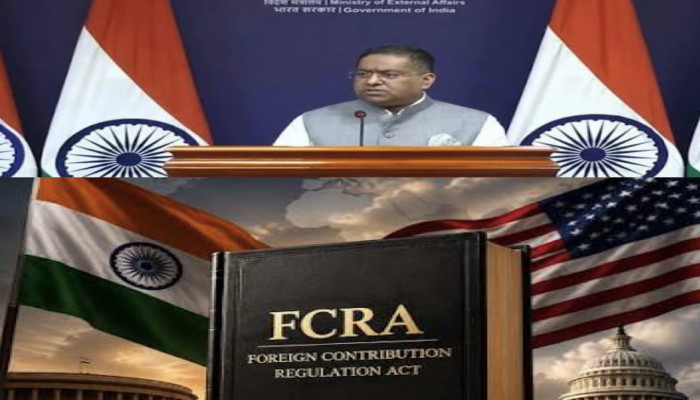
The Ministry of External Affairs (MEA) has rejected criticism from US Congressman Riley Moore over the proposed Foreign Contribution (Regulation) Amendment Bill, 2026. The government said the proposed changes are part of India’s domestic legislative process. It also pointed out that countries such as the United States have their own laws to regulate foreign funding.
The MEA responded to Moore’s remarks days after the Republican representative from West Virginia raised concerns over the proposed amendments. Moore had described the changes as a "clear attack against Christians" and warned that they could have an adverse impact on India-US bilateral relations.
Responding to media queries on Thursday, MEA spokesperson Randhir Jaiswal said India follows an established democratic process to frame its laws. He stressed that domestic legislation should be understood in the right legal and constitutional context. Jaiswal also noted that several countries, including the US, have legal frameworks to regulate foreign contributions received by organisations.
The MEA’s response is the first official reaction from the Indian government to Moore’s criticism. It underlines New Delhi’s position that decisions on domestic legislation fall within India’s internal affairs. The government has also sought to explain the proposed amendments as measures aimed at improving oversight of organisations that receive foreign funds.
Moore had issued his statement on August 4. He claimed that the proposed amendments could allow the Indian government to take control of churches and religious charities in cases where their registration under the Foreign Contribution (Regulation) Act, or FCRA, is cancelled or not renewed.
The US lawmaker argued that the proposed provisions could have a disproportionate impact on Christian organisations. He called on the Indian government to reconsider the legislation. His remarks also raised concerns over the possible impact of the proposed changes on religious institutions and charities that depend on foreign contributions.
The Foreign Contribution (Regulation) Amendment Bill, 2026 seeks to change provisions of the existing Foreign Contribution (Regulation) Act, 2010. The FCRA regulates how individuals, associations and non-governmental organisations receive and use foreign contributions in India.
The law is intended to ensure that foreign funding does not harm India’s sovereignty, integrity, security, public interest or democratic institutions. The proposed amendments seek to give the government greater authority over foreign-funded assets in certain situations.
Under the proposed changes, a government-designated authority would be allowed to temporarily manage foreign contributions and related assets if an organisation’s FCRA registration is cancelled, surrendered or not renewed. The provision is aimed at dealing with funds and assets held by organisations that are no longer eligible to receive foreign contributions.
The proposed Bill also contains specific provisions for places of worship and religious institutions. In such cases, the designated authority would have to ensure that the religious character of the institution is preserved while managing the relevant foreign-funded assets.
The government has maintained that the proposed provisions are meant to strengthen transparency, accountability and proper administration. It has said the changes are particularly relevant when organisations stop meeting the legal requirements for receiving foreign donations.
According to the Centre, the amendments would also help protect public assets created using foreign contributions. The government has said such assets need to be safeguarded when an organisation loses its eligibility under the FCRA. At the same time, ongoing charitable activities would have to be managed according to the law.
The proposed legislation has triggered debate in India and abroad. Critics have raised concerns over the extent of government oversight and the powers that could be given to the designated authority. Religious organisations and other groups have also been watching the proposed changes closely.
The government, however, has defended the Bill as a regulatory measure. Its position is that foreign-funded organisations must follow Indian laws and remain accountable for the use of overseas contributions. The proposed changes seek to address the management of funds and assets when an organisation can no longer legally receive foreign contributions.
The MEA has also rejected the suggestion that the proposed legislation should be viewed as a measure targeting a particular religious community. By referring to foreign funding laws in other countries, including the United States, the ministry has stressed that regulation of overseas contributions is not unique to India.
The government has further maintained that the provisions concerning religious institutions do not seek to change their religious character. Instead, the proposed framework requires the designated authority to preserve that character while managing the assets covered by the law.
Moore’s criticism has added an international dimension to the debate over the proposed FCRA amendments. His comments focused on the possible impact on Christian organisations and the broader India-US relationship. The Indian government has responded by placing the issue within its domestic legal framework.
The MEA’s latest statement makes clear that New Delhi considers the proposed FCRA changes an internal legislative matter. It has defended India’s right to regulate foreign contributions through its own laws while pointing to similar regulations in other countries. The Centre has also maintained that the proposed amendments are intended to improve oversight, protect assets and ensure accountability without changing the religious character of places of worship.



 Loading...please wait
Comments