




India ranks 16th in Responsible Nations Index, ahead of US, China
- In Reports
- 01:38 PM, Jan 20, 2026
- Myind Staff
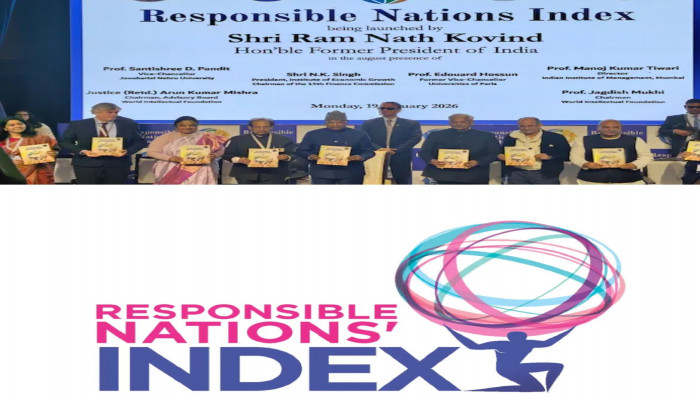
India has secured the 16th position among 154 countries in the newly launched Responsible Nations Index (RNI), a global framework that evaluates how responsibly countries use their power in relation to their citizens, the environment, and the international community. The index places India ahead of major global powers such as the United States and China, highlighting the country’s performance across multiple responsibility-based parameters.
The Responsible Nations Index is an initiative of the World Intellectual Foundation and is the result of a three-year-long academic and policy-based exercise. The index was officially launched on Monday. Singapore has emerged as the top-ranked country, followed by Switzerland in second place and Denmark at third.
Unlike traditional global rankings that largely focus on economic strength, military capacity, or geopolitical influence, the RNI introduces a different approach. It places responsibility at the centre of national evaluation and shifts the global lens from power to ethical and sustainable conduct. The index argues that power without responsibility cannot ensure long-term prosperity and that the true measure of national success lies in how fairly and sustainably power is exercised.
Explaining the rationale behind the index, the RNI framework emphasises that national progress should be judged not only by growth or influence, but by how responsibly a nation treats its people, protects the environment, and engages with the world.
Launching the index, former President of India Ram Nath Kovind highlighted its significance and conceptual clarity. He said, “The index is an innovative academic concept that defines what constitutes a responsible nation. The index reveals how responsibly a country behaves toward its own citizens and toward all of humanity. For the coming generation, this is an important step.” He also congratulated the World Intellectual Foundation for taking this initiative.
Sudhanshu Mittal, Founder and Secretary of the World Intellectual Foundation, described the index as a clear shift away from power-centric assessments toward responsibility-centric evaluation. He noted that the RNI raises fundamental questions about how nations use their influence and resources. According to him, prosperity without responsibility is not sustainable in the long run. The index aims to promote ethical governance, humane development, and responsible global behaviour, while providing a structured and data-driven method to compare countries with diverse social and economic backgrounds.
The Responsible Nations Index is structured around three core pillars. The first pillar, internal responsibility, examines how a nation upholds the dignity, well-being, and empowerment of its citizens. The second pillar, environmental responsibility, evaluates a country’s commitment to ecological protection and sustainable development. The third pillar, external responsibility, looks at how a nation behaves within the international system and how it contributes globally.
These three pillars are further assessed through seven key dimensions. These include quality of life, governance, social justice and empowerment, economic performance, environmental protection, commitment to peace, and international economic relations. To ensure a comprehensive evaluation, a total of 58 carefully selected indicators were used to calculate final scores and rankings.
For data accuracy and credibility, the index relies on widely recognised and publicly available international sources. These include data from the World Bank, United Nations agencies, the International Monetary Fund, the World Health Organisation, the Food and Agriculture Organisation, the International Labour Organisation, and the World Justice Project. The latest available data as of 2023 has been used, ensuring standardised and reliable comparisons across countries.
The academic and methodological foundations of the RNI were developed with support from reputed institutions such as Jawaharlal Nehru University and the Indian Institute of Management Mumbai. Senior academics from both institutions were present at the launch event, reflecting the scholarly depth and academic rigour behind the index.
According to the RNI 2026 rankings, Singapore holds the top position globally. Switzerland is ranked second, followed by Denmark in third place. Cyprus ranks fourth and Sweden fifth. Belgium, Georgia, Czechia, Austria, and Croatia complete the top ten. Germany stands at eleventh, followed by Portugal at twelfth, Bulgaria at thirteenth, Ireland at fourteenth, and Norway at fifteenth. India is placed sixteenth, ahead of Italy, France, Albania, and Poland, which complete the top twenty.
The RNI report highlights that many northern and eastern European countries consistently perform well due to the strict rule of law, inclusive welfare systems, and long-term commitments to climate action. At the same time, it points out that several emerging economies are showing strong performance in specific areas such as peacekeeping, renewable energy adoption, and inclusive welfare delivery.
The findings of the index suggest that responsible national conduct depends less on economic size and more on the quality of institutions, ethical governance, and equitable distribution of development benefits. The report also underlines a crucial global insight that responsibility is driven by political will and institutional integrity rather than wealth alone.
By focusing on responsibility, instead of power, the Responsible Nations Index seeks to reshape global conversations around nationhood, progress, and leadership. It presents responsibility as a measurable and comparable concept and offers policymakers, researchers, and citizens a new perspective to assess how nations contribute to peace, prosperity, and sustainability in an increasingly interconnected world.



 Loading...please wait
Comments