




India on track to manufacture 3-nanometre chips by 2032: Ashwini Vaishnaw
- In Reports
- 03:23 PM, Jan 12, 2026
- Myind Staff
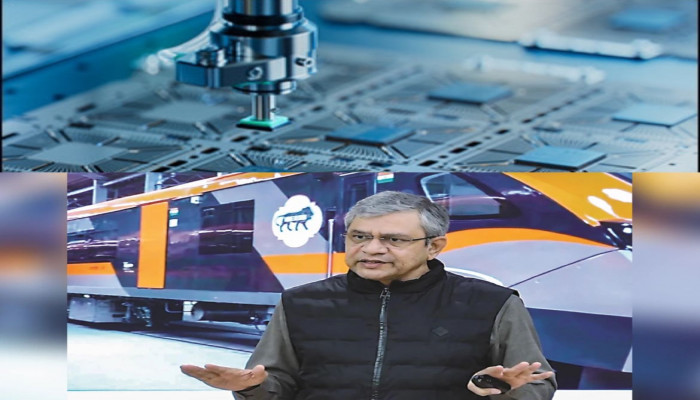
India is steadily moving towards becoming one of the world’s leading hubs for semiconductors and artificial intelligence, with the capability to manufacture advanced 3-nanometre chips by 2032, Union Minister for Electronics and Information Technology Ashwini Vaishnaw has said. He shared these details in an email interview, highlighting the government’s long-term vision backed by manufacturing growth, talent development, and the IndiaAI Mission.
The minister said the global semiconductor industry is growing rapidly due to increasing demand from artificial intelligence, electric vehicles, consumer electronics, and mobile phones. In this context, India has already made a “strong start” in building its semiconductor ecosystem. According to Vaishnaw, there are currently 10 semiconductor units in different stages of development across the country.
He further said, “Four plants, CG Semi, Kaynes Technology, Micron Technology and Tata Electronics in Assam will begin commercial production in 2026”. He added that these developments show that India’s semiconductor ecosystem is steadily taking shape.
Alongside manufacturing, semiconductor design has also gained momentum. Vaishnaw pointed out that 23 start-ups are currently involved in chip design initiatives. In addition, talent development programmes related to semiconductors and electronics have been introduced in 313 universities across the country. He also noted that equipment manufacturers are setting up facilities in India, which is further strengthening the overall ecosystem.
“Together, these factors will allow India to emerge as an important semiconductor player by 2028. After that, growth will cross a major tipping point, and by 2032, India will be among the major global players, manufacturing even 3-nanometre chips,” Vaishnaw said.
Responding to concerns about whether domestic outsourced semiconductor assembly and test (OSAT) units and fabrication plants would be fully utilised, the minister said the success of these facilities would depend on quality and pricing. “Every new industry faces a market-acceptance test, and our plants will be no exception,” he said, stressing the need to produce high-quality products at competitive prices.
On India’s artificial intelligence strategy, Vaishnaw said that developing sovereign AI is a national priority. “India must be competitive across all five layers of the AI stack — applications, models, chipsets, infrastructure and energy,” he said. He revealed that under the IndiaAI Mission, 12 teams are currently working on developing foundational AI models, while several design teams are focused on building chipsets.
The minister also said that around $70 billion is being invested in AI infrastructure in the country. This investment is being supported by clean and sustainable energy initiatives, including nuclear energy. Describing AI as the “fifth industrial revolution”, Vaishnaw said it would reshape every aspect of society and industry, making it essential for India to build strong sovereign AI capabilities.
Speaking about electronics manufacturing, Vaishnaw said the production-linked incentive (PLI) scheme for electronic components has received a strong response from the industry. He expressed confidence that by the end of the programme, domestic demand for most electronic components would be met within the country, while exports would also increase.
He acknowledged that smartphones currently dominate the electronics exports, and the export base is gradually expanding. “Exports are also growing in power electronics, medical electronics, industrial electronics and consumer electronics. As the component ecosystem matures, this export base will expand further,” he said.
Overall, the minister’s comments highlight India’s plans to build a strong and self-reliant semiconductor and AI ecosystem over the coming years, with a clear roadmap leading up to advanced chip manufacturing by 2032.



 Loading...please wait
Comments