




India joins elite club after Red Balloon Aerospace launches indigenously built stratospheric balloon
- In Reports
- 06:25 PM, May 27, 2026
- Myind Staff
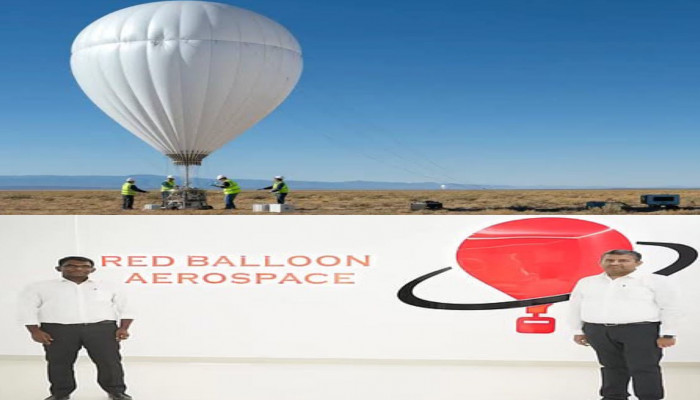
India has achieved a major milestone in near-space technology after Hyderabad-based startup Red Balloon Aerospace successfully launched the country’s first indigenous super-pressure balloon platform carrying commercial payloads. The mission has placed India among a select group of nations with homegrown stratospheric hydrogen balloon capability, joining countries such as the United States, France, Japan and China.
The company launched its Mission Sana from Indira Gandhi Stadium in Vijayawada, Andhra Pradesh. During the mission, the startup’s VISTA platform travelled nearly 25 kilometres above Earth into the stratosphere. This region lies above the altitude used by commercial aircraft and below the zone where satellites orbit. The successful launch marked a significant achievement for India’s expanding private space sector and highlighted the growing role of startups in advanced aerospace technology.
Mission Sana carried seven payloads from national and international partners. The payloads were designed for different experiments and technology demonstrations. These included biological experiments, propulsion systems, earth observation sensors, onboard computing platforms and navigation technologies. According to the company, all payload objectives were completed successfully during the mission.
Founded in 2025, Red Balloon Aerospace reached operational commercial flight capability within just eight months of its inception. The company described this as one of the fastest development timelines seen in the global near-space industry. The rapid achievement has drawn attention to India’s growing innovation ecosystem in aerospace and space-related technologies.
“This is only the beginning,” said Dr. C V S Kiran, Co-founder and CEO of the company. He said the successful VISTA mission validated the startup’s core near-space technology and would be followed by multiple future missions and expansion into telecommunications and disaster-management applications.
Unlike traditional weather balloons that rise and descend within a few hours, the VISTA platform uses super-pressure balloon technology. This system allows the balloon to maintain a stable altitude for long durations without losing gas during temperature changes between day and night. The platform is designed to stay operational in the stratosphere for weeks or even months. This makes it a low-cost and persistent system for several scientific and commercial uses.
The technology is also expected to address an important infrastructure gap in aerospace operations. Aircraft generally operate below 10 kilometres, while satellites orbit above 160 kilometres. The stratosphere, located between 20 and 50 kilometres, has remained largely underutilised despite its strong potential for communication services, disaster management, surveillance and environmental monitoring.
At an altitude of 25 kilometres, the VISTA platform can function as what the company calls a “tower in the sky.” This capability can help provide Non-Terrestrial Network connectivity to remote and underserved areas where reliable telecom infrastructure is limited or unavailable. Such systems could play a major role in improving communication access during natural disasters and emergencies.
The company also stated that a single VISTA mission can support multiple customers and industries at the same time. This rideshare-style operational model significantly reduces deployment costs for participating organisations. By sharing the same platform, different users can conduct experiments and test technologies without the high expenses usually associated with space-based systems.
Following the success of Mission Sana, Red Balloon Aerospace is now working on a wider ecosystem of high-altitude technologies. The company is developing tethered aerostats under its ALTIS programme. It is also building HELIX, a long-endurance autonomous stratospheric airship designed for telecommunications and cargo-related applications. These projects are expected to further strengthen India’s capabilities in near-space operations and commercial aerospace systems.
The achievement is being seen as an important moment for India’s private space industry. In recent years, Indian startups have increasingly expanded beyond traditional satellite launches and entered emerging areas of aerospace technology. Mission Sana demonstrates how Indian companies are now exploring the untapped potential of the stratosphere for commercial, scientific and public service applications.
The successful mission not only showcases technological innovation but also signals India’s growing ambitions in the global near-space sector. As the country continues to encourage private participation in aerospace and space research, developments like VISTA could open new opportunities in communication, disaster response, environmental observation and future high-altitude transportation systems.



 Loading...please wait
Comments