




India, Italy elevate ties to special strategic partnership, PM Modi receives FAO Agricola medal
- In Reports
- 12:58 PM, May 21, 2026
- Myind Staff
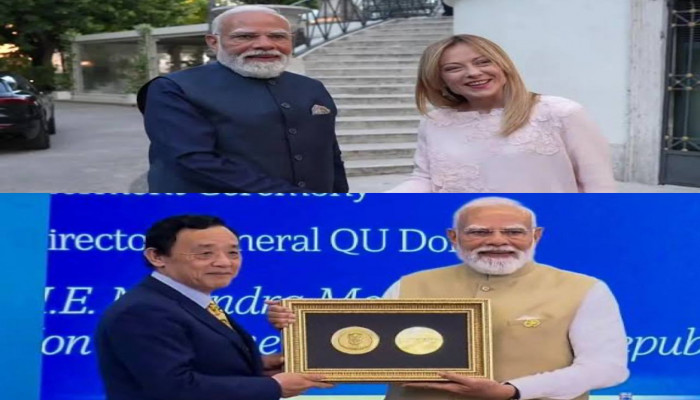
India and Italy elevated their bilateral relationship to a special strategic partnership as Prime Minister Narendra Modi and Italian Prime Minister Giorgia Meloni held wide-ranging talks in Rome, strengthening cooperation in trade, defence, technology and global security. During the visit, Modi also received the prestigious FAO Agricola Medal from the Food and Agriculture Organisation of the United Nations in recognition of India’s contribution to global food security and sustainable agriculture.
Modi arrived in Rome on Tuesday for the final leg of his five-nation tour. The visit focused on enhancing India’s energy security and expanding cooperation in sectors such as defence, trade, emerging technologies and critical minerals. During talks held over two days, both leaders agreed to upgrade ties to a special strategic partnership and set an ambitious target to increase bilateral trade from the current €14 billion to €20 billion by 2029.
At a joint media interaction, Modi said, “I am delighted that we are upgrading our relations to a special strategic partnership.” He added, “The India-Italy joint strategic action plan for 2025-29 provides a practical and futuristic framework for our partnership. We are progressing on it in a timely manner.”
The leaders discussed global conflicts and growing geopolitical tensions, including the wars in Ukraine and West Asia. Both sides stressed the importance of dialogue and diplomacy to ensure lasting peace. They also called for freedom of navigation and the restoration of shipping movement through the Strait of Hormuz, which remains crucial for global trade and energy supply.
Meloni highlighted the importance of stronger cooperation between India and Italy in maintaining freedom of navigation in the Indo-Pacific region. She also stressed the significance of the India-Middle East-Europe Economic Corridor (IMEC), which aims to improve connectivity between the Indo-Pacific and the Mediterranean region.
Speaking on India’s position regarding ongoing global conflicts, Modi said, “India’s stand is clear – all problems should be solved through dialogue and diplomacy.” Meloni also underlined the need for a lasting and fair peace in Ukraine and expressed hope that negotiations regarding the Iran crisis would continue positively.
The two countries agreed to create a review mechanism led by their foreign ministers to monitor the implementation of the joint strategic action plan for 2025-29 and guide the newly upgraded partnership. According to India’s external affairs ministry, both sides also agreed to expand collaboration in trade and investment, defence and security, innovation, science and technology, education, energy, AI, critical technologies, space and people-to-people ties.
Modi said technology and innovation would play a major role in strengthening relations between the two countries. “Technology and innovation are the engines of our partnership. There is immense potential for cooperation in areas such as AI, quantum, space and civil nuclear energy,” he said. “We are working on the India-Italy Innovation Centre to connect startups, research centres and industries of both countries.”
Defence cooperation also emerged as a major area of focus during the discussions. Modi said, “Cooperation is increasing between the defence industries of both countries as well as between our militaries. Our defence industrial roadmap has paved the way for co-development and co-production.”
The two countries welcomed a joint declaration of intent and a defence industrial roadmap aimed at boosting technological cooperation and joint manufacturing projects. These projects will include helicopters, naval platforms, marine armament systems and electronic warfare technologies. India and Italy also agreed to launch a new maritime security dialogue to improve coordination and information sharing.
Modi said both countries would work together on shipping, logistics, port modernisation and the blue economy. He also noted that India and Italy are looking to extend their cooperation to third countries, particularly in Africa. “We also discussed expanding our win-win partnership to third countries. Moving forward in this direction, we agreed to work on concrete projects in Africa,” he said.
On counter-terrorism cooperation, Modi said both countries shared concerns over terrorism and terror financing. “India and Italy have sent a clear message that responsible democracies not only condemn terrorism but also take concrete steps to disrupt its financial networks,” he said.
The two sides also agreed to improve mobility opportunities for students, researchers and skilled professionals, especially in STEM sectors. They signed a joint declaration of intent to support the movement of Indian nurses to Italy and enhance cooperation in skill development based on labour market requirements.
During the Rome visit, Modi also visited the headquarters of the Food and Agriculture Organisation, where he was awarded the FAO Agricola Medal by FAO Director-General Qu Dongyu. The award recognises exceptional contributions to food security, nutrition and agricultural development.
Accepting the honour, Modi said the recognition belonged to India’s farming community. “This is an honour to India's millions of farmers, livestock rearers, fish farmers, agricultural scientists, and workers. This is also an honour to India's unwavering commitment, at the centre of which lies human welfare, food security, and Sustainable Development,” he said.
The Prime Minister highlighted India’s efforts in promoting sustainable and technology-driven agriculture. He said agriculture in India represents a sacred connection between the people and the land. Modi emphasised that India’s farming policies are now focused not just on increasing production but also on improving quality and sustainability.
“We believe that the future of farming is not solely about ‘Producing More,’ but about ‘Producing Better.’ Guided by this vision, we are focusing on enhancing biodiversity and reducing reliance on chemical fertilisers,” he said.
Modi noted that India’s experience shows that scale and sustainability can progress together. “When technology and inclusion work together, they reinforce each other, and science-driven agriculture can serve as a strong foundation for global food security,” he said. He added, “For us, Food Security is not merely a Policy Matter; it is our responsibility towards humanity.”
The Prime Minister also spoke about India’s growing use of technology in agriculture. He said digital public infrastructure, AI-based advisory systems, drones, remote sensing technologies and sensor-based machinery are helping farmers improve productivity and income. Modi added that India has developed nearly 3,000 climate-resilient crop varieties over the past decade.
He also referred to initiatives such as ‘Per Drop More Crop’, precision farming and micro-irrigation as examples of India’s climate-resilient agricultural approach. Modi thanked the FAO for supporting India’s efforts to promote millets globally through the International Year of Millets initiative.
This was the first visit by an Indian head of government to the FAO headquarters in nearly 30 years. During his meeting with Qu Dongyu, Modi reaffirmed India’s support for the FAO’s mission and acknowledged the organisation’s long-standing contribution to India’s agricultural and food security programmes.



 Loading...please wait
Comments