



India, Israel reaffirm ‘Zero Tolerance’ against terrorism after Sydney attack: EAM Jaishankar
- In Reports
- 08:06 PM, Dec 17, 2025
- Myind Staff
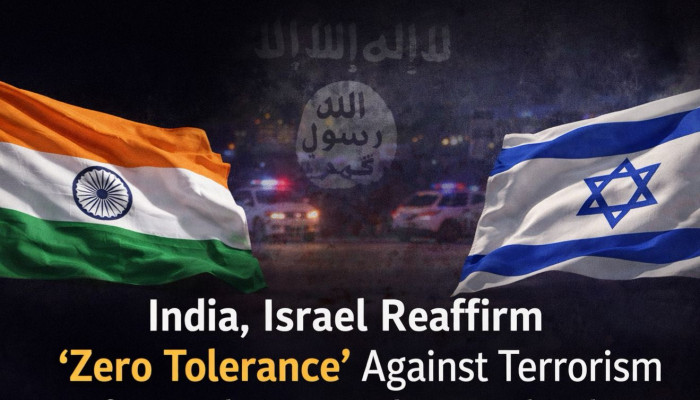
External Affairs Minister S Jaishankar on Tuesday strongly condemned the terror attack that took place during a Hanukkah celebration at Sydney’s Bondi Beach, stating that India and Israel share a policy of “zero tolerance” towards terrorism. He said both countries remain firmly united in their fight against all forms of terror. Jaishankar made these remarks while addressing the media in Jerusalem, alongside his Israeli counterpart Gideon Moshe Sa’ar, during his two-day official visit to Israel.
At the start of his remarks, the External Affairs Minister expressed deep sorrow over the loss of lives in the attack, which occurred during the Hanukkah by the Sea celebration on Sunday. “Let me first of all convey our very, very sincere, deep condolences at the loss of life due to the terror attack at Hanukkah celebrations in Bondi Beach. I want to say that we condemn it in the strongest possible terms,” Jaishankar said.
The attack at Bondi Beach left at least 15 people dead and around 40 others injured after two gunmen opened fire on a gathering celebrating the Jewish festival of Hanukkah. The event was attended by families and members of the Jewish community. The attackers were later identified as 50-year-old Sajid Akram, an Indian national, and his 24-year-old son Naveed Akram, an Australian citizen. While Sajid Akram had migrated to Australia 27 years ago, he continued to carry an Indian passport, according to official information. The incident has been described as one of the most shocking terror attacks in recent times and has drawn condemnation from leaders across the world.
Emphasising the shared approach of the two countries, Jaishankar said India deeply values Israel’s consistent support in the global fight against terrorism.
“Where India and Israel are concerned, we are both countries that have a policy of zero tolerance towards terrorism. We appreciate your consistent support to our fight against terrorism and all its forms and manifestations,” he said. He added that the two nations will continue to work closely to combat the common threat posed by terrorism.
During the press interaction, Jaishankar also spoke about the India–Israel strategic partnership, noting that ties between the two countries have grown significantly over the past decade. “We will be discussing a strategic partnership which has really developed very significantly in the last decade,” he said.
He explained that the partnership now includes several important dimensions. “It has a G2G dimension, a B2B dimension, and one P2P between people as well. And I would say there really are a very large number of domains today that our relationship touches in one form or the other,” Jaishankar stated. Calling India and Israel “very complementary partners,” he stressed the need to fully utilise the potential of this relationship. “We are very complementary partners, and we must make the most of that,” he said.
Jaishankar also reiterated India’s support for the Gaza peace plan, expressing hope that ongoing efforts would result in a lasting solution. He said India supports initiatives aimed at achieving durable and lasting peace in the region and continues to closely follow developments in West Asia.
Later in the day, Jaishankar shared details of his meetings in a post on the social media platform X.
In his post, he said he conveyed condolences to his Israeli counterpart and reaffirmed India’s resolve to fight terrorism. “Conveyed deepest condolences on terror attack on Hanukkah celebrations and reiterated our steadfast resolve in combating the shared challenge of terrorism,” he wrote.
He added that discussions with Israeli leaders were productive and wide-ranging. “Held productive discussions on our Strategic partnership and its further advancement across various domains. Also exchanged perspectives on regional developments, the Gaza Peace Plan and efforts to achieve lasting and durable peace,” Jaishankar said.
Jaishankar’s visit to Israel is also seen as an extension of high-level engagement between the two countries. During his stay, he is scheduled to meet Israeli President Isaac Herzog and Prime Minister Benjamin Netanyahu. This follows recent communication between Prime Minister Narendra Modi and Netanyahu, after which the Israeli leader said the two would be “meeting very soon.”
Jaishankar’s visit comes at a time when preparations are underway for Netanyahu’s proposed visit to India. A source familiar with the matter told PTI, “The discussions will revolve around bilateral and regional issues with a view to further deepen the strategic partnership between the two countries.”
Before arriving in Israel, Jaishankar was in Abu Dhabi, where he participated in the Sir Bani Yas Forum. He also attended the 16th India–UAE Joint Commission Meeting and the 5th round of the India–UAE Strategic Dialogue on December 15. The recent exchanges highlight India’s active diplomatic engagement in the region.
India and Israel have significantly expanded cooperation across several sectors in recent years. Several Israeli ministers, including Tourism Minister Haim Katz, Economy and Industry Minister Nir Barkat, Agriculture and Food Security Minister Avi Dichter, and Finance Minister Bezalel Smotrich, visited India earlier this year. These visits have helped build momentum towards a proposed Free Trade Agreement (FTA) between the two countries.
During Smotrich’s visit to New Delhi in September, India and Israel signed a Bilateral Investment Treaty (BIT). This was followed by the signing of the Terms of Reference (ToR) for the proposed FTA during Commerce and Industry Minister Piyush Goyal’s visit to Israel last month.
In the defence sector, India and Israel last month signed a landmark agreement to enhance defence, industrial, and technological cooperation. The agreement allows for sharing advanced technologies and promotes co-development and co-production. Cultural and academic ties have also seen steady growth. The two countries have hosted film festivals, dance performances, and filmmaker exchanges to strengthen people-to-people connections.
On Monday, the Indian Council for Cultural Relations (ICCR) and Tel Aviv University signed a Memorandum of Understanding to establish an India Chair at the university to boost academic cooperation.
Jaishankar’s visit to Israel, his condemnation of the Bondi Beach terror attack, and his meetings with Israeli leaders underscore the deepening partnership between India and Israel. Both countries have reiterated their shared commitment to a zero-tolerance approach to terrorism while continuing to strengthen cooperation across defence, trade, culture, and diplomacy.



 Loading...please wait
Comments