



India is expanding and diversifying LPG and crude imports: Minister Hardeep Puri
- In Reports
- 05:30 PM, Mar 13, 2026
- Myind Staff
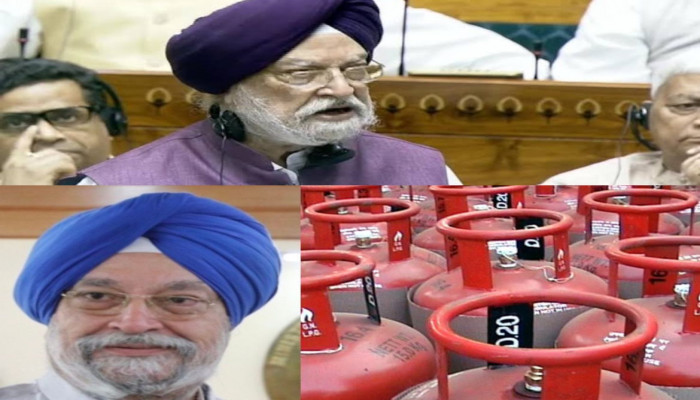
India has expanded and diversified its sources for liquefied petroleum gas (LPG) imports in response to global energy supply disruptions, Union Petroleum and Natural Gas Minister Hardeep Singh Puri informed Parliament on Thursday. The move comes at a time when tensions and military operations in West Asia have raised concerns about the stability of international energy supply routes.
The minister told the Lok Sabha that India has broadened its procurement strategy by securing LPG shipments from several countries, including the United States, Norway, Canada, Algeria and Russia, while continuing to import from traditional Gulf suppliers. Earlier, a major portion of India’s LPG imports came from Gulf nations such as Qatar, the United Arab Emirates, Saudi Arabia and Kuwait. Around 60 per cent of India’s LPG needs were met through imports from these countries, while the remaining 40 per cent was produced domestically. However, the government has now taken active steps to reduce dependence on any single region by purchasing LPG from a wider group of international suppliers, along with existing Gulf sources.
Puri explained that the current situation in global energy markets is extremely unusual. According to him, the world is witnessing a disruption of an important energy route after military actions involving Iran, Israel and the United States affected movement through the Strait of Hormuz. This route is considered one of the most critical global energy corridors as roughly 20 percent of the world’s crude oil, natural gas and LPG passes through it. He noted that this disruption has continued for nearly two weeks and has created significant uncertainty in global energy supply chains.
Despite the challenges, the minister assured Parliament that India’s crude oil supply remains secure. He stated that the country has successfully arranged crude volumes at prices higher than what would have normally arrived through the Strait of Hormuz during this period. Earlier, nearly 45 per cent of India’s crude imports passed through this route. With strong diplomatic outreach and good relations with global partners, India has been able to secure additional crude supplies from alternative routes and suppliers.
As a result, crude oil shipments that do not pass through the Hormuz route have now increased significantly. These non-Hormuz sources currently account for about 70 per cent of India’s crude imports, compared to around 55 per cent before the conflict began. The minister highlighted that India’s oil sourcing network has expanded considerably over the years. While the country imported crude from only 27 countries in 2006-07, it now sources oil from around 40 nations. This diversification has given India the flexibility to manage supply disruptions more effectively.
Indian refineries are currently operating at high levels of capacity, with some even running above their normal capacity. According to the minister, this strong refinery performance ensures that there is no shortage of petroleum products such as petrol, diesel, kerosene, aviation turbine fuel and fuel oil in the country. A senior official from the petroleum ministry, who requested anonymity, confirmed that all fuel retail outlets across the country continue to operate normally. As of September 30, 2025, India had a total of 99,281 fuel retail outlets, including 28,533 located in rural areas.
The government is also closely managing the supply of natural gas through a priority-based allocation system. The current supply position remains stable and is expected to meet demand in the near future. India produces around 90 million metric standard cubic metres per day (MMSCMD) of natural gas domestically, while the country’s daily consumption stands at approximately 189 MMSCMD. Imports of about 30 MMSCMD from Gulf sources have been affected after a major processing facility in Qatar declared force majeure, temporarily disrupting supplies.
To address this situation, the government issued the Natural Gas Control Order on March 9 under the Essential Commodities Act. This order introduced a priority system for the distribution of available gas supplies. Under this arrangement, piped natural gas for households and compressed natural gas used by vehicles will continue to receive their full supply without any reduction. Industrial and manufacturing sectors will receive up to 80 per cent of their previous six-month average consumption, while fertiliser plants will receive around 70 per cent of their requirement to protect agricultural production ahead of the upcoming sowing season. Gas supply to refineries and petrochemical units will be reduced slightly so that more fuel can be directed to sectors considered more essential.
Puri said the supply gap created by the disruption has been largely managed through alternative procurement. Large liquefied natural gas cargoes are arriving almost every day through different routes, helping the country maintain adequate gas supplies. The government believes that even if the ongoing conflict continues for a longer period, India has enough supply arrangements to sustain its needs. Electricity generation for households and industries remains fully protected.
To further strengthen domestic cooking gas availability, the government issued an LPG Control Order on March 8, directing refineries to maximise their LPG production. Refineries have been instructed to send their entire LPG output to the three public sector oil marketing companies for distribution as domestic cooking fuel. Because of these measures, LPG production has increased by about 28 per cent over the last five days, and additional imports are also being arranged.
The country’s LPG distribution network is largely managed by three state-owned oil marketing companies: Indian Oil Corporation, Bharat Petroleum Corporation Limited and Hindustan Petroleum Corporation Limited. Together, these companies serve about 33.1 crore active domestic LPG consumers through 25,584 distributors. The minister said the government’s top priority is to ensure that households, particularly those belonging to poorer sections of society, do not face any disruption in cooking gas supply. According to him, domestic LPG deliveries are continuing as usual, with the average time between booking and cylinder delivery remaining around 2.5 days, the same as before the crisis.
Essential services such as hospitals and educational institutions have also been given uninterrupted access to LPG supplies. The government has received reports that panic buying and hoarding by consumers at the distributor level are occurring in some areas, largely because of fear and misinformation rather than an actual shortage of fuel.
The government has also introduced temporary regulations for commercial LPG sales to prevent hoarding and black-market activities. Commercial LPG normally operates in a fully deregulated market where cylinders can be purchased freely at market prices without subsidy or booking requirements. Officials said that if the system had remained completely unrestricted during the current supply pressure, it could have allowed large quantities of cylinders to be diverted to illegal markets or resold at higher prices. To prevent such misuse and to protect genuine users, the government decided to regulate this channel with a clear allocation system.
A three-member committee consisting of executive directors from Indian Oil, HPCL and BPCL was formed on March 9 to review the situation. The committee has held discussions with state civil supplies departments and restaurant associations across the country to assess actual commercial LPG demand in different regions.
Based on these consultations, the government has decided that oil marketing companies will allocate 20 per cent of the average monthly commercial LPG requirement for distribution in coordination with state governments. This arrangement aims to ensure that the available commercial LPG supply reaches genuine users first while preventing hoarding and black marketing.
To reduce pressure on LPG supplies in the hospitality sector, the government has also suggested temporary alternative fuel options such as kerosene, biomass, refuse-derived fuel pellets and coal for restaurants and similar establishments for about a month. This measure is expected to help free up more LPG for households and other priority consumers.
The minister concluded by urging citizens not to spread rumours about fuel shortages. He emphasised that India is dealing with one of the most significant global energy disruptions in modern times, but continues to manage the situation effectively. Crude oil supplies are stable, gas is being prioritised for households and agriculture, and LPG production has already been increased significantly. Consumer prices are also being maintained below what international markets would normally demand. According to him, maintaining stability in the country’s energy system during such a crisis is a collective national responsibility.



 Loading...please wait
Comments