




India-Germany strengthen strategic partnership with wide ranging agreements
- In Reports
- 06:06 PM, Jan 12, 2026
- Myind Staff
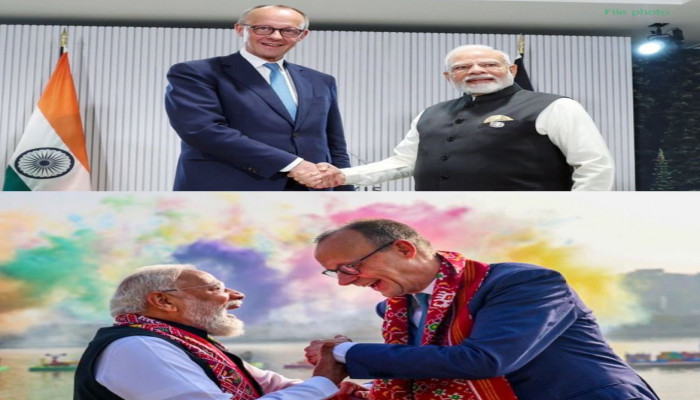
At the invitation of Hon’ble Prime Minister Shri Narendra Modi, the Federal Chancellor of the Federal Republic of Germany, H.E. Mr Friedrich Merz, paid an official visit to India from 12–13 January 2026. Chancellor Merz was accompanied by a high-level delegation, including 23 leading German CEOs and industry leaders, highlighting the strong economic and industrial focus of the visit.
This visit marked Chancellor Merz’s first official visit to India and his first visit to Asia since assuming office as Federal Chancellor. The visit reflected the high priority Germany attaches to India as a key strategic partner in the Indo-Pacific region. It followed the successful 7th India–Germany Inter-Governmental Consultations (IGC) held in New Delhi on 25 October 2024. The visit also came at a significant moment in bilateral relations, with the completion of 25 years of the India–Germany Strategic Partnership in 2025 and the commemoration of 75 years of diplomatic relations between the two countries in 2026.
Both leaders sincerely appreciated the renewed momentum in bilateral engagement across government, business, civil society and academia, and noted that this engagement has played an “instrumental role in advancing and deepening the Strategic Partnership.”
Prime Minister Modi welcomed Chancellor Merz in Ahmedabad. During the visit, the two leaders paid floral tribute at the statue of Mahatma Gandhi at Sabarmati Ashram and participated in the famous Kite Festival. They also jointly addressed the India–Germany CEOs Forum, where they interacted with leading business representatives from both countries. Chancellor Merz is also scheduled to visit Bengaluru, where his engagements will focus on strengthening business and technological collaboration between India and Germany.
Prime Minister Modi and Chancellor Merz held restricted and delegation-level talks in Ahmedabad on 12 January 2026. During the discussions, the two leaders reaffirmed their shared democratic values, their commitment to a rules-based international order, and mutual respect, which they described as the foundation of the India–Germany Strategic Partnership. They reviewed the full spectrum of bilateral relations and also exchanged views on key regional and global developments.
The leaders reaffirmed their strong commitment to further strengthening defence and security cooperation. They welcomed the outcomes of the High Defence Committee meeting held in New Delhi in November 2025, which aimed at further augmenting bilateral defence cooperation, including institutionalised Services Staff Talks and visits of Service Chiefs.
Both leaders endorsed the commitment of India and Germany to deepen military-to-military cooperation through joint exercises, training programmes and exchanges of senior officials. They noted with satisfaction the regular reciprocal port calls by naval ships of both countries and welcomed the establishment of a new Track 1.5 Foreign Policy and Security Dialogue.
Prime Minister Modi welcomed Germany’s intent to participate in Naval Exercise MILAN and the 9th Indian Ocean Naval Symposium (IONS) Conclave of Chiefs in February 2026, the Air Combat Exercise TARANG SHAKTI in September 2026, and Germany’s decision to deploy a Liaison Officer to the Information Fusion Centre–Indian Ocean Region (IFC-IOR).
Both sides expressed satisfaction at the ongoing cooperation between India’s Defence Research and Development Organisation (DRDO) and the Organisation for Joint Armament Cooperation (OCCAR) for the Eurodrone MALE UAV programme. The leaders noted that this cooperation will enable India to harness advanced military technologies and further strengthen its strategic and defence ties with Europe.
The leaders welcomed the signing of a Joint Declaration of Intent to develop a Defence Industrial Cooperation Roadmap. This roadmap aims to promote long-term industry-level collaboration, including technology partnerships, co-development and co-production of defence platforms and equipment. India welcomed Germany’s efforts to facilitate expeditious export clearances of defence equipment.
Both leaders appreciated the growing interaction between Indian and German defence businesses through Defence Roundtables and Seminars held in Berlin and New Delhi. They lauded continuing cooperation in submarines, helicopter obstacle avoidance systems and Counter Unmanned Aerial Systems (C-UAS). They looked forward to enhanced defence industrial collaboration based on the complementarity of strengths, with India contributing a skilled workforce and competitive costs, and Germany providing advanced technologies and investments.
In the area of training and exchanges, the leaders welcomed progress towards concluding a Memorandum of Understanding on Peacekeeping Training, a Reciprocal Logistics Support Agreement between the armed forces, and knowledge exchange on new defence technologies between DRDO and Germany’s Federal Office of Bundeswehr Equipment, Information Technology and In-Service Support (BAAINBw).
The two leaders “unequivocally and strongly condemned terrorism and violent extremism in all its forms and manifestations, including cross-border terrorism.” They called for concerted international efforts to combat terrorism in a comprehensive and sustained manner, in accordance with the UN Charter and international law. They condemned “in the strongest terms” the terrorist attack in Pahalgam, Jammu and Kashmir, on 22 April 2025, and the terror incident in Delhi on 10 November 2025.
Both sides have committed to strengthening cooperation against terrorists and terrorist entities, including those listed under the UN 1267 Sanctions Committee. They also called upon all countries to eliminate terrorist safe havens and infrastructure and to disrupt terrorist networks and financing in accordance with international law. The leaders welcomed the ratification of the Mutual Legal Assistance Treaty and noted progress under the Joint Working Group on Counter-Terrorism.
The leaders welcomed the sustained growth in bilateral trade and investment. They noted that India–Germany bilateral trade in goods and services reached a record high in 2024, surpassing USD 50 billion and accounting for over 25 per cent of India’s trade with the European Union. They also noted strong two-way investments and their positive role in diversifying global supply chains.
Both leaders reaffirmed their commitment to fully realising untapped economic potential, including through SMEs, startups, digitalisation, artificial intelligence and innovation-driven enterprises. Prime Minister Modi invited German companies to invest and expand their businesses in India, citing India’s strong economic growth, business-friendly environment, large skilled workforce and vast scaling opportunities. Chancellor Merz, in turn, recommended Germany as an attractive investment destination for Indian companies.
The leaders reiterated their support for the early conclusion of the India–EU Free Trade Agreement, describing it as a key outcome of the upcoming EU–India Summit. They welcomed the Joint Declaration of Intent to strengthen bilateral economic cooperation through the German-Indian CEO Forum.
The leaders welcomed progress in cooperation on critical and emerging technologies, including semiconductors, critical minerals, digitalisation, telecommunications, health and the bioeconomy. They welcomed the Joint Declaration of Intent on Semiconductor Ecosystem Partnership and underlined the importance of enhanced institutional research and industrial collaboration. Prime Minister Modi welcomed the opening of Infineon’s Global Capability Centre in GIFT City in March last year.
They also welcomed progress on critical minerals cooperation, digital dialogue, telecommunications cooperation, extension of the Indo-German Science and Technology Centre, collaboration in space between ISRO and DLR, and cooperation in traditional medicine and bioeconomy.
The leaders expressed satisfaction at the implementation of the Green and Sustainable Development Partnership (GSDP), noting that around €5 billion of Germany’s €10 billion commitment until 2030 has already been used or earmarked. Cooperation covers renewable energy, climate action, green hydrogen, urban mobility, sustainable infrastructure and biodiversity.
They welcomed joint efforts on renewable energy, battery storage, green hydrogen, and a major offtake agreement for Indian-produced green ammonia.
Both leaders reaffirmed their commitment to a “free and open Indo-Pacific,” respect for international law, including UNCLOS, and announced a new bilateral Indo-Pacific consultation mechanism. They reiterated support for the India–Middle East–Europe Economic Corridor (IMEC).
They reiterated the need for UN Security Council reforms, expressed concern over the war in Ukraine, welcomed progress toward peace in Gaza, and reaffirmed the importance of climate action under the Paris Agreement.
The leaders highlighted the importance of people-to-people ties. Prime Minister Modi thanked Chancellor Merz for announcing a visa-free transit facility for Indian passport holders. They welcomed growing cooperation in education, skilled mobility, renewable energy skilling, culture, sports and language training.
Chancellor Merz thanked Prime Minister Modi for the warm hospitality extended to him and his delegation. Both leaders agreed that the next India–Germany Inter-Governmental Consultations will be held in Germany later in 2026 and reaffirmed their shared commitment to further deepening the Strategic Partnership.



 Loading...please wait
Comments