




India, France unveil ambitious roadmap to boost trade, AI, defence partnership
- In Reports
- 01:57 PM, Jun 15, 2026
- Myind Staff
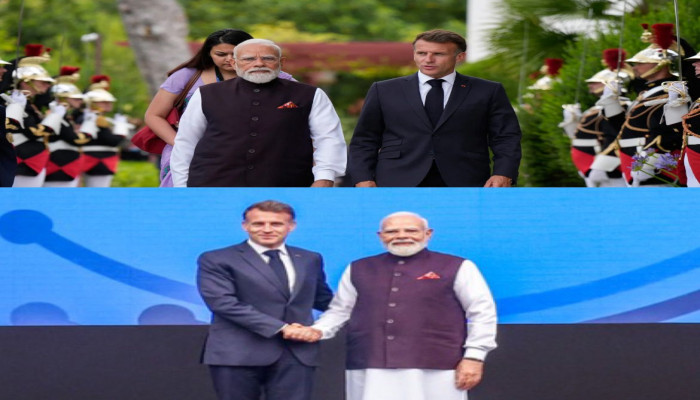
India and France have agreed to strengthen their strategic partnership by setting a target to double their annual bilateral trade to $32 billion over the next five years. The decision was announced after talks between Prime Minister Narendra Modi and French President Emmanuel Macron in Nice on Sunday. The leaders also unveiled several new initiatives covering technology, innovation, defence, education and economic cooperation.
The agreements were finalised during PM Modi’s visit to France as part of his week-long tour of France and Slovakia. Following the meeting, both countries announced 13 major outcomes aimed at expanding cooperation across key sectors. These included the launch of the India-France Innovation Roadmap 2030, the creation of a Joint Artificial Intelligence Working Group, the expansion of India’s Unified Payments Interface (UPI) in France and the establishment of a high-level mechanism to help achieve the new trade target.
Sharing his thoughts after the meeting, PM Modi posted on X, “What a pleasure to have met you again in Nice. A first step that was resolutely productive. The partnership between India and France will continue to reach new heights. See you in Évian and Paris…”
Foreign Secretary Vikram Misri said the discussions covered the entire range of bilateral relations. The two sides reviewed cooperation in defence, civil nuclear energy, space, trade, investment, technology, innovation, education and people-to-people exchanges. They also explored ways to deepen engagement in each of these areas.
Technology and innovation emerged as one of the key focus areas of the talks. India and France unveiled the Innovation Roadmap 2030 to expand collaboration in critical and emerging technologies. The roadmap aims to strengthen partnerships between startups, incubators, academic institutions and research organisations in both countries. It is expected to create new opportunities for innovation and technological development.
The two nations also announced the formation of a Joint Artificial Intelligence Working Group. The platform will support cooperation in AI governance, research and development, industry partnerships and capacity building. It will also encourage exchanges between experts and institutions working in the field of artificial intelligence.
Economic cooperation was another major highlight of the meeting. Both countries agreed to establish a high-level mechanism dedicated to doubling bilateral trade within five years. They also launched a new dialogue on economic security. The initiative will focus on improving supply chain resilience and strengthening cooperation in critical minerals and other strategic sectors.
In a significant step for digital connectivity, India and France decided to expand the use of India’s Unified Payments Interface (UPI) in France. The digital payment system is expected to become operational at Paris’ Charles de Gaulle Airport and Nice Airport in the coming days. The move is expected to benefit Indian tourists, students, business travellers and members of the Indian diaspora living in France by providing easier payment options.
Defence cooperation featured prominently during the discussions. According to Misri, talks moved forward on India’s proposed procurement of 114 Rafale fighter jets. Both sides stressed the importance of greater localisation under the “Make in India” initiative. The discussions focused on co-design, co-development and co-production, reflecting the commitment of both countries to expand defence manufacturing cooperation.
The leaders also reviewed ongoing cooperation in the civil nuclear energy sector. Discussions included progress on the Jaitapur nuclear power project and new opportunities created by India’s recently enacted SHANTI legislation. They also explored possibilities for collaboration in advanced reactor technologies and small modular reactors, which are considered important for the future of clean energy generation.
People-to-people ties also received considerable attention during the talks. PM Modi thanked President Macron for the swift implementation of visa-free transit facilities for Indian nationals at French airports. The leaders agreed that stronger exchanges between citizens would further deepen the relationship between the two countries.
Both sides discussed measures to improve talent mobility and student exchanges. They also explored expanding the mutual recognition of educational qualifications. These initiatives are expected to make it easier for students and professionals to pursue opportunities in both countries.
As part of the outcomes announced, India and France will establish a National Centre of Excellence for Skilling in Aeronautics and Allied Sectors in Kanpur. The centre will focus on developing a skilled workforce for the aviation, aerospace and maintenance industries. It is expected to support industry growth and create new employment opportunities.
PM Modi also invited French universities to establish campuses in India under the framework of the National Education Policy. The proposal aims to increase educational cooperation and provide greater access to international academic opportunities for Indian students.
Apart from bilateral matters, the two leaders exchanged views on major international developments. Their discussions included the situation in West Asia and the ongoing Russia-Ukraine conflict. They also underlined the importance of the early implementation of the India-European Union Free Trade Agreement. According to both sides, the agreement has the potential to create fresh opportunities for trade, investment and economic growth.
The meeting in Nice highlighted the growing strength of the India-France partnership. With new initiatives in trade, technology, defence, education and digital cooperation, both countries have signalled their commitment to building a stronger and more comprehensive relationship in the years ahead.



 Loading...please wait
Comments