



India-France sign MoUs to produce Hammer missiles in India, renew defence cooperation
- In Reports
- 07:21 PM, Feb 18, 2026
- Myind Staff
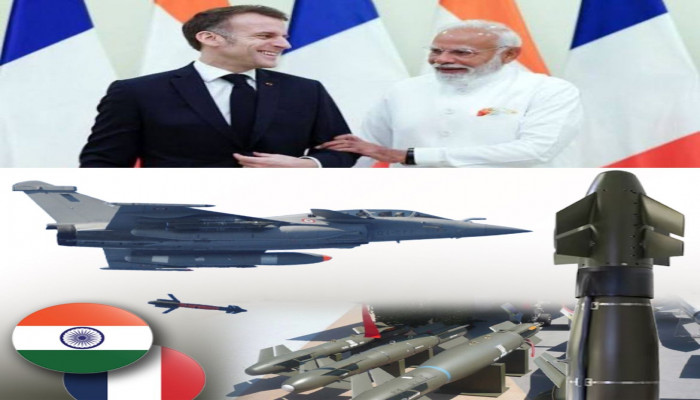
India and France have further strengthened their long-standing defence partnership by signing two important Memoranda of Understanding (MoUs) during the 6th India-France Annual Defence Dialogue, held in Bangalore on Tuesday. The dialogue was co-chaired by India’s Defence Minister Rajnath Singh and France’s Defence Minister Catherine Vautrin, reflecting the strong strategic bond between the two nations.
The meeting highlighted the growing defence and security cooperation between India and France, especially at a time when global and regional security concerns are increasing. Both sides discussed ways to expand their military collaboration and promote defence manufacturing, technology sharing, and joint exercises.
The first MoU signed during the event was related to the renewal and amendment of a comprehensive 10-year defence cooperation agreement between India and France. This agreement is seen as an important framework that guides defence cooperation between the two countries. The MoU was signed by Defence Secretary Rajesh Kumar Singh from the Indian side and Lt Gen Eric Peltier, the Deputy Director General of International Relations and Strategy from France.
This renewed agreement shows that both countries remain committed to deepening their defence relationship. It also indicates that India and France are looking to work closely together in response to changing security challenges across the world. The renewal is expected to support continued cooperation in key areas such as defence planning, training, and strategic coordination.
The second MoU signed during the dialogue focused on the production of Hammer missiles in India. This MoU was exchanged between Manoj Jain, Chairman and Managing Director of Bharat Electronics Limited (BEL), and Alexander Ziegler, Executive Vice President and Defence Director at Safran Electronics and Defence, a French company.
Hammer missiles are known for their precision-guided strike abilities and are considered a modern weapon system used in air-launched attacks. The agreement to manufacture these missiles in India is being viewed as a major step towards strengthening India’s defence manufacturing capabilities under the ‘Make in India’ and Atmanirbhar Bharat initiatives. It is expected to increase India’s ability to produce advanced missile systems within the country while reducing dependence on imports.
The dialogue being held in Bangalore also reflects the growing importance of the city as a major centre for defence and aerospace development. Bangalore is already home to major defence organisations such as Hindustan Aeronautics Limited (HAL) and key research and development facilities of the Defence Research and Development Organisation (DRDO). Hosting such an important defence meeting in the city further strengthens its role in shaping future defence collaborations.
During the dialogue, Defence Minister Rajnath Singh praised France for its consistent support for strategic autonomy and its role in supporting a strong European defence system. He also pointed to the recently announced India-European Union security and defence partnership, calling it a major step forward in multilateral cooperation.
Singh said India hopes to use this framework to improve joint capabilities, support regional stability, and strengthen the Indo-French strategic partnership not only bilaterally but also across wider European engagement. His remarks showed India’s intention to build stronger security networks with trusted partners.
French Defence Minister Catherine Vautrin described defence cooperation as the foundation of India-France relations. She said their partnership is an example of how two countries can work together with mutual respect and shared goals. She highlighted that the relationship is supported by joint military exercises, defence industry cooperation, and the co-production of important defence platforms.
Vautrin also described India as a key partner for France in the Indo-Pacific region, especially at a time when geopolitical tensions are increasing. She stressed that partnerships in defence, space, and industrial cooperation are becoming more important than ever. According to her, India and France have built a strong partnership that can expand further in the coming years.
The agreements signed during this meeting are aligned with India’s goal of increasing self-reliance in defence manufacturing. The involvement of BEL, a major public sector defence company, and Safran, a global defence technology leader, shows how India is working with international partners to develop advanced weapon systems domestically.
This development comes after several major defence deals between the two nations in recent years. India and France have already worked together on defence projects such as the purchase of Rafale fighter jets and the construction of Scorpene submarines. These collaborations have made France one of India’s most important defence partners.
The Hammer missile manufacturing MoU is expected to improve India’s precision strike capability, especially in air-based missions. It may also involve advanced avionics, guidance systems, and technology integration that will help India upgrade its defence strength. France’s role in this project is likely to bring valuable technology support and possible technology transfer, helping India develop its missile systems more effectively.
Meanwhile, the renewed 10-year defence cooperation agreement is expected to expand future collaboration in joint training, military exercises, technology development, and interoperability between the armed forces of both nations.
Both ministers also discussed the importance of maintaining strong defence preparedness, particularly in the Indo-Pacific region. They emphasised that regional threats and instability require strong partnerships and coordinated defence strategies.
The dialogue also included discussions on new areas such as space defence and industrial cooperation, suggesting that India and France may explore further partnerships beyond traditional defence sectors.
Overall, the Bangalore meeting strengthened India-France defence ties and signalled a shared commitment to expand defence cooperation in the coming decade. Experts believe these MoUs also reflect strategic planning in response to growing security concerns in the region, including rising challenges in the Indo-Pacific. With France continuing to be a major supplier of advanced defence equipment, the partnership is expected to grow stronger through joint production and long-term strategic coordination.



 Loading...please wait
Comments