




India, Finland elevate bilateral ties to strategic partnership, sign multiple MoUs
- In Reports
- 06:16 PM, Mar 05, 2026
- Myind Staff
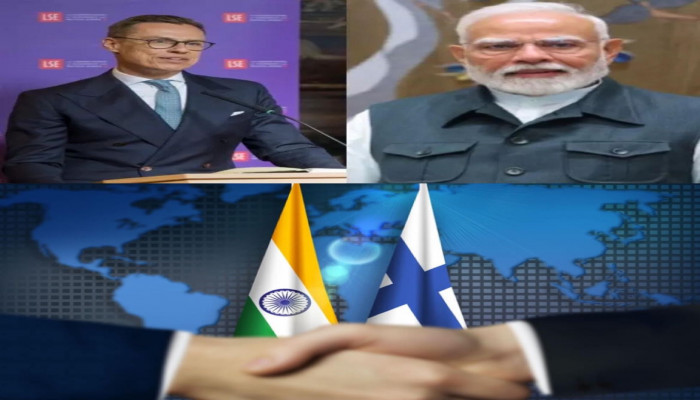
PM Narendra Modi on Thursday held bilateral talks with Finnish counterpart Alexander Stubb at Hyderabad House in New Delhi. During the meeting, both leaders agreed to expand cooperation between India and Finland in several key areas, including digitalisation, sustainability, clean energy, quantum computing and semiconductors. The two sides also decided to deepen engagement in defence and space cooperation.
After the talks, the two countries elevated their bilateral relationship to a strategic partnership and signed several Memoranda of Understanding (MoUs) to strengthen cooperation across different sectors. The decision marks an important step in strengthening ties between India and Finland and reflects the growing partnership between the two countries in emerging technologies and sustainable development.
Addressing a joint press statement after the meeting, Prime Minister Narendra Modi said that India and Finland have decided to shape their bilateral relationship into a strategic partnership with a focus on digitalisation and sustainability. According to him, the partnership will help both countries expand cooperation in high-technology sectors and create new opportunities for collaboration.
“This partnership will accelerate and energise our cooperation in many high-tech areas, from AI to 6G telecom, from clean energy to quantum computing,” Modi said. He further added that collaboration between the two nations will also deepen in sectors such as defence, space, semiconductors and critical minerals.
The Prime Minister also emphasised the importance of trusted partnerships between democratic countries. He said that partnerships like the one between India and Finland can help create reliable technology ecosystems and stronger global supply chains. Such cooperation, he noted, will help countries work together in emerging technological fields while ensuring stability in the global economy.
During his remarks, Modi highlighted the ongoing cooperation between India and Finland in several sectors. He mentioned that Finnish telecom company Nokia has played an important role in connecting millions of Indians through its mobile and network technologies. This cooperation shows how technology partnerships between the two countries are already contributing to development.
The Prime Minister also pointed to collaboration between the two countries in infrastructure and green technology projects. He referred to Finnish architectural collaboration in building the world’s tallest railway bridge over the Chenab River in Jammu and Kashmir. In addition, he mentioned the development of the world’s largest bamboo-to-bioethanol refinery in Numaligarh as another example of cooperation between India and Finland.
Modi also said that the proposed India–European Union Free Trade Agreement (FTA) would further strengthen economic cooperation between India and Finland. According to him, the agreement will help boost trade, investment and technology collaboration between the two sides and open up new opportunities for economic growth.
Speaking about the broader global situation, the Prime Minister said that the world is currently facing a period of instability and uncertainty. He noted that conflicts are continuing in several parts of the world, including Ukraine and West Asia. In such circumstances, stronger cooperation between India and Europe can help support global stability and development.
“India believes in dialogue and diplomacy, and we believe in the rule of law,” Modi said while referring to ongoing global conflicts.
The Prime Minister also spoke about the growing relationship between India and Europe. He said that India and Europe are entering what he described as a “golden era” in their relations, with expanding cooperation across many sectors. According to him, this partnership will contribute to global stability, development and shared prosperity.
“Today, the world is going through a period of instability and uncertainty. Conflict persists in many parts of the world, from Ukraine to West Asia. In such a global environment, India and Europe, two of the world's major diplomatic powers, are entering a golden era of their relationship. Our growing cooperation is giving new strength to global stability, development, and shared prosperity. At the beginning of 2026, the historic India-European Union Free Trade Agreement was signed. This agreement will further strengthen trade, investment, and technology cooperation between India and Finland. India and Finland are important partners in areas such as digital technology, infrastructure, and sustainability,” Modi said.
The leaders also discussed expanding cooperation in areas such as Arctic and polar research. Along with emerging technology partnerships, this collaboration is expected to open new areas of joint work between the two countries in scientific and research fields.
According to the Ministry of External Affairs, the discussions between the two leaders covered a wide range of issues, including trade, technology, innovation, cooperation in multilateral forums and regional as well as global developments. These discussions reflect the growing engagement between India and Finland in international and strategic matters.
As part of the visit, Prime Minister Modi also hosted a luncheon in honour of the visiting Finnish President. The meeting and the events held during the visit are expected to strengthen ties between the two countries further and create more opportunities for cooperation in the future.
Earlier in the day, India’s External Affairs Minister S. Jaishankar met President Alexander Stubb ahead of the summit-level meeting. During his visit to India, President Stubb also paid homage at Rajghat.
The visit is expected to further strengthen relations between India and Finland, which are based on shared democratic values and expanding engagement between India and the Nordic and European regions. The elevation of the relationship to a strategic partnership marks a new phase in bilateral ties and reflects the commitment of both countries to work together in technology, sustainability and global cooperation.



 Loading...please wait
Comments