



India, European Union announce historic FTA, ‘mother of all deals’
- In Reports
- 05:06 PM, Jan 27, 2026
- Myind Staff
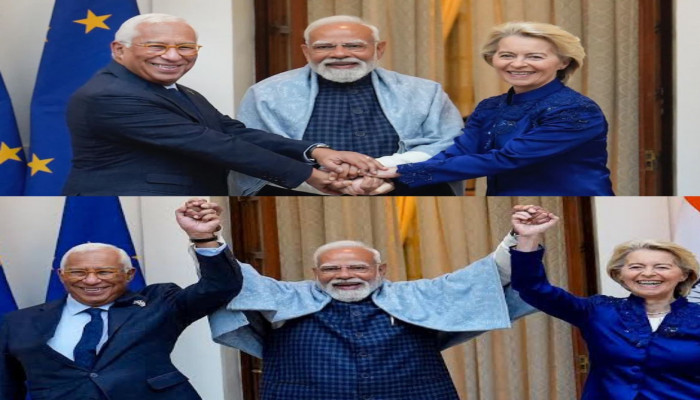
India, European Union announce historic ‘mother of all deals’, FTA
India and the European Union have announced a historic Free Trade Agreement (FTA) at a time of global economic uncertainty, marking a major milestone in their partnership. European Commission President Ursula von der Leyen described the agreement as the “mother of all deals,” highlighting its significance for both sides. The announcement was made during a joint statement with Prime Minister Narendra Modi and European Council President Antonio Costa in India.
Ursula von der Leyen expressed her excitement over the agreement and said, “Prime Minister, distinguished friend, we did it, we delivered the mother of all deals.” She described India and the European Union as “two giants who chose a win-win partnership,” emphasising that the agreement would strengthen economic ties and create mutual benefits.
According to Ursula von der Leyen, the deal is expected to cut around € 4 billion in tariffs. This is expected to provide a major boost to businesses on both sides and strengthen supply chains. She said the agreement would significantly deepen economic cooperation and reduce trade barriers between India and the EU.
As part of the trade pact, the European Union will lower import duties on 99.5% of traded goods over seven years. This includes bringing tariffs down to zero on several Indian products, such as marine products, leather and textile goods, chemicals, rubber, base metals, and gems and jewellery. The move is expected to open new opportunities for Indian industries in the European market.
Highlighting the importance of the agreement, Ursula von der Leyen said, “It brings together Indian skills, services and scale, with European technology, capital and innovation. It will create levels of growth which neither side can achieve alone.” She also stressed the strategic value of the deal in the current global scenario and said, “By combining our strengths, we reduce strategic dependencies at a time when trade is increasingly weaponised.”
During her visit to India, Ursula von der Leyen also spoke about her experience of being the chief guest at the Republic Day celebrations. She thanked India for its hospitality and said, “Thank you very much for the exceptional hospitality we experienced. It was such an honour for us to be your chief guests at Republic Day yesterday. This is a memory I will carry for a lifetime because the sense of communion was so powerful. People filled the streets, united in the pride and joy of belonging to the Indian nation and rightfully so.”
She further praised India’s progress and said, “India has risen, and Europe is truly glad about it because when India succeeds, the world is more stable, more prosperous and more secure, and we all benefit.”
Prime Minister Narendra Modi also highlighted the importance of the agreement and called it the biggest Free Trade Agreement in India’s history. He said, “Today, India has concluded the biggest Free Trade Agreement in its history. On 27th January, India signed this FTA with 27 European nations.” He added that the deal would boost investment, create new innovation partnerships, and strengthen supply chains at the global level.
PM Modi further said, “This will boost investment, form new innovation partnerships and strengthen supply chains at the global level...This is not just a trade agreement, it is a blueprint for shared prosperity.” He described the agreement as a remarkable example of cooperation between major economies and emphasised its positive impact on domestic sectors such as textiles, gems and jewellery, and leather goods.
The Prime Minister also pointed out the global significance of the agreement and said, “The deal represents approximately 25 per cent of global GDP and nearly one-third of global trade. It strengthens our shared commitment not only to trade but also to democracy and the rule of law.”
India–EU bilateral trade continues to be a strong pillar of their partnership. In 2024–25, bilateral trade crossed USD 190 billion. During this period, India exported USD 75.9 billion worth of goods and USD 30 billion in services to the EU. At the same time, EU exports to India stood at USD 60.7 billion in goods and USD 23 billion in services.
The India–EU Free Trade Agreement is expected to take at least six months to be formally signed, as it will undergo legal vetting by both sides. Negotiations for the agreement began in 2007 but were put on hold in 2013. Talks resumed in June 2022, eventually leading to the historic announcement.
The agreement marks a new chapter in India–EU relations and reflects a shared vision of economic growth, cooperation, and stability. With reduced tariffs, stronger supply chains, and deeper economic ties, the FTA is expected to reshape trade relations between India and the European Union and create new opportunities for businesses and industries on both sides.



 Loading...please wait
Comments