



India-EU trade deal allows EU Banks to set up 15 branches in four years
- In Reports
- 02:46 PM, Jan 29, 2026
- Myind Staff
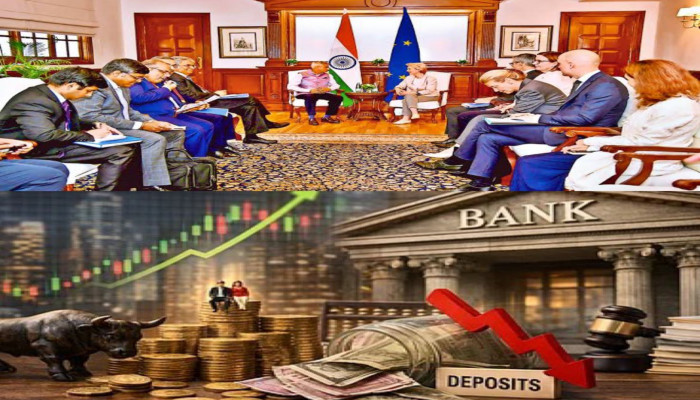
India has taken a major step in its trade and financial relations with the European Union by allowing EU banks to open more branches in the country under the newly signed India-EU trade deal. According to the agreement, EU banks will be permitted to establish up to 15 branches in India over a period of four years. This marks an increase from the earlier limit of 12 branches and reflects India’s gradual approach toward liberalising its financial sector.
Under the deal, India has also agreed to allow foreign direct investment (FDI) in the insurance sector to 100 per cent. In return, Indian professionals working in EU member countries will benefit from a more stable visa regime. This move is expected to strengthen financial services cooperation between India and the EU and improve opportunities for both sides.
The government explained that India’s sectoral offers show a forward-looking approach toward liberalisation. In an official announcement, the government said, “India's sectoral offers represent a forward-looking liberalisation approach, factoring in the recent liberalisation allowing 100% FDI in Insurance sector and featuring enhanced Foreign Direct Investment (FDI) limits of 74% in banking, alongside a liberalised bank branch licensing framework allowing up to 15 bank branches to be established over a four-year period—a significant expansion from the previously offered GATS limits of 12 branches.”
Earlier, India did not provide similar relaxation for bank branches under the free trade agreement signed with the United Kingdom last year, although concessions were offered to New Zealand. The new offer under the India-EU trade deal places EU financial service providers in a strong competitive position in India’s expanding financial services market. At the same time, it highlights India’s commitment to gradual market liberalisation aligned with its broader strategic goals.
The agreement also brings benefits for Indian financial service providers. The EU’s liberalised offers will allow Indian companies to expand their operations in the EU, which is expected to strengthen India’s financial services exports and support long-term growth in the sector. The trade deal is seen as a step toward deeper integration of the financial systems of both economies.
Apart from banking and financial services, the trade deal includes provisions related to professionals and services. Under the agreement, the EU has allowed AYUSH practitioners, and doctors have also been given permission to open clinics and wellness centres. AYUSH professionals will be able to provide services using the professional qualifications they obtained in India.
The deal also introduces visa-related benefits for professionals. Across sectors, intra-corporate transferees will be eligible for three-year visas, which can be extended by another two years. These benefits will also be available to spouses and dependents. An official told TOI that this move would help Indian IT companies and multinational firms that operate in India or EU member countries.
The India-EU Free Trade Agreement is being described as a milestone in bilateral cooperation between the two sides. Total services trade between India and the EU was around $83 billion in 2024. In the same year, India exported about $700 million worth of financial services to the EU and imported around $600 million worth of financial services.
The agreement is expected to provide a strong institutional and regulatory framework to accelerate bilateral cooperation, improve market access, and support deeper integration of the financial systems of India and the EU. The India-EU Financial Services Annexe is considered a major improvement over earlier commitments under the General Agreement on Trade in Services (GATS). It has evolved to include a total of 16 articles.
The key achievements of the Financial Services Annexe include provisions related to electronic payments and real-time transaction infrastructure, financial technology and regulatory innovation, credit rating and non-discrimination, increased FDI investment limits, and bank branches. These developments are expected to strengthen financial sector cooperation and create new opportunities for businesses and professionals in both regions.
Overall, the India-EU trade deal reflects a balanced approach in which India has opened more space for EU banks and investors while securing benefits for Indian professionals and service providers. The agreement is expected to play an important role in strengthening economic ties and expanding cooperation in financial services between India and the European Union.



 Loading...please wait
Comments