




India declared Naxal-free: Amit Shah credits security push, targets Congress and Urban Naxals
- In Reports
- 12:27 PM, Mar 31, 2026
- Myind Staff
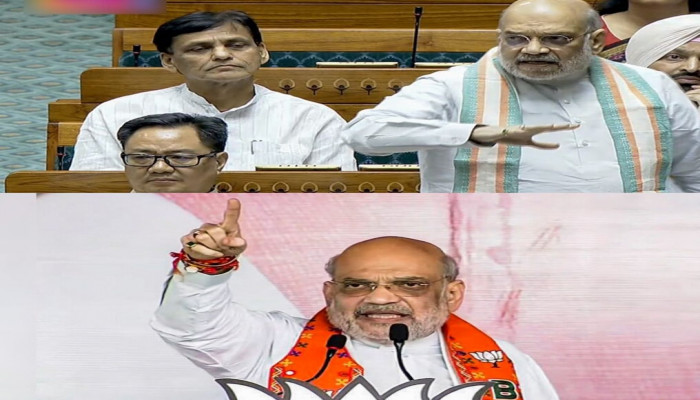
Union Home Minister Amit Shah on Monday declared in the Lok Sabha that India has become “Naxal-free,” a day before the government’s March 31, 2026, deadline to eliminate left-wing extremism. In his 84-minute address, Shah highlighted the success of security operations and development initiatives while blaming the Congress and earlier governments for allowing the insurgency to persist for decades.
Shah presented data to show the scale of the crackdown. He said that in the last three years, 4,839 Maoists surrendered, 706 were killed, and 2,218 were arrested and jailed. He also pointed out that the leadership structure of the Maoists has collapsed. “The central committee and politburo of the Maoists had 21 members at the beginning of 2024. Today, there is none. There were 37 state committee members in the Dandakaranya region. All of them have been either killed, arrested or surrendered. In Telangana, only one leader is absconding. We vowed that by March 31, we will uproot Naxalism. Now, I can say that India is Naxal-mukt,” Shah said.
Defending the government’s approach, Shah said force was necessary against armed rebels. “Those who fire bullets must be responded to with bullets,” he said, adding that 92% of the arms used by Maoists were taken from police stations. He explained that improved policing, better coordination between CAPF and state police, and an all-agency approach involving the NIA, ED, and intelligence agencies helped remove gaps in governance.
Shah also criticised a 2011 Supreme Court judgment that banned Salwa Judum, a civilian militia formed to counter Maoists. The judgment was delivered by a bench that included former judge B Sudershan Reddy. “I condemn such a judgment, which is based on an ideology that led to the killings of thousands of civilians. Ideology can’t be above people’s interests,” Shah said.
Targeting the Congress, Shah alleged that earlier governments enabled the spread of Maoism. Referring to former Prime Minister Indira Gandhi, he claimed Maoists had received support during her tenure. He also referred to the Sonia Gandhi-led National Advisory Council and named individuals like Harsh Mandar, alleging that they supported Maoists.
He cited remarks by former Home Minister P Chidambaram after the killing of 70 jawans, stating that Chidambaram had said he could not ask Maoists to give up arms. Shah also alleged that Maoist sympathisers celebrated such killings and accused Rahul Gandhi of associating with Maoist leaders in the past.
Speaking about Salwa Judum, Shah said it was created by Congress leader Mahendra Karma but was later banned by the court. He claimed that after the ban, Maoists killed former members of the militia. He also criticised the Congress for supporting Justice Reddy later in the vice-presidential elections, repeating his objection to the judgment.
Shah said that after 2014, under Prime Minister Narendra Modi, the government adopted a clear and firm policy against insurgency. He said illegal activities in Maoist areas, as well as in Kashmir and the Northeast, were dealt with strongly. He highlighted better coordination between states and improved functioning of security forces and central agencies.
The minister also targeted what he called “Urban Naxals.” He accused them of showing sympathy towards Maoists while ignoring the victims. “These Urban Naxals didn’t write a single word for the mother whose eight-year-old son was abducted by Maoists for arms training. They didn’t show sympathy towards impaired farmers whose legs were blown off with bombs. More than 5,000 security forces were martyred. No article for their widows and orphan children. I do not accept this double character of humanity,” he said. He also indicated that the government could take action against such sympathisers.
Describing rehabilitation camps, Shah shared accounts of victims who were forced into Maoist groups. “All Urban Naxals must go to the rehab camps and see how the lives of people have been destroyed,” he said, adding that the government is working to rehabilitate those affected.
He described the issue as an ideological battle and criticised Left ideology, saying it was influenced by Russia and China. He argued that taking up arms against the Constitution cannot be justified and said that Maoists tried to create a vacuum in governance and security. He also accused them of running a parallel system where they controlled local administration and blocked democratic processes.
Shah repeated the government’s position on talks with Maoists. “Give up your weapons, the government will rehabilitate you,” he said. He added, “Those who fire bullets will be replied with bullets. This is our policy.”
He also highlighted the use of technology in operations, including drone surveillance, satellite imaging, forensic analysis, and AI-based tracking. He mentioned several operations such as Operation Octopus, Double Boot, Thunderstorm, Bhim, and Chakrabandha, along with a major operation on the Telangana-Chhattisgarh border where Maoists had set up a strong base.
Shah described the difficult conditions faced by security forces, including extreme heat and limited water supply. He said the forces remained committed despite these challenges and successfully carried out long operations.
He stressed that development played a major role in ending Maoist influence. He said governance has now reached remote areas, and infrastructure has improved significantly. According to him, 17,500 kilometres of roads were approved in affected areas, with 12,000 kilometres already constructed. Thousands of mobile towers, bank branches, ATMs, post offices, schools, and skill centres have also been set up.
Shah added that large funds were allocated for security and development projects. He mentioned a super-speciality hospital in Jagdalpur and other initiatives aimed at improving public services. He concluded that development has been possible because violence has been controlled and governance has been strengthened in these regions.



 Loading...please wait
Comments