




India creates history in 48 hours with first private orbital rocket and hydrogen train
- In Reports
- 02:23 PM, Jul 20, 2026
- Myind Staff
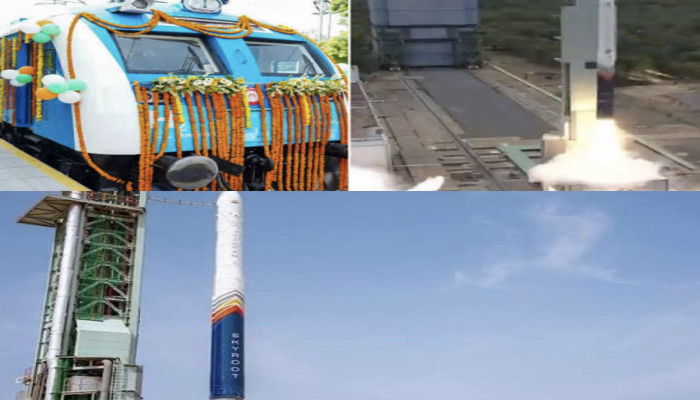
India achieved two major technological milestones within 48 hours. The country strengthened its position in space technology and clean transportation with two landmark developments. Hyderabad-based Skyroot Aerospace successfully launched Vikram-1, India's first privately developed orbital launch vehicle. A day earlier, Prime Minister Narendra Modi flagged off India's first indigenously built hydrogen-powered train from Jind. These achievements highlight India's growing focus on innovation, private participation, and sustainable development.
Skyroot Aerospace made history on Saturday after it successfully launched Vikram-1 under Mission Aagaman from the Satish Dhawan Space Centre in Sriharikota. The mission marked the first successful launch of an orbital rocket developed by a private Indian company. The achievement opened a new chapter for India's private space sector.
Unlike suborbital rockets, Vikram-1 can place satellites into a stable Earth orbit. This capability supports several important applications, including communication, navigation, Earth observation, and scientific research. The successful mission also reflected the progress of India's commercial space industry after the Indian Space Policy 2023 allowed greater private participation across the country's space ecosystem.
Vikram-1 stands 24 metres tall, making it nearly the height of a seven-storey building. Skyroot Aerospace designed the rocket for rapid and on-demand launch services. The vehicle can carry payloads of up to 350 kilograms to a 450-kilometre Low Earth Orbit (LEO) at a 60-degree inclination.
The company built the rocket using an all-carbon composite structure. This design reduces the vehicle's weight while improving its strength and durability. Vikram-1 uses a four-stage configuration. It includes three solid-fuel stages along with a liquid-fuelled orbital adjustment module. Skyroot Aerospace also equipped the rocket with 3D-printed liquid engines. The technology helps reduce manufacturing time and simplifies production.
The successful launch is widely seen as a major milestone for India's private space industry. It also reflects the impact of recent policy reforms that opened the country's entire space value chain to private companies. The mission demonstrates the growing capabilities of Indian startups in advanced space technology.
Just a day before the Vikram-1 launch, India achieved another significant milestone in sustainable transport. Prime Minister Narendra Modi flagged off the country's first indigenously built hydrogen-powered train from Jind. The launch placed India among a small group of nations that have introduced hydrogen-powered rail technology.
India now joins countries such as Japan, Germany, the United States, and China in operating hydrogen-powered trains. The new train consists of 10 coaches, making it one of the longest hydrogen-powered passenger trains developed so far. It runs on a powerful 3,200-horsepower propulsion system. This makes it one of the world's most powerful hydrogen-powered trainsets currently in operation.
Hydrogen-powered trains offer a cleaner alternative to conventional rail transport. The introduction of this technology reflects India's efforts to adopt cleaner energy solutions while modernising its railway network. The project also showcases the country's growing ability to develop advanced transportation systems using indigenous technology.
Addressing a public gathering in Jind after flagging off the train, Prime Minister Narendra Modi spoke about the significance of the achievement. He also highlighted how recent hydrogen rail technology is on the global stage.
"Hydrogen trains have only recently arrived on the global stage. They came into existence just seven or eight years ago. Currently, only three or four countries possess the capability to operate hydrogen trains, and even in those nations, the technology is still in its early stages. However, hearing about the capabilities of India's hydrogen train will fill you and every Indian with pride," the Prime Minister said.
The two milestones showcase India's expanding capabilities across different sectors. The successful launch of Vikram-1 strengthens the country's position in commercial space technology. The introduction of the hydrogen-powered train marks an important step towards cleaner and more sustainable public transport.
Together, these achievements underline India's ambition to become a global leader in advanced technology. They also highlight the country's growing focus on innovation, self-reliance, and future-ready infrastructure. Within less than 48 hours, India demonstrated progress both on the ground and in space, setting new benchmarks in transportation and aerospace.



 Loading...please wait
Comments