



India condemns airstrikes on Afghanistan at UNSC, calls them ‘flagrant violations’ of International Law
- In Reports
- 05:47 PM, Mar 10, 2026
- Myind Staff
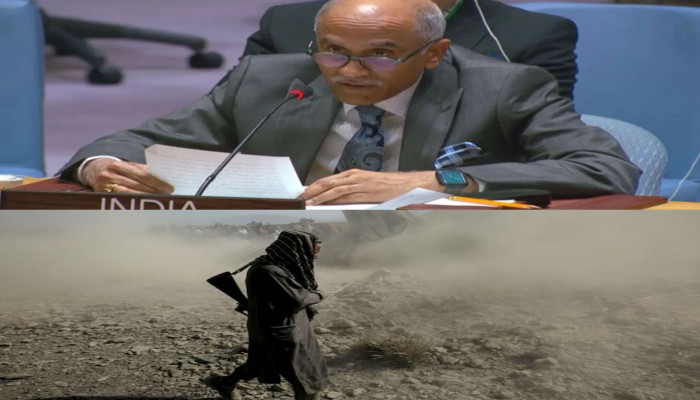
India on Tuesday strongly condemned recent airstrikes on Afghanistan, describing them as “flagrant violations” of international law, the United Nations Charter, and the principle of state sovereignty. The statement was made at the United Nations as tensions and cross-border clashes between Pakistan and Afghanistan continue to intensify.
India’s Permanent Representative to the United Nations, Parvathaneni Harish, raised the issue during discussions at the UN. His remarks came while referring to concerns highlighted in a report presented by the Secretary-General of the United Nations about civilian casualties resulting from cross-border violence.
Harish pointed out that the Secretary-General’s report had expressed serious concern about the impact of armed conflict on civilians living in the affected regions. He said India supports the appeal made by the UN leadership to follow international law and ensure the protection of civilians.
“The Secretary-General’s report also expresses deep concern over civilian casualties caused by cross-border armed violence. We reiterate our support for the Secretary-General’s call urging compliance with obligations under international law, including international humanitarian law, and ensuring the protection of civilians,” Harish said.
He further emphasised India’s strong opposition to the airstrikes carried out on Afghan territory.
“We strongly condemn the airstrikes on the territory of Afghanistan, which are flagrant violations of international law, the United Nations Charter, and the principle of state sovereignty,” he said.
The remarks come at a time when fighting between Pakistan and Afghanistan has escalated sharply. In recent days, both sides have carried out multiple strikes against each other across their shared border. The ongoing clashes have become the deadliest confrontation between the two neighbouring countries in recent years.
Authorities in Islamabad have described the situation as an “open war,” indicating the seriousness of the hostilities between the two sides. The clashes have now continued for nine days, despite repeated appeals from the international community urging both countries to exercise restraint and avoid further escalation.
On Friday, both sides reported heavy losses during cross-border military operations. Officials from each country claimed that dozens of enemy troops had been killed during the fighting.
The violence has also been accompanied by attacks targeting security personnel in the region. In one such incident, a suicide car bomber attacked a security post in North Waziristan, a district that borders Afghanistan. According to a local doctor, the explosion killed one civilian and injured 18 other people. Several of the injured were reported to be in serious condition.
No group immediately claimed responsibility for the attack. However, suspicion has fallen on the militant group Tehrik-e-Taliban Pakistan, which frequently carries out attacks against Pakistani security forces and civilians.
Meanwhile, Afghanistan’s Taliban-run defence ministry said its forces had destroyed several Pakistani military positions along the border. According to Afghan officials, the strikes targeted military posts located in different provinces along the frontier.
The Afghan side claimed that its forces had “destroyed numerous Pakistani military posts” in border areas, including Nangarhar, Kandahar, Kunar, Paktia, and Khost. Afghan authorities also claimed that dozens of Pakistani soldiers were killed during the operations.
However, Pakistani state-run media reported a different version of events. According to those reports, Pakistan’s air force and ground troops carried out strikes that caused heavy losses to Afghan forces and militants during the recent fighting.
Islamabad has said that the military operations launched last week will continue until Afghanistan takes clear and verifiable steps to control the activities of militant groups that Pakistan claims are operating from Afghan territory.
Pakistan has repeatedly accused the Taliban government in Kabul of providing shelter to the Tehrik-e-Taliban Pakistan. Afghan authorities have denied these allegations.
Since the Taliban returned to power in Afghanistan in August 2021, the Tehrik-e-Taliban Pakistan has intensified attacks inside Pakistan, leading to growing tensions between the two countries.
As the clashes continue, international concern is rising over the possibility of further escalation and the increasing risk to civilians living near the border regions.



 Loading...please wait
Comments