




India calls for strict accountability of attackers of schools and children at UNSC
- In Reports
- 12:36 PM, Jun 26, 2026
- Myind Staff
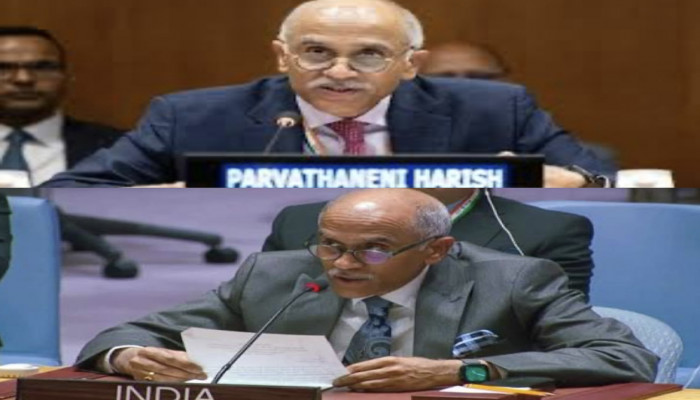
India has called for strict accountability against those who attack schools and children during armed conflicts. The country told the United Nations Security Council (UNSC) that protecting children is not enough if those responsible for such crimes continue to act without facing consequences. India stressed that education remains a basic right even during war and must be protected at all costs.
India's Permanent Representative to the United Nations, Ambassador Harish Parvathaneni, raised the issue during the UNSC open debate on "Strengthening the Prevention of and Protection of Education for Children Affected by Armed Conflict: From Normative Commitments to Effective Implementation" held on Wednesday. He said education gives children hope and plays a major role in building lasting peace in societies affected by conflict.
"Education is a right that should endure in times of conflict. It is a right whose fulfilment is among the most powerful contributions to lasting peace. India remains unwavering in its commitment to protecting children in armed conflict and to upholding their right to learn, to grow, and to realise their full potential," Parvathaneni said.
He also highlighted the need to ensure justice for attacks on children and educational institutions. "Protection without accountability is incomplete. Those who target schools and children with impunity must be held to account," he said.
India's remarks came after the United Nations released its latest report on Children and Armed Conflict, which presented alarming findings for 2025. The report said violations against children in conflict zones reached "shocking levels" during the year. The United Nations verified 38,558 grave violations involving 24,174 children. The affected children included 15,493 boys, 7,990 girls and 691 children whose sex remained unknown. This marked the highest number of children affected since the UN began monitoring such violations.
The report also showed that more children suffered multiple serious violations during the year. The number increased from 3,137 in 2024 to 3,176 in 2025. According to the report, parties involved in armed conflicts failed to meet their obligations under international humanitarian law and international human rights law. Many continued to commit serious violations with almost complete impunity. These actions caused severe humanitarian consequences for civilians. Children suffered the most as schools, hospitals and essential public services came under attack.
The report stated that government forces were responsible for the majority of grave violations. They emerged as the main perpetrators in cases involving the killing and maiming of children, attacks on schools and hospitals, and denial of humanitarian access.
India also pointed to another worrying finding from the report. It noted that attacks on schools increased by 44 per cent in just one year. Parvathaneni described these figures as deeply concerning. He said nearly 473 million children, or more than one in every six children worldwide, either live in conflict zones or have fled them. He added that more than 85 million of these children have no access to education.
"These figures are a damning verdict on humanity's collective failure to translate commitments into reality on the ground," he said.
Parvathaneni stressed that protecting children's education also protects the future of every nation. He said governments have the primary responsibility to safeguard children's rights and ensure access to education even during difficult times.
He highlighted India's own efforts in this area. He said the Right to Education is a fundamental right under the Indian Constitution. It guarantees free and compulsory education for every child up to the age of 14 years. India has also introduced DIKSHA (Digital Infrastructure for Knowledge Sharing), the national digital platform for school education. The platform has expanded access to quality learning through interactive content and AI-powered tools available in several languages.
"Our domestic commitment to ensure access to affordable and quality education also shapes our engagement on this issue internationally," he said.
Parvathaneni said India successfully used digital technology to maintain learning during the Covid-19 pandemic, when physical classrooms remained closed. He said this experience demonstrated the importance of digital education during emergencies.
"Our experience has convinced us that access to digital learning can be the bridge that helps children access education during conflicts," he said.
He further stated that investing in education for children affected by war remains essential. He said India has consistently supported education for refugees and displaced communities from neighbouring countries. The country believes uninterrupted learning strengthens resilience and supports long-term recovery.
Parvathaneni also noted that India has contributed to rebuilding educational infrastructure in several countries, including those in its neighbourhood. These efforts include constructing schools and vocational training centres to help children continue their education despite the challenges created by conflict.



 Loading...please wait
Comments