




India becomes world’s second-largest arms importer between 2021-25: SIPRI Report
- In Reports
- 06:18 PM, Mar 09, 2026
- Myind Staff
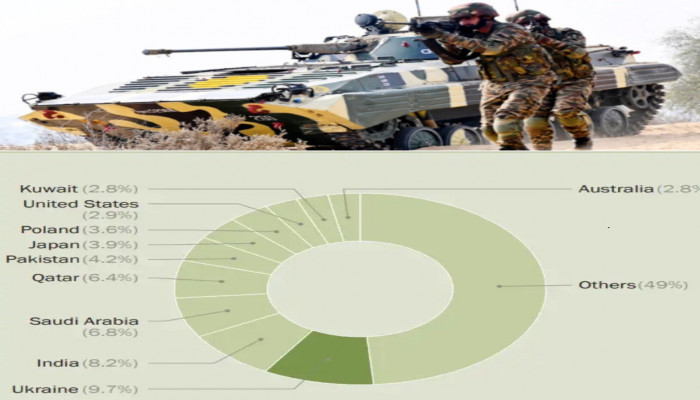
India was the world’s second-largest importer of arms between 2021 and 2025, accounting for 8.2 per cent of total global arms imports, according to a report released by the Stockholm International Peace Research Institute (SIPRI). The report highlights India’s continuing reliance on foreign suppliers for defence equipment while also noting a gradual shift in its procurement strategy.
According to the think tank, India’s position as the second-largest importer reflects its ongoing efforts to strengthen its defence capabilities amid regional security challenges. The report stated, “India was the world’s second largest recipient of major arms in 2021–25 with an 8.2 per cent share of total global arms imports.”
The report also explained the reasons behind India’s continued defence imports. SIPRI noted that security tensions in the region remain a major factor influencing India’s military procurement decisions. It said, “These tensions have regularly led to armed conflict, as they did briefly between India and Pakistan in May 2025, with both sides using imported major arms.”
Over the past decade, India has gradually changed the way it sources military equipment. While Russia has historically been the country’s main supplier of arms, India has increasingly diversified its defence partnerships. According to SIPRI, the country has been shifting its arms relations away from Russia and towards Western suppliers such as France, Israel and the United States.
Despite this shift, Russia remained India’s top arms supplier during the 2021–2025 period. However, the share of Russian weapons in India’s arms imports has declined significantly over time. SIPRI data shows that Russia’s share in Indian arms imports fell from 70 per cent during 2011–15 to 51 per cent in 2016–20, and further dropped to 40 per cent during 2021–25.
The report also indicated that India’s total arms imports have slightly declined in recent years. Between 2016–20 and 2021–25, India’s arms receipts fell by about 4 per cent. SIPRI partly attributed this reduction to India’s growing ability to design and produce its own defence equipment.
Even though imports have declined slightly, India is still expected to continue relying on foreign suppliers for several defence requirements. SIPRI pointed to India’s recent defence deals and procurement plans as examples of this trend. The report referred to India’s agreements with European suppliers, including France and Germany, which indicate that foreign partnerships remain important for the country’s military modernisation.
One of the major defence deals mentioned in the report was signed in April 2025. India entered into an Inter-Governmental Agreement with France for the procurement of 26 Rafale fighter aircraft for the Indian Navy. The aircraft includes 22 single-seater and four twin-seater jets.
The agreement covers several components beyond the aircraft themselves. It includes training, simulators, associated equipment, weapons, and performance-based logistics. Additional equipment will also be supplied for the existing Rafale fleet operated by the Indian Air Force. According to the agreement, the delivery of the aircraft is expected to be completed by 2030, while training for the crew will take place both in France and in India.
India has also entered into another defence arrangement involving the United States. The Ministry of Defence signed an agreement with US-based Metrea Management for the wet leasing of one flight refuelling aircraft. The aircraft will be used to provide air-to-air refuelling training for pilots of both the Indian Air Force and the Indian Navy.
The report also referred to a broader strategic framework between India and the United States aimed at strengthening defence cooperation. Under a 10-year framework for a major defence partnership, the US has identified India as a priority country for defence collaboration. During the announcement, US Secretary of War Pete Hegseth said that India is a priority country for the US in defence cooperation.
Alongside imports, India is also focusing on expanding its domestic defence manufacturing capabilities. The latest Union Budget allocated Rs 7.85 lakh crore for defence spending, which represents an increase of 15.19 per cent over the Budgetary Estimates of FY 2025–26. Defence expenditure now accounts for 14.67 per cent of the total Union Budget, making it the highest allocation among all ministries.
A significant portion of the defence budget has been earmarked for procurement from domestic manufacturers. Out of the total defence budget, Rs 1.39 lakh crore has been allocated specifically for purchases from domestic defence industries. The government has also reserved about 75 per cent of the capital acquisition budget for domestic defence industries in FY27, highlighting the push for greater self-reliance in defence production.
India’s defence spending has also increased significantly over the years. The defence budget has grown from Rs 2.53 lakh crore in 2013–14 to Rs 7.85 lakh crore in 2026–27, which represents nearly a threefold increase.
The SIPRI report also examined global trends in arms trade. According to the data, the five largest arms importers between 2021 and 2025 were Ukraine, India, Saudi Arabia, Qatar and Pakistan. Together, these five countries accounted for 35 per cent of total global arms imports during the period.
On the export side, the report identified the United States, France, Russia, Germany and China as the five largest arms exporters globally during the same period. These five countries together accounted for 70 per cent of all global arms exports.
The report also highlighted major changes in the global arms market. Arms exports from the United States, France, Germany and China increased between 2016–20 and 2021–25. In contrast, Russia’s share of global arms exports declined sharply.
According to SIPRI, America’s arms exports grew by 27 per cent during this period, and the country’s share of global exports increased from 36 per cent to 42 per cent. Over the past five years, the United States’ share of global arms exports has been greater than the combined share of the next seven largest suppliers.
The findings underline India’s continuing role as one of the largest defence importers in the world while also showing a gradual shift in its procurement strategy and increasing efforts to strengthen domestic defence production.



 Loading...please wait
Comments