




India, Bangladesh, and the Hindu Minority Crisis: A Strategic, Legal, and Civilisational Assessment Under the Responsibility to Protect (R2P) Doctrine
- In Current Affairs
- 12:36 PM, Dec 21, 2025
- Dr Ryan Baidya
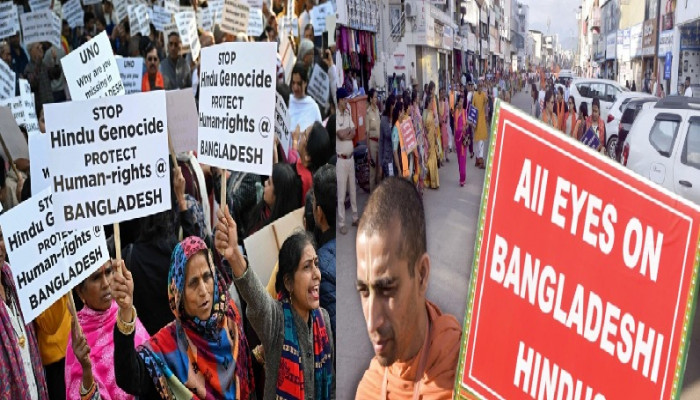
The rapid political meltdown in Bangladesh following the fall of the Sheikh Hasina government has triggered an unprecedented wave of organised violence against the Hindu minority. This violence, visible in the past year but intensified dramatically in the last several days, includes targeted killings, arson, assaults on women, desecration of temples, and mass displacement. Bangladesh’s transitional government has failed to provide security, and non-state extremist actors have exploited the instability.
India, as the region’s largest power and the civilisational homeland of the Hindu population of East Bengal, faces a dilemma with profound humanitarian, strategic, and geopolitical implications. The crisis challenges India's regional leadership ambitions, its historical responsibilities arising from the 1947 Partition, and its growing global position as a defender of democratic norms and human rights.
The article argues that India must seriously consider invoking the Responsibility to Protect (R2P) doctrine—an UN-endorsed framework that obliges states and the international community to intervene (including with limited force) when a state fails to protect its population from genocide, ethnic cleansing, war crimes, or crimes against humanity.
India has legal standing, moral legitimacy, historical responsibility, and strategic incentive to act. The crisis demands a multi-phase, calibrated approach that combines diplomatic escalation, humanitarian mechanisms, international legal frameworks, and contingency planning for targeted protective action if violence further escalates.
Failure to act will not only endanger the Hindu minority in Bangladesh but also destabilise India’s eastern frontier, embolden extremist actors, undermine India’s global standing, and allow external powers (notably China) to fill strategic vacuums.
India must recognise that regional stability begins at its borders—and that the protection of vulnerable populations with deep civilizational ties to India is both a moral duty and a strategic necessity.
A Crisis India Can No Longer Ignore
Bangladesh is undergoing one of the most chaotic transitions since its independence in 1971. The resignation of the Hasina government, followed by the rise of a fragile interim administration, has dismantled the security architecture that once restrained extremist networks. In this climate, the Hindu minority—already traumatised by decades of discrimination—has become a primary target.
Reports and field assessments show:
-
Houses burned in coordinated attacks
-
Hindu women assaulted or abducted
-
Temples looted or destroyed
-
Entire neighbourhoods depopulated overnight
-
Police units are either inactive or overwhelmed
-
Massive demonstrations by Hindus pleading for help
This violence is not random. It is systematic, organised, and occurring under conditions in which the Bangladeshi state is failing in its basic duty to protect vulnerable populations.
For India, this is not merely a humanitarian concern. It is a regional security threat, a civilisational responsibility, and a strategic test.
The Historical Burden: Partition and Abandonment
Any analysis of the Hindu crisis in Bangladesh must return to 1947, when the Partition created borders that did not reflect historical, demographic, or cultural realities. The Hindus of East Bengal—the very population now under attack—did not choose to separate from India. They did not vote for Pakistan. They did not consent to their minority status.
Partition was shaped by:
-
Colonial divide-and-rule strategies
-
Hasty geopolitics of departing British administrators
-
Political compromises among Indian elites
The outcome was catastrophic:
-
Millions killed or displaced
-
Civilisations split unnaturally
-
Families scattered
-
Religious minorities left stranded
The Hindus of East Bengal were abandoned by history, and India never fully acknowledged the magnitude of this abandonment.
The demographic collapse since then reflects a pattern of structural violence:
|
Year |
Hindu Population in East Bengal/Bangladesh |
|
1947 |
~30% |
|
1974 |
~13% |
|
1991 |
~10% |
|
2022 |
<8% |
|
2026 |
Estimated 6–7% |
No minority in South Asia has suffered such sustained demographic erosion without large-scale war.
The present crisis must be seen through this long historical lens: the suffering of Bangladeshi Hindus is not new—it is the continuation of Partition’s unfinished tragedy.
The Current Crisis: Anatomy of a State Failure
Following the government's collapse:
-
Security forces retreated or fragmented.
-
Extremist networks mobilised.
-
Local political actors exploited chaos.
-
Minorities became primary targets.
Documented incidents include:
-
Homes burned in districts such as Khulna, Jessore, and Barisal
-
Murders of Hindu schoolteachers and community leaders
-
Forced resignations of minority professors
-
Looting of ISKCON temples
-
Abduction of young Hindu women
-
Entire villages migrating toward the Indian border
The state’s inability to protect its citizens has triggered a humanitarian emergency and raised the question of international obligations under R2P.
The R2P Framework: Sovereignty as Responsibility
The Responsibility to Protect, adopted unanimously at the 2005 UN World Summit, rests on three pillars:
Pillar I: States must protect their populations from mass atrocities: Bangladesh is failing this obligation.
Pillar II: The international community must assist States in fulfilling this responsibility: India has the geographic proximity and civilizational connections to lead such assistance.
Pillar III: If a State manifestly fails, the international community must be prepared to take collective action, including force, as a last resort.
The doctrine explicitly recognises:
-
genocide
-
war crimes
-
ethnic cleansing
-
crimes against humanity
The situation in Bangladesh increasingly aligns with ethnic cleansing indicators, including forced displacement, destruction of cultural sites, and targeting of specific communities.
India, under R2P, has full legal standing to lead regional or multilateral interventions.
India’s Strategic Imperatives
5.1 Border Stability and Refugee Pressures
Violence against Hindus has consistently produced refugee flows into India—particularly West Bengal, Assam, and Tripura. Large-scale displacement creates:
-
demographic pressures
-
communal tensions
-
administrative burdens
-
political flashpoints
India cannot absorb another wave resembling the 1971 exodus.
Extremist Expansion on India’s Eastern Frontier
Bangladesh’s instability creates opportunities for - Islamist groups, insurgent outfits, transnational networks and intelligence proxies
An extremist corridor on India’s eastern flank poses the same threat magnitude as Pakistan-based networks on the western border.
China’s Expanding Influence
China has invested billions in Bangladesh through BRI projects, port infrastructure, and military cooperation. A weakened Bangladeshi state under Chinese influence, combined with anti-Hindu violence, directly undermines India’s regional leadership.
India’s Civilisational Identity and Global Leadership
As India aspires to leadership in the Global South, its credibility depends on principled humanitarian action. Silence in the face of atrocities weakens India’s normative power.
India’s Policy Options: A Multi-Phase Strategy
This article proposes a calibrated, three-phase framework.
Phase One: Diplomatic Escalation (Immediate)
-
Raise the crisis at the UN Security Council- Demand an emergency session.
-
Mobilise R2P language in international statements - Signal legal intent.
-
Push for an international monitoring mission- Including human-rights observers.
-
Engage key partners- the US, Japan, the EU, Australia and ASEAN
-
Demand that Bangladesh secure its minorities- Hold perpetrators accountable.
Phase Two: Humanitarian Protection Measures (Short Term)
-
Establish humanitarian corridors near the border. Precedent: Syria, Yemen, Sudan.
-
Deploy Indian disaster-response units. Not military incursions—but security-assisted humanitarian operations.
-
Create “Safe Shelters” along the Indian side of the border. Prevent chaotic refugee influxes.
-
Coordinate with NGOs, ISKCON, and civil society networks.
-
Provide logistical and medical assistance.
Phase Three: Contingent Protective Action Under R2P (If Violence Escalates)
If atrocities continue:
-
Establish internationally monitored safe zones inside Bangladesh- With India providing security assistance.
-
Conduct limited, precise operations against extremist groups- Only those directly attacking Hindu settlements.
-
Joint India–Bangladesh stabilisation framework- If Dhaka consents, India can assist in restoring order.
-
Technology-enabled monitoring- Satellites, drones, and intelligence sharing.
This is not an invasion.
This is a preventive humanitarian intervention, consistent with 1971 and modern R2P norms.
Scenario Forecasts: The Next 6–18 Months
|
Scenario 1: Bangladesh stabilises (Low-Medium probability) |
Requires strong political leadership, security coherence, and regional support. |
|
Scenario 2: Prolonged instability and minority cleansing (High probability) |
Most likely trajectory given current conditions. |
|
Scenario 3: Mass refugee flow into India (Medium-High probability) |
It would strain India domestically and heighten political tensions. |
|
Scenario 4: Radical groups seize territorial footholds (Medium probability) |
A long-term strategic threat to India. |
|
Scenario 5: China expands influence through stabilisation offers (High probability) |
Beijing may present itself as a “neutral stabiliser,” sidelining India |
Risks & Mitigations
|
Risk 1: Diplomatic fallout with Bangladesh |
Mitigation: Frame actions through R2P and humanitarian language. |
|
Risk 2: International criticism of intervention |
Mitigation: Build multilateral backing and document atrocities. |
|
Risk 3: Domestic communal polarisation |
Mitigation: Emphasise protection for all persecuted minorities. |
|
Risk 4: Military escalation |
Mitigation: Use limited, precise, legally justified operations. |
|
Risk 5: Chinese countermoves |
Mitigation: Strengthen India-Japan-US coordination. |
Strategic Recommendations
|
Recommendation 1: Immediately internationalise the issue. No more bilateral quiet diplomacy. |
Recommendation 5: Prepare military and intelligence contingencies discreetly. |
|
Recommendation 2: Mobilise R2P frameworks proactively. Signal that India is prepared for responsibility-sharing interventions. |
Recommendation 6: Increase monitoring of extremist activity within Bangladesh. |
|
Recommendation 3: Build a regional coalition for minority protection. |
Recommendation 7: Offer political support for Bangladesh’s internal stabilisation—conditional on minority protection. |
|
Recommendation 4: Establish humanitarian infrastructure on India’s side of the border. |
Recommendation 8: Counter Chinese influence diplomatically and strategically. |
Conclusion: A Defining Test of India’s Role in South Asia
The crisis facing Bangladesh’s Hindu minority is not an isolated event. It is a continuation of historical injustices dating back to Partition, compounded by contemporary political failures. For India, the crisis is a test of regional leadership, strategic foresight, humanitarian responsibility, civilisational identity, and geopolitical maturity.
If India aspires to be the stabilising power of South Asia, it must act—not rashly, but decisively, lawfully, and strategically.
The Responsibility to Protect doctrine provides both the legal framework and moral foundation for action. India must lead, not merely observe.
To protect Sanatan beyond India’s borders is to secure it within them.
To protect vulnerable populations in Bangladesh is to protect regional stability itself.
This is India’s moment to demonstrate that its rise is anchored not only in economic and military power, but in moral courage and civilisational duty.
Disclaimer: The opinions expressed within this article are the personal opinions of the author. MyIndMakers is not responsible for the accuracy, completeness, suitability, or validity of any information on this article. All information is provided on an as-is basis. The information, facts or opinions appearing in the article do not reflect the views of MyindMakers and it does not assume any responsibility or liability for the same.



 Loading...please wait
Comments