




India and Japan unveil major defence, technology initiatives to deepen strategic partnership
- In Reports
- 07:06 PM, Jul 02, 2026
- Myind Staff
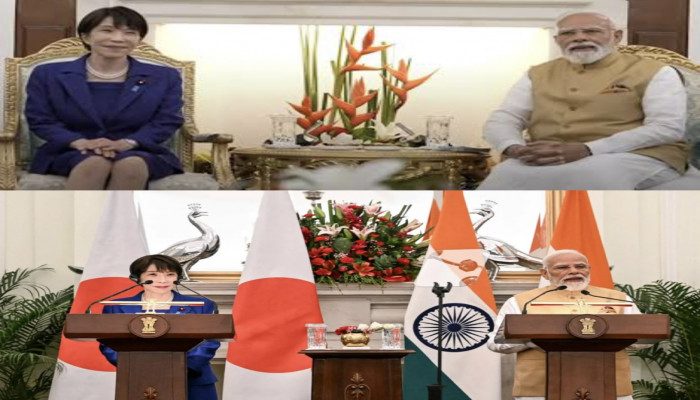
Prime Minister Narendra Modi and Japanese Prime Minister Sanae Takaichi announced several major initiatives in defence, technology, energy and mobility after holding wide-ranging talks during the 16th India-Japan Annual Summit in New Delhi on Thursday. The leaders introduced a defence co-development project, a roadmap for semiconductors, quantum technologies and resilient supply chains, an energy resilience initiative, and the India-Japan Next-Generation Mobility Partnership Framework. These decisions marked another important step in strengthening the Special Strategic and Global Partnership between the two countries.
Addressing a joint press statement at Hyderabad House, Prime Minister Modi said India and Japan had entered a new phase in their relationship. He said the partnership continued to grow through mutual trust and stronger cooperation in several important sectors. Referring to his recent remarks at the G7 Summit, Modi said, "Just a few days ago at the G7 Summit, I remarked that in today's climate of global turbulence, mutual trust is our greatest strategic asset. I am proud that the India-Japan partnership fully lives up to this standard."
Prime Minister Modi welcomed Sanae Takaichi on her first official visit to India after becoming Japan's Prime Minister. He described her as Japan's first woman prime minister and praised her leadership. Modi also mentioned her connection with Nara Prefecture. He said the region holds special importance as a centre of the shared Buddhist heritage of India and Japan. He noted that this cultural connection has strengthened the relationship between the two countries over the years.
Defence and technology emerged as the main focus of the summit. Modi said technology had become one of the strongest pillars of the India-Japan partnership. He added that growing cooperation in advanced sectors reflected the increasing strategic depth of bilateral ties. A major outcome of the summit was the signing of the first defence co-development project between the two countries. Modi said, "We have signed our first co-development project in defence today. We will jointly develop defence technologies that will contribute to regional peace, maritime security and a rules-based order."
The two leaders also announced a new joint roadmap that focuses on semiconductors, quantum technologies and resilient supply chains. The roadmap aims to strengthen energy security and economic security for both countries. It also seeks to reduce risks in critical supply chains and improve cooperation in advanced technologies. Modi highlighted the importance of these sectors during the current global situation. He said, "In today's uncertain times, energy security and economic security are extremely important. We have prepared a joint roadmap. It covers semiconductors, quantum technologies and strengthening supply chain resilience."
India and Japan also launched an energy resilience initiative during the summit. The initiative aims to improve cooperation in tackling global energy challenges, including disruptions in oil supplies. The leaders agreed to expand collaboration in batteries, green hydrogen and nuclear energy. They said these areas would support clean energy goals and contribute to the global transition towards sustainable energy sources. The partnership reflects the commitment of both countries to develop reliable and future-ready energy systems.
Another important announcement was the launch of the India-Japan Next-Generation Mobility Partnership Framework. The initiative will promote cooperation in advanced mobility solutions and future transport technologies. Both countries expect the framework to encourage innovation and strengthen collaboration in the mobility sector. It will also support efforts to build sustainable and modern transportation systems.
Prime Minister Modi also announced the India-Japan Biogas Initiative. Under this programme, India will set up biogas plants in different parts of the country. The initiative aims to promote clean energy, improve sustainability and create better livelihood opportunities in rural areas. It also reflects the shared commitment of India and Japan to support environmentally friendly development.
Economic cooperation remained another important part of the discussions. Modi said nearly 120 new business agreements had been signed over the past year. These agreements are expected to bring investments worth around USD 10 billion into India. He also reaffirmed the shared target of attracting 10 trillion yen in Japanese investment over the next decade. Both leaders expressed confidence that stronger investment ties would create new opportunities for businesses and support economic growth in both countries.
The summit also highlighted the shared strategic outlook of India and Japan. Modi said both countries consider economic security as shared security. He added that they also view the global energy transition as a shared opportunity. The two leaders reaffirmed their commitment to maintaining a free, open and rules-based Indo-Pacific. They agreed to continue working together to promote peace, stability and prosperity across the region.
Several senior officials attended the delegation-level talks. External Affairs Minister S. Jaishankar, National Security Adviser Ajit Doval, Foreign Secretary Vikram Misri and other senior officials represented the Indian side during the discussions. Their participation reflected the importance both governments placed on expanding cooperation across multiple sectors.
Earlier in the day, Prime Minister Sanae Takaichi received a ceremonial welcome at Rashtrapati Bhavan. She is on a three-day official visit to India from July 1 to July 3 at the invitation of Prime Minister Narendra Modi. The visit underlined the growing importance of the India-Japan partnership and the shared commitment of both countries to deepen cooperation in defence, technology, energy, investment and regional security.



 Loading...please wait
Comments