




India and GCC begin talks on comprehensive free trade agreement
- In Reports
- 04:22 PM, Feb 25, 2026
- Myind Staff
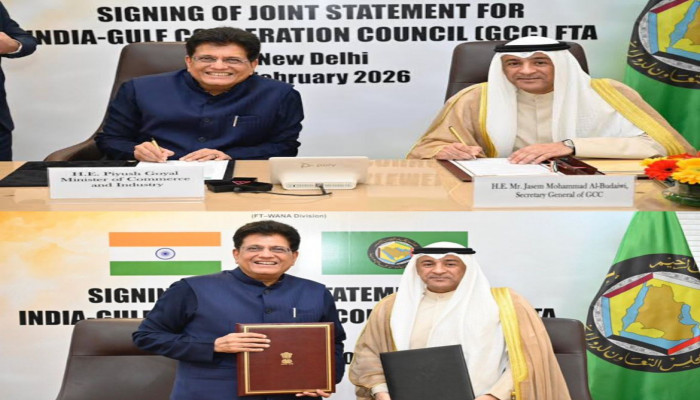
India and the Gulf Cooperation Council (GCC) have officially begun the negotiations for a Free Trade Agreement (FTA) after signing a joint statement on Tuesday in New Delhi. The move is aimed at strengthening economic ties by increasing trade, investment and cooperation between India and the six GCC member countries.
The joint statement was signed by Piyush Goyal, India’s Union Minister of Commerce and Industry, and Jasem Mohamed Albudaiwi, Secretary General of the Gulf Cooperation Council (GCC). This signing marks the formal start of discussions for a “comprehensive and mutually beneficial agreement.”
According to the government, the joint statement and the Terms of Reference (ToR) signed earlier this month together represent a significant milestone in the relationship between India and the GCC countries. The ToR sets the framework for future negotiations and ensures that both sides are committed to working together on a broad trade pact.
Piyush Goyal said the joint statement, along with the ToR, shows a shared commitment to strengthening economic ties. He noted that the relationship between India and the GCC is not just economic but also has deep roots in shared history and cultural connections. This strong foundation is expected to help both sides negotiate a robust trade arrangement that capitalises on their strengths and supports mutual growth.
Jasem Mohamed Albudaiwi described the proposed agreement as an “important tool to further strengthen trade and investment ties between India and GCC countries by infusing predictability and certainty for businesses.” This indicates that both India and the GCC aim to create a stable, predictable environment for companies to operate and expand.
The GCC, which includes Saudi Arabia, the United Arab Emirates (UAE), Qatar, Kuwait, Oman, and Bahrain, is one of India’s most important trade partners globally. In the financial year 2024-25, trade between India and the GCC reached $178.56 billion. This figure includes nearly $56.87 billion in Indian exports and $121.68 billion in Indian imports, making up about 15.42% of India’s global trade total.
Over the past five years, trade between India and the GCC has grown at an average rate of 15.3% annually, showing a strong and expanding economic link. India exports goods such as engineering products, rice, textiles, machinery, and gems and jewellery to GCC nations. On the other hand, India mainly imports crude oil, liquefied natural gas (LNG), petrochemicals and precious metals like gold from the GCC.
Together, the GCC countries represent a market of about 61.5 million people and a combined economy with a GDP of $2.3 trillion at current market prices, making the region globally significant. This large economic presence adds value to the potential FTA, giving India an opportunity to increase trade volumes and diversify its export markets.
The Gulf region is also a major source of foreign direct investment (FDI) in India. As of September 2025, the total GCC FDI in India had exceeded $31.14 billion, reflecting strong investment interest and existing financial linkages.
Indian nationals numbering nearly 10 million live in GCC countries, serving as a “living bridge” between the nations. This large diaspora strengthens people-to-people links, supports bilateral cooperation, and enhances cultural and social ties between India and the Gulf region.
Indian companies also have a strong presence in the GCC, particularly in sectors such as infrastructure, services, energy, and technology. The FTA is expected to help Indian firms expand further into these markets, supporting job creation and economic growth at home while strengthening commercial presence abroad.
The signing of the joint statement is only the first step in a lengthy negotiation process. Detailed discussions will continue over the coming months as both sides work towards a final agreement that addresses tariffs on goods and many other aspects of trade, including services, customs procedures, investment, digital commerce and more.
Officials on both sides have expressed confidence that the future trade pact will help unlock the full potential of bilateral commerce and strengthen economic integration between India and the Gulf Cooperation Council.



 Loading...please wait
Comments