




India and Australia: Enduring Democratic Ties Across the Indian Ocean
- In Current Affairs
- 10:54 PM, May 09, 2026
- Viren S Doshi
Overview
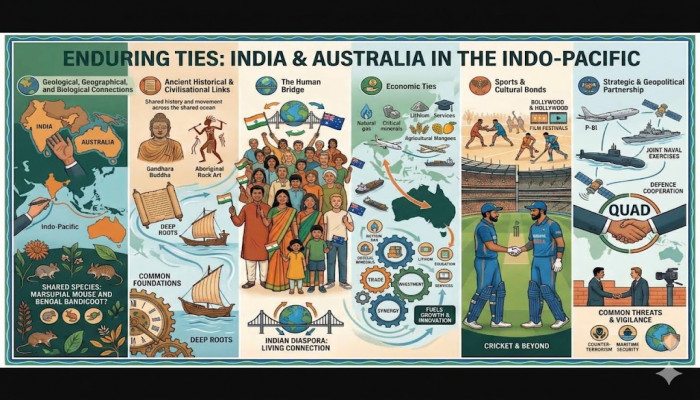
Australia and India stand as two major democracies and influential powers in the Indo-Pacific region, strategically positioned at opposite ends of the great Indian Ocean. Their partnership, rooted in historical bondings and shared democratic values, growing people-to-people ties, economic complementarity, and strategic alignment, has evolved into a comprehensive strategic relationship vital for regional stability and global peace.
Geological, Geographical and Biological Connections
Gondwana's tectonic history physically linked the landmasses eons ago. Both countries are atop the same tectonic plate.
The species of ferns and some other species found in both countries led scientists to theorise that both countries were one landmass viz. Gondwana, in the past.
Shared geography in the tropics/subtropics and Indian Ocean stewardship further aligns interests. The tropic of Cancer passes through India in the Northern Hemisphere while the Tropic of Capricorn traverses through Australia in the Southern Hemisphere. Both countries have similar geographical and meteorological features.
Flora exchanges, such as Eucalyptus (atop Nilgiri in South India and Blue Mountains in South Australia), underscore deeper botanical ties. Surprisingly, these two similar-looking mountains are known as Blue Mountains (Nil means Blue and Giri means Mountain) in Australia as well as in India. Eucalyptus plantation was done in the Indian Nilgiris by the then British Rulers, who ruled over both countries at that time and who brought Eucalyptus plants to Nilgiris in India, hoping that these would thrive in the Indian Nilgiris as the climate was (and is) comparable. And they were proven right. Eucalyptus itself became known as “Nilgiri” in many Indian languages. Before that, the concerned Indian Mountain was known as Nilgiri and Eucalyptus made it even more blue, making the name even more relevant and concurrent. The aromatic oils evaporating from Eucalyptus lend the air a bluish tinge and give the mountain a blue appearance.
Ancient Historical and Civilisational Links
Ancient connections trace back millennia. Vedic civilisation traditions highlight Rishi Agastya, a pioneering sage who migrated southward, promoting Tamil language and culture. Legends portray him as a master of the oceans — allegorically "drinking the ocean" in his palm — symbolising his maritime prowess. Scholars and cultural interpreters link his influence to Southeast Asia, East Asia, and Australasia. His name was given to the star in the South, the star Canopus, marking his reach right up to Polynesia. He is revered in Java (e.g., Agastyaparva text), Indonesia, Cambodia and other places in South East Asia and Australasia even today with temples built in his memory and his tales echo in Polynesian/Maori lore.
Rishi Pulastya, ancestor of Agastya, connects through lineage to southern epics like the Thai Ramakien. He was the one who established a political state in the Southern territories. His brother Vishrava was the father of two kings viz. Kuber and Ravan from his two different wives of different clans - mother of Ravan from Rakshasas Clan and mother of Kuber from Devas Clan.
Linguistic similarities between Tamil/Dravidian, Austroasiatic (e.g., Santhali/Kol), and Australian Aboriginal languages suggest possible ancient maritime contact or shared Austric super-family influences.
Aboriginal Australian traditions share features with Indian ones. Australia word translates into simple English as the land of the Southern End. Australis means South in Latin language.
Historical trade by Indian seafarers spanned the Indian Ocean for millennia.
In modern history, Indian soldiers alongside ANZAC forces fought in the Gallipoli Campaign during World War I against the Ottoman Empire.
Hinduism, Buddhism, Yoga, and organisations like HSS, ISKCON and BAPS etc. further deepen cultural ties.
The Human Bridge: Indian Diaspora in Australia
The most vital connection is the people. The Indian-origin community has emerged as a strong fulcrum, building a positive image of India through hard work, integrity, peaceful integration, and substantial contributions across sectors.
As of June 30, 2025, the Indian-born population in Australia reached 971,020, making it the largest overseas-born group, narrowly surpassing even those born in England (970,950). This represents roughly 3.5% of Australia's total population of about 27.6 million, with ancestry figures often cited around 3-4%.
Notably, this proportion is more than double the share of Indian-origin Americans in the U.S. population (around 1.5%).
Indian Australians contribute significantly to the economy through taxes, productivity, businesses and they also contribute to healthcare, education, and culture. They are known as law-abiding and peaceful people.
Community organisations of Indian Australians provide extensive social services to all sections of Australian society, not just their own. While temples, gurudwaras and cultural centres buzz with festivals, kirtans, and devotional events like “Seva Diwali” by Hindu Swayamsevaks Sangh and other like-minded organisations exemplify selfless service, with massive collections of food, hygiene items, and donations supporting the needy nationwide — positioning the community as a highly respected group in humanitarian efforts and drawing laurels from all sections of people.
Indian students form a major pillar, contributing to Australia's education sector (a key export industry). They remain among the top sources of international students, with enrolments in the hundreds of thousands, bolstering universities and fostering long-term goodwill; though at times the Australian centre-left tries to bargain against the student visa policies for trade favors.
Economic Ties: Trade, Investment, Complementarity and Synergy
Bilateral trade has grown robustly. In FY 2024-25, total merchandise trade reached around USD 24.1 billion, with India's exports to Australia more than doubling post the Economic Cooperation and Trade Agreement (ECTA). Two-way goods and services trade was valued at AUD 54.4 billion in FY2024-25 in some estimates. Australia supplies resources like coal, minerals, and education; India offers IT, pharmaceuticals, skilled professionals, and services. Investments flow both ways, with Adani Group projects and Foreign Institutional Investor (FII)/Foreign Direct Investment (FDI) activity. Full tariff elimination under ECTA is enhancing access.
Sports and Cultural Bonds: Cricket and Beyond
Cricket has connected generations of both nations for decades. Bilateral series, despite occasional controversies, showcase sportsmanship and directly link the youth of both sporting nations.
Strategic and Geopolitical Partnership
In the contemporary era, both nations collaborate through the Quadrilateral Security Dialogue (Quad)—comprising Australia, India, Japan, and the United States—for a free and open Indo-Pacific. They maintain a Comprehensive Strategic Partnership, with deepening defence ties, logistics support, maritime security cooperation, and initiatives in critical minerals, technology, and supply chains. Both nations are also part of the Commonwealth, as both were under British Rule.
Common Threats and the Need for Vigilance
Both democracies face hybrid challenges from adversarial forces. CCP-OCCUPIED China pursues expansionist policies, militarisation in the Indo-Pacific, and economic coercion, posing risks to sea lanes and sovereignty. Jihadi terrorism, often state-sponsored, threatens pluralistic societies. Internally, leftist and liberal networks sometimes converge in narratives that downplay these threats, undermine strong security postures, or align tactically with adversarial propaganda under pretexts of human rights and LGBTQ rights and women rights and children's rights etc. — forming a nexus that weakens resolve against external pressures. Robust bilateral and Quad cooperation counters these through shared intelligence, capacity-building, and democratic resilience.
The Path Forward
Australia and India exemplify how ancient civilisational threads, vibrant diaspora energy, democratic values, and strategic necessities can forge a resilient partnership. As the Indian community continues to thrive and contribute — protecting open institutions while advancing ties with the world's largest democracy — the relationship is poised to deepen. In a volatile world, specifically the Indo-Pacific, marked by the hegemony of the Communist Regime occupying China and transnational threats, this bridge across the Indian Ocean offers a model of constructive cooperation for peace, prosperity, and stability in the Indo-Pacific.
Disclaimer: The opinions expressed within this article are the personal opinions of the author. MyIndMakers is not responsible for the accuracy, completeness, suitability, or validity of any information on this article. All information is provided on an as-is basis. The information, facts or opinions appearing in the article do not reflect the views of MyindMakers and it does not assume any responsibility or liability for the same.



 Loading...please wait
Comments