




Implications of Total Gross Debt and Its Components of Selected Countries
- In Economics
- 03:01 PM, Aug 10, 2026
- Mukul Asher
Total Gross Debt (TGD) of a country comprises debt by households, corporations, and the Government sector. Both domestic and external debt are included. This column examines variations in the TGD to GDP ratios, as well as its three components in select countries and their implications.
It should be emphasised that in a balance sheet, debt is only one side. The other side is the assets. High assets can support higher debt. Therefore, debt figures must be interpreted in a nuanced manner.
The following observations may be made from the data in Figure 1 on TGD and its components in selected countries. TGD is a stock concept while GDP is a flow concept.
First, there are five economies, Hong Kong, Japan, Singapore, France, and Canada, whose TGD to GDP ratio far exceeds 300 per cent of GDP. However, the composition of the TGD to GDP ratio and ability to manage it varies considerably among these economies. Japan and Singapore have high external assets by their governments and corporations, and the ownership structure of their debt, mainly among the government-guided entities, with less exposure to market forces, makes financing their debt, including rollover of debt, much more manageable. High TDG is therefore so far not a major concern. Japan’s anaemic economic growth, and recent increases in its 10-year government bond yield to 2.8 per cent, however, could increase rollover costs 1.
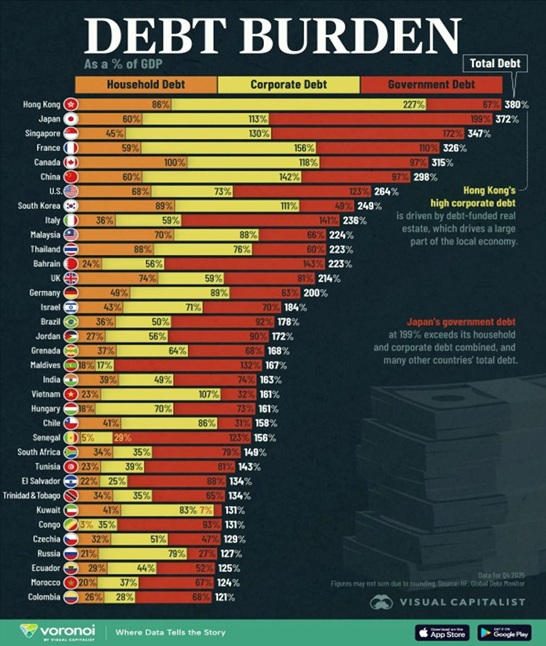
Figure 1: Total Debt Burden of Selected Countries
The highest share of household debt to GDP ratio is exhibited by Canada (100 per cent), while the lowest ratio is by Singapore (45 per cent). A major contributory factor in Canada’s household debt is mortgages, accounting for two-thirds of the total. It is argued that as “…house prices increase in Canada, households take on debt leading to a rise in the total amount of debt in the economy. Longer term, reestablishing housing affordability in Canada will be key to reducing household debt if they want to become homeowners.” 2
Hong Kong’s household debt to GDP ratio at 86 per cent can be considered high. As a significant proportion of household debt is for real estate purposes, sustained high employment and earnings, and addressing volatility in the real estate sector is important for these countries to stabilise the household debt component.
The corporate debt to GDP ratio among the five economies ranges from a high of 227 per cent in Hong Kong, driven by a debt-funded real estate sector, to 113 per cent in Japan. In all five countries, this ratio exceeds one hundred per cent of GDP. High corporate debt makes an economy vulnerable to cyclical downturns, to technological shifts, particularly in the age of AI (Artificial Intelligence), and to interest rate cycles.
While Hong Kong has the highest corporate debt to GDP ratio, it has the lowest government debt to GDP ratio (67 per cent) among the five economies. Japan (199 per cent) and Singapore (172 per cent) have by far the highest government debt to GDP ratios. Singapore’s high debt ratio is not of concern as it has a strong asset position to finance it, and most of the debt is not exposed to market forces.
Japan’s high government debt to GDP ratio has so far been manageable as “… debt is overwhelmingly held domestically in yen, a persistent current account surplus providing a steady pool of domestic savings, and low reliance on foreign capital. These factors have protected Japan from external funding crises…yet these buffers have limits. The world's most indebted developed economy is attempting its most expansionary fiscal policy in decades whilst navigating the end of ultra-low rates. Bond vigilantes are calculating whether the numbers add up. Thus far, they remain sceptical, and the mathematics suggests they are right to be.” 3
(2) There are nine countries with TGD of 200 per cent or more, but less than 300 per cent of GDP. Among the nine, China’s TGD to GDP ratio is very close to 300 per cent of GDP. Its household debt to GDP ratio seems manageable at 60 per cent of GDP. Its corporate debt to GDP ratio at 142 per cent of GDP, however, appears to warrant concern, as it remains vulnerable to cyclical factors, to interest rate cycles, and to technological developments globally.
China’s government debt to GDP ratio at 100 per cent of GDP is widely regarded to be understated as off-budget entities, including local government entities, whose contingent liabilities are on the government, are likely to be not fully included. In current GDP, China’s government debt is around USD 18 to USD 20 trillion.
The TGD to GDP ratio of the United States at 264 per cent of GDP can be regarded as fairly high, particularly given its nominal GDP of USD 32 trillion in 2025. Its household debt at 68 per cent of GDP, and its corporate debt at 73 per cent of GDP appear manageable. Recent media reports, however, suggest that some of the largest corporations in the United States may have a hidden debt which is not recorded. It is reported that, “…Alphabet, Microsoft, Amazon, Meta, and Oracle together account for roughly $1.65 trillion in liabilities missing from their public balance sheets. That figure exceeds the $1.35 trillion these firms officially disclosed last quarter, with Meta alone holding roughly $420 billion off-balance-sheet.4
The US government debt in current terms is valued at nearly USD 40 trillion. US and China account for about half of the global government debt. Cost of rolling over of debt, weaponisation of trade and tariff instruments by the current United States administration, as well as unwillingness to recognise that trust and confidence in the policymakers of debtor countries are vital elements in debt management, have created uncertain dynamics for the debt management of the United States, and given that it accounts for a quarter of global GDP, for the global economy as well.
In April 2026, GAO (U.S. Government Accountability Office) “…projected that continued federal deficits will add an average of $2 trillion to U.S. debt each year through 2036. The Treasury Department is responsible for financing this borrowing and seeks to do so at the lowest cost over time. Treasury has strategies for managing risks to the nation's finances. For example, it issues debt on a regular and predictable schedule to minimise investor uncertainty. But Congress needs to address other risks, such as unsustainable levels of debt leading to higher interest rates. We continue to recommend that Congress develop a strategy to address the nation's unsustainable fiscal path.” 5
The other countries with TGD to GDP ratio of between 200 and 300 per cent of GDP are South Korea, Italy, Malaysia, Thailand, Bahrain, the United Kingdom, and Germany. Among these countries, managing household debt poses difficult challenges for the policymakers in Thailand and South Korea.
Thus, for Thailand, whose household debt to GDP ratio is 88 percent, it is reported that “… a closer look at the structure of that (household) debt suggests the underlying picture remains troubling, particularly as the economy continues to recover only unevenly, while uncertainty and high living costs continue to weigh on households…the central concern is that the composition of borrowing is becoming more fragile. More households appear to be relying on debt for consumption and day-to-day liquidity, rather than for investment or income generation. That shift is increasingly seen as a sign of persistent income pressure and limited financial resilience.6
For South Korea, with the household debt-to-GDP ratio of 89 per cent of GDP, it is reported that “…With a debt-to-income ratio of 174%, many households are under considerable financial pressure, and additional borrowing could further weaken balance sheets. Moreover, a significant proportion of recent loans has been taken by individuals in their 20s and 30s, whose repayment capacity is already stretched. Their debt service ratios of approximately 40–50% imply nearly half of disposable income is allocated to debt repayments, leaving limited room for consumption and savings.” 7
For Malaysia, whose household debt-to-GDP ratio is 70 per cent of GDP, the government believes this ratio is manageable. Nevertheless, its household debt remains vulnerable for at least some sections of the population due to high income inequalities, and to interest rate cycles.
Among other countries in this group, Italy’s government debt of 141 per cent of GDP severely constrains its fiscal flexibility. As has been noted, “… Italy’s narrower fiscal deficit of 3.1% of GDP in 2025 supports the public finance outlook but sustained primary surpluses and political stability will be essential to manage a prolonged Middle East crisis, rising defence and ageing-related spending.”8
The government debt of the United Kingdom at 81 per cent of GDP can be a challenge for policymakers, as it requires raising GDP growth and lower rollover interest rates.
(3) There are ten countries with a TGD-to-GDP ratio of between 150 and 200 per cent of GDP, including India.
For Vietnam, corporate debt of 107 per cent of GDP merits rigorous monitoring of corporate governance, and ensuring that it is not concentrated in one or two sectors, especially the real estate sector. Vietnam’s government debt-to-GDP ratio is most likely significantly understated, mainly due to less than full coverage.
Brazil’s government debt at 92 per cent of GDP, while managed well so far, can be expected to constrain its public financial management in the medium term due to population ageing and related issues.
For India, the household debt (39 per cent of GDP), corporate debt (49 per cent of GDP), and government debt (74 per cent of GDP) are all manageable. India’s external debt-to-GDP ratio is about 21 per cent, the remaining being domestic debt. India’s conservative and competent macroeconomic management, along with foreign exchange reserves of nearly USD 700 billion, gives added comfort in managing its debt.
(4) The rest, eleven countries, exhibit a TGD-to-GDP ratio of between 121 per cent (Colombia) and 149 per cent (South Africa) of GDP. While South Africa’s government, with a debt-to-GDP ratio of 78 per cent, is undertaking several reform measures, such as adopting fiscal rules, to manage it. Most of its government debt is domestically owned.9
Concluding Remarks
There are several lessons which emerge from the above analysis of TGD of selected countries globally. First, managing TGD prudentially is a global challenge, affecting high, medium, and low-income countries.
Second, it is essential to manage the real estate sector prudentially and in a balanced manner to address household debt stress, and in some countries to maintain corporate sector resilience. Concrete, focused steps to enhance financial literacy, particularly the importance of tapping the power of compound interest, which also implies communicating the balance between short-term desires and delayed gratification habits, are also essential.
Third, transparency and sound corporate regulatory architecture, which is competently enforced, are essential to prudentially manage the corporate sector debt. Overexposure to any one sector, whether real estate or AI (Artificial Intelligence) needs to be monitored.
Fourth, the political economy consensus needs to evolve for sustainable medium-term-oriented fiscal policies. Along with these myriad aspects, big and small, aspects of public financial management, elites in the society should need to create sufficient trust in governing institutions to pursue growth-oriented political discourse rather than pursuing counterproductive identity politics. The sub-national levels of government, often neglected, should be given sufficient weight in managing public debt.
Fifth, the quality of governance, trust in societal institutions, and policies designed to enhance society’s resilience against divisive domestic and external forces will have a significant impact on how a country manages its TGD.
References
- https://tradingeconomics.com/japan/government-bond-yield (Accessed on 2 August 2026)
- https://www.cmhc-schl.gc.ca/observer/2023/risks-canadas-economy-remain-high-household-debt-levels-continue-grow (Accessed on 1 August 2026)
- https://www.ig.com/en/news-and-trade-ideas/takaichi-japan-debt-crisis-260211 (Accessed on 30 July 2026)
- https://finance.yahoo.com/technology/articles/massive-ai-ambitions-push-big-24500581.html?guccounter=1&guce_referrer=aHR0cHM6Ly93d3cuZ29vZ2xlLmNvbS8&guce_referrer_sig=AQAAABHX-n6uhofmW7dZOkQ9R3pmeeZCjJEeUKYBz3-8GQPiHKFgutBmGdwt8-0qrG91JJmbVjAhISzrg79xEeAg3C9VB3uL7SSs2f9DLTlPsDc3vtFGdL4-upMrlmQgdMyj3aJdIK7yXHXZB-zHcDG9iQq7ukYmExS0w87HpNFUkF-f (Accessed on 2 August 2026)
- https://www.gao.gov/products/gao-26-107529?utm_source=facebook&utm_medium=social&utm_campaign=pa (Accessed on 25 July 2026)
- https://www.thestar.com.my/aseanplus/aseanplus-news/2026/04/03/thai-household-debt-climbs-to-867-of-gdp-exposing-deeper-economic-fragility (Accessed on 30 July 2026
- https://finance.yahoo.com/economy/policy/articles/south-korea-rise-household-debt-103639263.html (Accessed on 2 August 2026)
- https://www.scoperatings.com/announcements/research-announcement/EN/180083 (Accessed on 5 August 2026)
- https://www.imf.org/en/news/articles/2026/02/10/pr-26039-south-africa-imf-executive-board-concludes-2025-article-iv-consultation (Accessed on 2 August 2026)
Disclaimer: The opinions expressed within this article are the personal opinions of the author. MyIndMakers is not responsible for the accuracy, completeness, suitability, or validity of any information on this article. All information is provided on an as-is basis. The information, facts or opinions appearing in the article do not reflect the views of MyindMakers and it does not assume any responsibility or liability for the same.



 Loading...please wait
Comments