



IIT Madras to create 3D Maps of 100 Human Brains, from foetal stage to age 85
- In Reports
- 06:32 PM, Oct 21, 2026
- Myind Staff
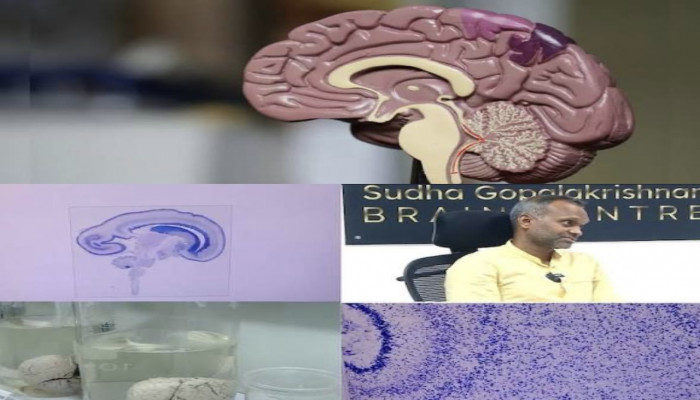
The Sudha Gopalakrishnan Brain Centre at IIT Madras is creating detailed three-dimensional maps of 100 human brains, covering stages from the foetal period to the age of 85. Launched by Prime Minister Narendra Modi, the project aims to map the human brain at cellular resolution across the lifespan, offering insights beyond conventional medical imaging.
The maps will show brain structures, individual cells, their organisation and changes with age. “Today, we don't have a detailed view of how a human brain and its structures look across the lifespan,” Professor Mohanashankar Sivaprakasam, head of the centre, told NDTV.
“The brain evolves continuously, unlike other organs. We need a map of how the brain looks at various ages. Only then will we be able to translate this into medicine,” he said.
Researchers freeze donated brains and cut them into extremely thin sections, each measuring 10 to 20 microns, roughly one-tenth the thickness of a human hair. They image each section and combine the data to create a detailed 3D model.
An adult brain produces around 8,000 to 10,000 sections, while a foetal brain requires about 3,000 and a young child's brain approximately 5,000. The centre has developed customised instruments and systems to carry out the process at scale.
Unlike conventional MRI scans, which typically provide information at the millimetre scale, these atlases reveal the brain's cellular architecture in much greater detail.
The project seeks to establish reference maps showing how brain structures develop and age. These maps could help researchers identify abnormalities and investigate conditions such as developmental disorders, stroke and neurodegenerative diseases.
The centre released its first set of maps, called DHARANI, in 2025. Sivaprakasam said its foetal brain atlas has gained international recognition. The centre plans to make all its maps publicly available to researchers and medical institutions worldwide.
Around 200 scientists from life sciences, medicine, engineering, computing and artificial intelligence are contributing to the project. The centre is also studying brain regions through RNA sequencing to identify molecular processes that could offer targets for drug development.
Detailed reference maps could also help neurosurgeons better understand brain structures during surgery. The centre is collaborating with more than 10 medical institutions, including CMC Vellore, KMC and Saveetha.
The centre has also unveiled C-STROKE, an atlas mapping an entire human brain affected by stroke. It enables researchers to examine affected regions within the context of the whole brain.
“We have the entire view of the whole human brain at any level and angle, including the stroke-affected region,” Sivaprakasam said.
The project generates petabytes of data. The centre has developed a visualisation platform and an AI research assistant to help researchers explore the maps, identify patterns and analyse brain structures.
Sivaprakasam said visiting Nobel laureates had recognised the platform's potential to support research that could lead to a Nobel Prize.
“We want to advance science in a significant way. If we do, the rest will follow,” he said.



 Loading...please wait
Comments