




IG Defence successfully tests AI-powered JWALA MK-1 micro-missile at Pokhran
- In Reports
- 07:45 PM, Nov 23, 2026
- Myind Staff
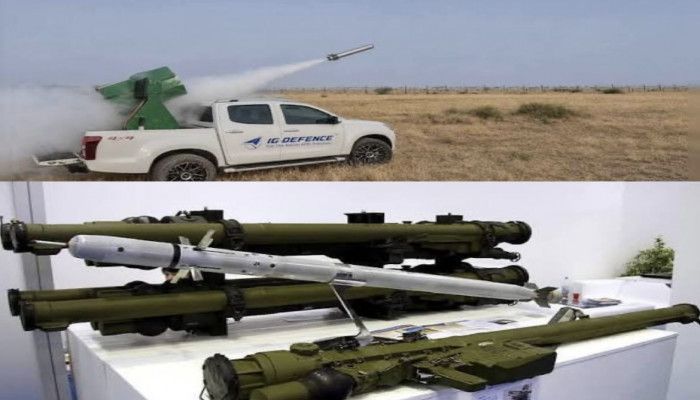
India's indigenous defence capabilities received a boost with the successful test-firing of JWALA MK-1, the country's first private-sector AI-powered autonomous micro-missile system. Developed by defence technology firm IG Defence, the surface-to-air counter-unmanned aircraft system (CUAS) was tested at the Pokhran field firing ranges in Rajasthan.
With an operational range of up to 5 km, JWALA MK-1 can detect, identify and classify hostile unmanned aerial vehicles (UAVs) before destroying them through a hard-kill mechanism. It is designed to counter small attack drones, surveillance UAVs and other unmanned aerial threats.
Unlike conventional air-defence systems that use expensive interceptors, JWALA MK-1 offers a compact and potentially cost-effective solution. Its engagement range extends from 50 metres to 5,000 metres, allowing it to target cruise as well as higher-altitude aerial threats.
A key feature of the system is its integration with GRID, IG Defence's proprietary AI-powered mission autonomy and battle management system. GRID manages the entire operational kill chain, including sensor integration, target detection, identification, classification, mission decisions and engagement management.
Bodhisattwa Sanghapriya, founder and Chief Executive Officer (CEO) of IG Defence, called the successful flight test a defining moment for India's private-sector defence industry. He said it demonstrated the growing ability of domestic companies to develop advanced indigenous weapon systems.
"GRID brings together sensor integration, target detection, identification, classification, mission decision-making and engagement management within a unified architecture, enabling coordinated mission execution," Bodhisattwa said.
"Our vision is to build indigenous defence systems where hardware and software are developed together, with autonomy and intelligence at their core. India must not simply manufacture weapons; it must build the intelligence, technology and integrated systems that power the future battlefield," he added.
In October, Noida-based IG Defence had successfully tested two solid rocket motors for JWALA, marking an important step towards its maiden experimental flight. The company had also developed major components, including the seeker and target-acquisition systems, avionics, warhead and electronic subsystems.
The development comes amid the growing use of drones in modern conflicts. Unmanned aerial systems now play a major role in surveillance, target acquisition, precision strikes and coordinated swarm attacks. Their ability to fly at low altitudes and approach from multiple directions leaves limited time for defence systems to respond.
Wing Commander Anoop Sharma (Retd), associate vice-president of IG Defence, said modern warfare required a new approach to air defence.
"Countering low-cost drones with expensive conventional systems is a challenge that modern militaries can no longer overlook. India needs indigenous, reliable and cost-effective solutions that can address these emerging threats at scale. JWALA MK-1 represents an important step in that direction. Our focus is on developing an integrated counter-drone capability that combines advanced technology, mission autonomy and operational effectiveness," he said.
JWALA is part of IG Defence's wider counter-drone portfolio. The company had earlier demonstrated T-SHUL BEAM, an electronic countermeasure-based soft-kill system, at the Indian Air Force's Dronathon 2026 exercise in Pokhran. While T-SHUL BEAM disrupts or disables drones electronically, JWALA physically destroys aerial targets, offering a complementary hard-kill capability.



 Loading...please wait
Comments