




‘If Stan Swamy can have...’: Madras High Court allows stupa for 1755 War Heroes
- In Reports
- 05:39 PM, Jan 02, 2026
- Myind Staff
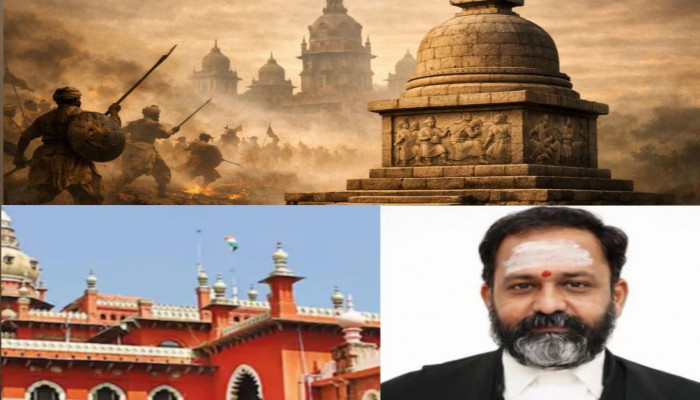
The Madras High Court has allowed the installation of a memorial stupa to honour the warriors who fought in the 1755 Natham Kanavai Battle against British forces. The court said that if a memorial could be erected for Stan Swamy without special permission, then there should be no objection to a memorial for the Natham Kanavai war heroes either.
Justice G R Swaminathan passed the order while hearing a writ petition filed by Siva Kalaimani Ambalam, a practising lawyer. The petition was filed after the Tahsildar of Natham rejected Ambalam’s request to install a memorial stupa to commemorate the historic battle.
While allowing the plea, the court made a clear comparison and observed, “If for erecting a stone pillar in memory of Stan Swamy, permission is not required, certainly, no permission is required for erecting a stupa in memory of the Natham Kanavai battle.”
The case relates to the Natham Kanavai battle that took place in 1755 in the Madurai region. It was placed on record before the court that Natham Kanavai witnessed a “bloody confrontation” between the Melur Kallars and British forces. In this clash, the Kallar community emerged victorious against the colonial army.
The petitioner told the court that British troops led by Colonel Alexander Heron had looted brass idols from the Thirumogur (Koilkudi) Temple. Later, the Kallar community recovered these idols after their victory in the battle. The court took note of these submissions while examining the historical importance of the event.
Justice Swaminathan listed several reasons while granting permission for the installation of the memorial stupa. One of the key observations made by the court was about India’s civilisational unity. The judge said that while the United States is often described as a “melting pot”, India can be seen as a “salad bowl”. The court explained that India is a “collection of communities and sub-communities” that speak different languages and belong to different regions. According to the court, historical memories linked to these identities can be used for higher and positive purposes.
The court also discussed the history and background of the Kallar community. It noted that the Kallars have a strong martial tradition and can be compared to communities such as the Gurkhas and Rajputs. The judge pointed out that the British had branded the Kallars as “criminal tribes”, which led to decades of suffering and hardship for the community. The court observed that the community remained marginalised until it was redeemed by the legendary leader Shri Pon Muthuramalinga Thevar.
Referring to resistance against British rule, the court observed that many scholars believe the first war of Indian independence did not begin in 1857, but much earlier. It was pointed out that such resistance began in the Tamil region. Taking judicial notice of history, the court remarked that the British “met their match” in the Madurai region. In this context, the court recalled prominent historical figures such as Velu Nachiyar, the Marudu brothers, Puli Thevar, Kattabomman and Oomaithurai.
Justice Swaminathan also referred to a well-known saying while explaining the importance of celebrating success. He mentioned the cynical maxim, “success has many fathers but failure is an orphan”, and added that there is also a converse to it, which is “success will beget many more successes.” The court said that remembering and celebrating victories can inspire people and lead to further achievements.
The judgment stressed the importance of remembering battles where native forces defeated colonial powers. The court said it is necessary to celebrate such moments because every victory came at a “great cost” and against “impossible odds.” The judge said these victories deserve to be “relished”, and the memory of those who sacrificed their lives should be “honoured.”
In an interesting comparison, the court also referred to modern-day achievements. It highlighted that Chennai is the “Chess Capital of India” and is home to many top chess players. The court mentioned world champion Gukesh Dommaraju and other well-known players such as R Praggnanandhaa, Vaishali Rameshbabu, Pranesh, Ilamparthi, and Aravindh Chithambaram. The judge said celebrating success, whether in history or in sports, can motivate people, inspire them, and bring transformation.
The court further referred to the Constitution and reminded citizens of their fundamental duties. Justice Swaminathan pointed out that Article 51A of the Indian Constitution states that it shall be the duty of every citizen to cherish and follow the noble ideals that inspired the national struggle for freedom, and to defend the country and render national service when required.
In its order dated November 26, the Madras High Court finally held that the practising lawyer is free to erect the memorial stupa for the “Natham Kanavai War” on the land mentioned in the petition. The ruling makes it clear that remembering and honouring early resistance against colonial rule is not only permissible but also important for preserving historical memory and inspiring future generations.



 Loading...please wait
Comments