




Hong Kong Tiananmen vigil organisers convicted as security law tightens grip on dissent
- In Reports
- 09:28 PM, Aug 21, 2026
- Myind Staff
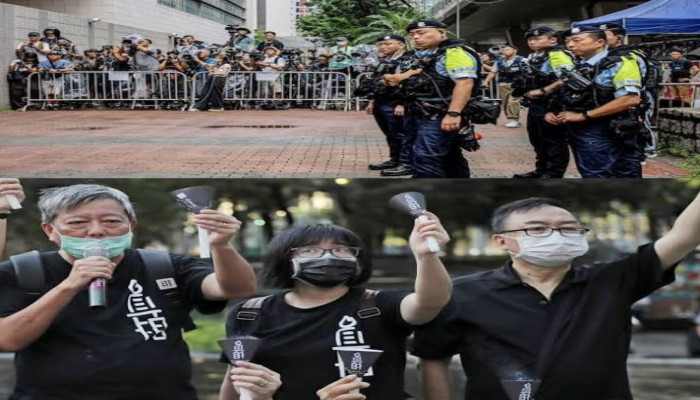
Two former organisers of Hong Kong’s annual Tiananmen Square vigil have been convicted of inciting subversion under the city’s national security law. Lee Cheuk-yan and Chow Hang-tung, former leaders of the Hong Kong Alliance in Support of Patriotic Democratic Movements of China, were found guilty along with the alliance itself. The verdict marks another major case tied to the crackdown on Hong Kong’s pro-democracy movement and has raised fresh concerns over freedom of expression in the city.
Lee and Chow pleaded not guilty to charges filed in 2021. They face a maximum prison sentence of 10 years and will be sentenced at a later date. One of the judges said the defendants would make pleas for lighter sentences next week. The verdict comes as Hong Kong’s once-active pro-democracy movement has been largely dismantled since Beijing introduced the national security law in 2020.
Government-approved judges focused on the alliance’s long-used slogan, "end one-party dictatorship". They ruled that the slogan was not a call for the Chinese Communist Party to return to a constitutional system based on multiparty cooperation. Instead, they said it called for an end to the party’s leadership under the constitution. The judges interpreted the word "end" as meaning "overthrowing" and "undermining".
The judges said the defendants continued using the slogan after the national security law came into force. They ruled that the slogan was inconsistent with the constitution, which describes the Communist Party’s leadership as an essential feature of socialism with Chinese characteristics. The judges said the use of the slogan fell under "other unlawful means" covered by the security law. "(The defendants) intentionally encouraged supporters of the alliance to wait for the right time to carry out the goal of ending one-party dictatorship with unlawful means," the judges said.
Lee and Chow smiled and waved towards people in the public gallery before leaving the courtroom. Another co-defendant, Albert Ho, pleaded guilty when the trial began in January. A guilty plea can usually result in a reduced sentence. Ho is still waiting to be sentenced.
For decades, Hong Kong held the only large public commemoration of the 1989 Tiananmen crackdown. Its annual candlelight vigil attracted tens of thousands of people each year. On mainland China, authorities continue to tightly censor discussion of the crackdown and ban public commemorations. Hong Kong was able to hold the vigil for years under the "one country, two systems" framework, which gave the city greater political freedoms. Authorities banned the event during the coronavirus pandemic.
The trial has drawn criticism from observers who see it as another sign of shrinking freedom of expression in Hong Kong. Eric Lai, a senior fellow with the Georgetown Centre for Asian Law, said the charge of inciting subversion had often been used in mainland China against human rights lawyers, activists and intellectuals, including late Nobel laureate Liu Xiaobo. "We can see to what extent the court in Hong Kong falls into the level of the party-led judiciary in the mainland through the criminal verdict," he said.
During the trial, Lee rejected the claim that the slogan sought to end the Communist Party’s constitutional leadership. He said it represented a push towards democracy and giving people the right to decide who should lead them. He also argued that the Communist Party should not enforce "dictatorship".
Chow, who has been held in prison, described her experience in a Patreon post on Thursday. She recalled being taken from prison to court in handcuffs, with chains around her waist and ankles. She said correctional service officers walked her "like a dog". She wrote, "Justice lives in the hearts of the people. There is no need to look up to this kind of top-down ruling, and one verdict doesn’t matter much."
Lee’s wife, Elizabeth Tang, told reporters after the conviction that she felt disappointed and angry, though she had expected the outcome. She said Lee was innocent and criticised the court’s handling of the defence arguments. "I feel it’s unfair. I feel the judges did not consider our lawyers’ opinions and materials," she said. Tang added that the family would later decide whether to appeal the verdict.
Chow’s mother, Medina Chow Lau Wah-chun, also spoke after the ruling. She said she hoped conditions in Hong Kong could improve. "I hope the environment can be a little healthier" and added, "Flowers and plants of all colours can bloom."
Dozens of people waited outside the court in light rain before the hearing. Former alliance member Tang Ngok-kwan said police would not allow him to join the queue if he carried "sensitive" materials. These included bookmarks bearing the words "vindicate June 4", a reference to the anniversary of the 1989 crackdown. He chose not to enter the court.
Former vigil attendee Margaret Chan joined the queue at 6 am. She questioned how the alliance could be accused of inciting people when its name itself included the word "patriotic". "Everyone is patriotic. How to incite? Incite others to be patriotic?" she said.
Hundreds, and possibly thousands, of people were killed during the 1989 crackdown when Chinese military tanks moved into central Beijing. In Hong Kong, the site where the vigil was once held has taken on a different role. After coronavirus restrictions ended, the former vigil site was used for a carnival organised by pro-Beijing groups.
Beijing has defended the 2020 national security law as necessary for maintaining stability in Hong Kong. Since its introduction, several prominent activists have been jailed under the law, including former media tycoon Jimmy Lai. Dozens of civil society organisations have also dissolved, including the Hong Kong Alliance. The conviction of Lee, Chow and the alliance adds to the wider transformation of Hong Kong’s political and civic space since the security law came into force.



 Loading...please wait
Comments