



Homes Demolished and Temples Fell Silent: The Ongoing Suffering and Loss of Dignity Among Displaced Indigenous Manipuris
- In Current Affairs
- 07:52 PM, Jan 16, 2026
- Vladimir Adityanaath
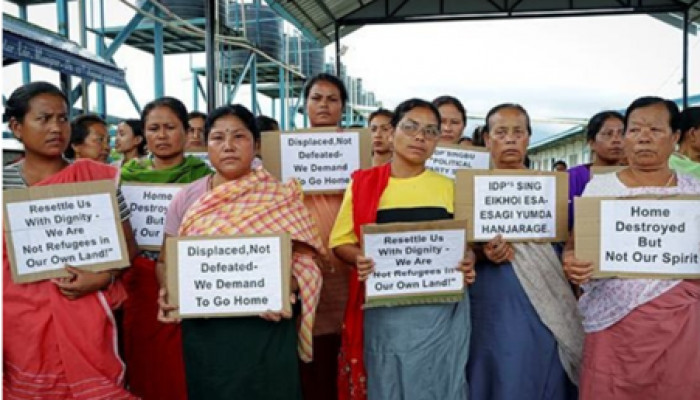
Tens of thousands of indigenous Manipuris, predominantly Meitei civilians from districts such as Churachandpur, Moreh, Torbung, Ekou and adjoining areas have been violently uprooted from their homes and livelihoods and forced into prolonged internal displacement within their own state since 3rd May, 2023. What began as sudden, coordinated attacks rapidly transformed into one of India’s gravest internal displacement crises in recent history. Nearly two years later, the humanitarian emergency has hardened into a prolonged, structural failure of protection, relief and rehabilitation.
I. Collapse into Displacement: Sudden Violence and Forced Flight
Indigenous Manipuri residents of Churachandpur and Tengnoupal districts, together with Meitei and long-settled Gorkha communities in the peripheral regions of the Imphal Valley, were subjected to well-organised and coordinated arson, looting, and armed attacks. Entire neighbourhoods in Moreh Bazaar, Torbung, Churachandpur town, Ekou and the surrounding villages were emptied within hours, displacing at least 20,000 people [1]. Families fled with little more than the clothes they were wearing, often after hiding for hours in fear, witnessing their homes, temples, shops and ancestral properties get reduced to ashes before their eyes.
Traumatised survivors have described [2]:
a) Armed mobs roaming the streets for hours without restraint.
b) Selective targeting of homes, shops and places of worship.
c) Delayed or ineffective intervention by security forces during the most critical hours.
d) Failure by on-duty security personnel to take timely and decisive action to protect ancestral lands and property.
For many families, displacement was not a temporary flight but the complete erasure of lives built over generations: homes reduced to ash, documents lost, savings wiped out, and community networks shattered
2. Early Relief: Survival, Not Protection
Initial evacuation brought survivors to makeshift relief camps at convention halls, schools, offices and hastily-erected temporary shelters. The earliest days were marked by acute food shortages, severe scarcity of safe drinking water, unhygienic sanitation and severe overcrowding. Medical care was rudimentary, while trauma, shock and fear were pervasive, particularly among children and the elderly. For at least three consecutive nights, displaced families sheltering at the Mini Secretariat building of Churachandpur Town lived in constant terror as gunfire rang out from violent Kuki mobs, with bullets striking the walls on more than one occasion.
Survivors consistently describe this period as one of pure survival, a harrowing prelude that set the tone for all the indignity that followed.
3. Living in Limbo: Relief Camps and Daily Deprivation under Cramped, Inhumane Conditions
By late 2023, displacement was no longer treated as an emergency but had instead become normalised. Relief camps remained overcrowded and poorly maintained. Families were crowded into single rooms or large halls, separated only by flimsy cloth partitions. Privacy, safety, and sanitation remain severely compromised.
Documentation by human rights organisations such as Amnesty International and reports by mainstream media outlets like India Today, have consistently highlighted the inhumane conditions under which internally displaced persons are being forced to survive [3][4]. These conditions include:
a) Grossly inadequate toilet and bathing facilities.
b) Chronic food insecurity, with meals insufficient in both quantity, nutritional quality and cooking hygiene.
c) Severely limited access to healthcare, particularly for chronic illnesses such as dysentery and for mental-health needs
d) Persistent insecurity within and around the camps, especially during nighttime hours
Despite repeated official assurances, efforts toward camp consolidation and improvement have remained largely superficial, offering little meaningful relief to those affected.
4. Psychological Trauma and Suicides
A 2024 peer-reviewed cross-sectional study of internally displaced persons in Manipur [5], published in the Journal of Family Medicine and Primary Care, alongside contemporary civil-society documentation, records alarmingly high levels of psychological distress among displaced Manipuris, including widespread post-traumatic stress disorder (65.8%), anxiety, and depression, driven by prolonged uncertainty, entrenched poverty, loss of dignity, and the persistent fear of permanent dispossession.
Multiple suicides were reported among displaced persons in 2024, including breadwinners unable to provide for their families and youths who saw no future beyond the camps. These deaths were not isolated incidents but symptoms of a deeper mental health emergency that were not properly addressed by the State. No systematic follow-up was conducted after counselling sessions, undermining their effectiveness. Reflecting the gravity of the situation, K. Pradeep Kumar, Chairperson of the Manipur Commission for Protection of Child Rights (MCPCR), publicly expressed concern on 14 January 2025 over the rising incidence of suicides among displaced persons [6].
5 Compensation Delayed, Justice Deferred: Prolonged Inaction
Although large sums were announced for relief and rehabilitation, displaced families waited months, in many cases over a year, for compensation. Even when funds were sanctioned, disbursement was slow, uneven and opaque. Numerous displaced households reported receiving nothing, while others received partial or delayed payments that bore no relation to actual losses [7].
Investigations revealed that funds frequently failed to reach intended beneficiaries, leaving families dependent on charity and informal support networks.
The scale of delay and administrative inertia became so severe that the National Human Rights Commission (NHRC) was compelled to intervene, urging the Government to expedite compensation and guarantee the basic rights of the displaced. That such an intervention was necessary itself underscored the depth and gravity of institutional failure.
Yet even after NHRC engagement, progress remained incremental rather than transformative.
6. From Shelter to Seizure: The Fear of Permanent Loss
As months turned into years, many displaced Manipuris were forced to occupy abandoned houses or temporary structures in safer valley areas. These arrangements were informal, insecure and fraught with fear of eviction, land grabs and fear that their original homes would never be recovered.
Investigative reports from journalists like Naorem Mohen warn that prolonged displacement risks permanently severing communities from their ancestral lands, eroding social cohesion and cultural continuity [8].
Disturbingly, reports emerged of eviction notices issued to displaced families without alternative housing arrangements. Simultaneously, hundreds of Internally Displaced People (IDPs) protested government cash assistance amounting to roughly ₹84 per day, rejecting it as humiliating and insufficient even for a single meal.
Their demand was clear: dignity, security and real rehabilitation instead of symbolic allowances [9].
7. Protest, Frustration, and Broken Trust
Throughout 2024 and early 2025, displaced Manipuris repeatedly took to the streets of Imphal, staging mass protests and rallies demanding:
a) Safe and dignified return to their homes
b) Guaranteed security and freedom of movement
c) Time-bound rehabilitation with restoration of livelihoods.
IDP representatives have met senior Government officials multiple times, expressing deep dissatisfaction with the pace and seriousness of government action. Journalists, Activists and victims have increasingly questioned whether prolonged central rule and administrative measures had failed to grasp the humanitarian urgency of the crisis, reflecting a complete erosion of trust.
8. Insecurity Persists: Return Without Safety
Even limited attempts at return have proven dangerous. Displaced persons have been injured while trying to access their villages, underscoring the absence of safe freedom of movement. Attacks on supposedly resettled areas, such as the December 16 assault in Phougakchou and the January IED blast in Torbung, have reinforced fears that return without comprehensive security is an illusion.
Near-continuous blockades of National Highways NH-2 and NH-37, the twin lifelines of Manipur, have crippled economic activity. Across communities, residents of the Imphal Valley find it almost impossible to sustain their livelihoods. Employment opportunities are scarce, transport is unreliable, and markets remain disrupted.
9. Policy Contradictions and the SoO Question
A recurring grievance among displaced Manipuris is the government’s perceived soft stance toward armed Kuki extremist groups operating under the controversial Suspension of Operations (SoO) Agreement. While civilians languish in camps without homes or income, armed groups continue to enjoy negotiated protections, deepening perceptions of injustice and abandonment.
This contradiction between leniency toward armed actors and neglect of civilian victims has become a central moral and political fault line in Manipur’s crisis.
10. Current Scale of the Crisis (as of May 2025)
Approximately 57,000–58,000 Manipuri IDPs were residing in relief camps
At least 47,000 remain effectively homeless, surviving on a pittance of around ₹84 per day [10].
The majority are unable to earn a living due to insecurity, displacement and highway blockades
Even those nominally “resettled” face renewed violence and intimidation
11. Conclusion: A Crisis of Governance and Humanity
The displacement of Manipuris since May 2023 is no longer merely a humanitarian emergency but an indictment of governance failure. Prolonged camp life, delayed compensation, psychological collapse and persistent insecurity reveal a system unable or unwilling to protect its own citizens.
Displacement without dignity cannot be normalised. Without urgent, transparent, and victim-centred rehabilitation — grounded in security, livelihood restoration, and accountability — the crisis will harden into permanent dispossession. For tens of thousands of Manipuri families, the question remains painfully unresolved: when will survival give way to justice and return?
References
[2] Verified victim testimonies
[5] https://pmc.ncbi.nlm.nih.gov/articles/PMC11610866/
[6] https://www.youtube.com/watch?v=oBeWUr-_jws
[10] https://www.theweek.in/wire-updates/national/2025/12/30/cal58-mn-idp-resettlement.html
Disclaimer: The opinions expressed within this article are the personal opinions of the author. MyIndMakers is not responsible for the accuracy, completeness, suitability, or validity of any information on this article. All information is provided on an as-is basis. The information, facts or opinions appearing in the article do not reflect the views of MyindMakers and it does not assume any responsibility or liability for the same.



 Loading...please wait
Comments